
Reissues
20 JAHRE INVENTIONEN II
Volume 2 of the CD documentation of the Berlin festival "Inventionen" (volume 1 containing Horatiu Radulescu's string quartet no. 4)a various artists retrospective sampler including recordings of works by the following composers: Hildegard Westerkamp, Salvatore Sciarrino, John Cage, Sainkho Namtchylak, Joe Jones, Giacinto Scelsi, Masanori Fujita, John Driscoll.Hildegard Westerkamp: Whisper Study (1975-79, Tape work, Inventionen 1986)Salvatore Sciarrino: Codex purpureus, Trio per archi (1968-1983…

Birds + Machines
Co-founder of Pogus with Al Margolis, Gen Ken Montgomery is often unfairly disregarded when assessing the history of radical music in the last half-century. This collection – another clarification of a unendingly probing creativity – examines works from the decade in which the American composer’s terminology was first met by yours truly, at that time seriously hooked in the unearthing of entrancing materials of post-industrial derivation. But don’t let this piece of news mislead you: Montgomery’…

Triangles
"Triangles offers you more of the powerbook electronics sounds we're all digging on so much, and from speaking comparatively from the field as it stands today, Triangles sounds quite good, really amazing, in fact. Despite falling into the, dammit, start saying it -- 'melancholy electronics,' hole that you clearly need filled, Triangles stands on it's own. Need more? Try this -- Triangles occupies the space between powerbook extrapolations (quite reminiscent of the sole person in America w…
Journey into Space
York University's music department houses one of the UK's first-ever
electronic music studios, and during the early '70s, it was a hotbed of
creative activity. Much of the released output from the studio at this
time revolved around the work of the dynamic composer Trevor Wishart. Journey Into Space
was his first release, composed between 1970 and 1972, and was
privately-pressed (shortly before the formation of YES records), as two
separate LPs in 1973. (The CD cover amalgamates the two or…

Music for 88
Simplicity and clarity have always been among Tom Johnson's chief concerns as a composer. That concern led him to research number theory, particularly by Pascal, Fermat, and Euclid, and these sources suggested musical structures somewhat more complicated than those that he had used before. Music for 88 is the result of these researches. It contains nine sections (six of which are on this recording), each of which is a musical demonstration of a mathematical phenomenon.
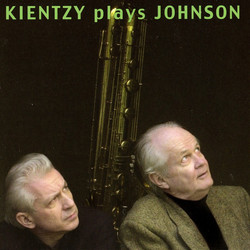
Kientzy plays Johnson
In Kientzy Loops, the accompanying loop is a mix of six alto saxophones played in continuous blowing, while the principal lines are played on alto saxophone, except for the third section, played on baritone. The piece, premiered at the auditorium of the ADAC in Paris, was awarded a French national prize in the Victoires de la musique as the best piece of contemporary music for the year 2000. We are indebted to our friend Marc Chemillier for La Tortue de mer. As a mathematician Chemillier became …

An Hour For Piano
"First, the booklet notes. If you pine for Gertrude Stein speaking circles around herself, meaning what she doesn’t mean, and not meaning what she means, you’ll probably like Tom Johnson’s non-sort-of-explanation of his magnum keyboard opus, An Hour For Piano. The composer prefers that you don’t read his notes while listening to the music. In fact, don’t read them before you play the CD for the first time. Listen to the piece first. Then, if you’re feeling artsy, put on the CD again and read the…
Hourouurin
The Japanese underground band Johari was create in 1990 by the magic duo Asahito Nanjo (High Rise) and Makoto Kawabata (Acid Mothers Temple) and will became later, in 1995, this shamanistic avant-garde formation Toho Sara. “Hourouurin” is their third opus, after two albums on PSF “Eastern most” (1995) and “Mei Jou Tan Sho” (1999) and some live performances in Europe during the years 1996 and 1997. “Hourouurin” is a weird unit who attempt to achieve a mystic fusion of ethnic music and rock, accor…

Violin Improvisations
Originally released in 1989, Violin Solo documents Takehisa Kosugi's improvisations with electric violin and miscellaneous sounding objects, recorded September 3-4, 1989. Kosugi's approach has a sense of emerging from the bottom of a spiritual unconscious. From this place comes a music based more on the feeling of sounds than conscious arrangement. Memory, physical action, tactile perceptions, environmental conditions, and awareness of subconscious microcosmic and macrocosmic extremes inform his…
33 1/3
2024 stock 33 1/3 is Smegma''s tribute to their 20th century avant-garde and out-jazz influences. The title is one part reference to the happy revival of passionate vinyl listening in the 21st century and one part celebration of their long hard slog of 33 1/3 years of being one of the most free thinking and original American underground groups. Their focus, ideas and determination has brought them through more than three decades and to this day they remain unparalleled, original and highly influ…
Objekt 2
Volume 2 of the music of RUNE LINDBLAD (1923-1991). This cd consists of the remainder of the long out of print Radium double lp. These works cover the years 1962-1988. Lindblad, a Swede began composing music in 1953. Ignored by the musical establishment in Stockholm, Rune went his own merry way, composing over 200 works of electronic music. Limited in the early years to often primitive equipment, he carved out his own musical niche. The sounds were often raw, occasionally scary.
1939
This release reissues Robert Rutman's Pogus Lp (P201-1) and includes an additional track. Rutman (b. 1930) has been building and performing on his homemade metallic instruments for many years. This recording features his buzz chime, steel cello, and bow chime, along with tabla, Tibetan horn, and Rutman's vocal chants. Rutman caresses the metal, drawing out eerie drones and overtones that buzz and trumpet. The music in turn can be as fragile as glass or reach the depths of resonance, as if one ha…
String Quartet
"'String Quartet Describing The Motions of Large Real Bodies' was composed as the potential orchestra for a Robert Ashley opera based on the text of 'In Sara, Mencken, Christ and Beethoven There Were Men And Women'. When the work was composed, in 1972, it was clear that a huge change in electronic instrumentation was just beginning, a change that would involve computers and sound producing devices as yet undreamed of. The piece consists of an electronic orchestra of 42 sound producing modules. T…
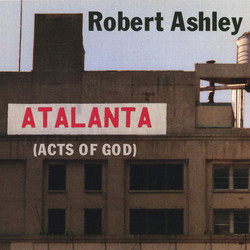
Atalanta (Acts of God)
Originally released on Lovely Music in 1985. Robert Ashley makes use of the story of Atalanta
- a royal princess, discarded by her family, who was raised by the
animals to become the fastest-running human, and who was later reclaimed
by her father to marry her off for dynastic purposes - to present the
character aspects of the "successful suitor". These three aspects of
character are presented in the opera as anecdotes about three
extraordinary men of our times: Max Ernst (surrealist paint…

Celestial Excursions
2005 release. Following the ground-breaking work, Dust (LCD 1006CD), godfather of experimental opera Robert Ashley returns with Celestial Excursions. Ashley's endeavor explores remarkably uncharted territory -- the kind of language that is common among "old" people who talk all the time or not at all, to anyone passing by or to themselves. The opera premiered at the Hebbel Theater in Berlin, before coming to The Kitchen for its U.S. premiere in April 2003. Celestial Excursions delves into the wi…
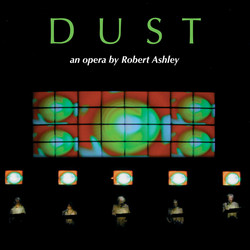
Dust
Robert Ashley's street-corner opera: five voices, Joan La Barbara, Thomas Buckner and Jacqueline Humbert among them, recall a man who lost his legs in a war and, when the morphine wore off, his conversation with God. "Blue" Gene Tyranny on synthesizer; 2CD with the 160-page libretto in a slipcase.
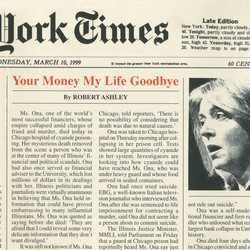
Your Money My Life Goodbye
An opera commissioned by Bayerisher Rundfunk Munich's Hörspiel und Medienkunst department about an internationally renowned swindler, who almost took down the European and American banking system. Featuring the voices of Robert Ashley, Sam Ashley, Thomas Buckner, Jackie Humbert, and Joan La Barbara. Recorded and mixed by Tom Hamilton. Robert Ashley on the piece: "Your Money My Life Goodbye is one of forty-nine vocal-ensemble pieces of various lengths (from ten minutes to ninety minutes or more) …
eL/Aficionado
1994 release. The fourth opera in Robert Ashley's Now Eleanor's Idea tetralogy: Junior, Jr.'s story. A group of scenes from the life of an agent. The scenes are a kind of debriefing to a jury of interrogators, in which the Interrogators challenge the agent in various forms of musical dialogue. The mood of the opera owes much to American society's ongoing fascination with espionage and with the character of those people who lead double lives. Featuring Thomas Buckner as the agent and Jacqueline H…
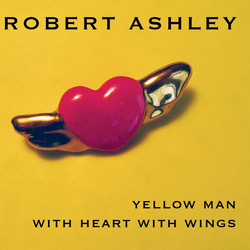
Yellow Man With Heart With Wings
1990 CD issue of Robert Ashley's 1978 piece for voice and electronics. A two-part composition with narration (part one in Spanish and part two in heavily altered English) commissioned by public radio station KUNM in Albuquerque, this music has a plain, serene beauty. Part one is a narration by Guillermo Grenier in dreamy, flatly inflected Spanish, backed by a four-note synthesizer track, and punctuated by mysterious, heavily processed vocalizations. Ashley throws in extensive sound washes and ot…
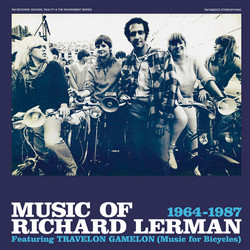
Music of Richard Lerman 1964 - 1987
Richard Lerman has spent over four decades gathering sounds that most of us never notice, amplifying the mundane until it reveals itself as magic. This deluxe two-CD set, featuring his classic 1982 Folkways LP Travelon Gamelon (Music for Bicycles) plus selected works spanning 1964 to 1987, offers an essential survey of one of American experimental music's most questing spirits. Born in 1944, Lerman belongs to the John Cage and David Tudor continuum of composers for whom all sound is potentially …
Natural Selection
Following the reissue of the Beyond the Black Crack LP, Paradigm delivers a second installment of outsider art from this American experimental showman. Collecting the offcuts of his numerous deranged sessions, this Kansas City tape collage artist turned electronic composer has an entirely unique vision, which is presented here as an overview of 25 years of work. A wide range of musical background informs the varied works on this collection, from Sun Ra-inspired space jazz to multi-channel electr…

Experimenting with household chemicals
Experimenting With Household Chemicals' is a 1995 album by the laregly elusive post-minimalist Downtown experimenter Peter Zummo. Whilst possibly best known for his work on classic Arthur Russell recordings, he's been a mainstay of New York's vaunted experimental scene since the the mid-late '70s, but only released three solo albums proper. This is his 2nd, exploring "a trombone-specific method for generating melodic movement, as well as a collection of related, "spinoff" melodic material for en…
Day for night
This CD represents a 25-year collaboration between renowned British avant-garde improviser Peter Cusack and instrument builder and sculptor Max Eastley. Cusack and Eastley have made these short episodes together between busy careers recording experimental music alongside artists such as Nicolas Collins, Steve Beresford, and David Toop). With numerous releases on ReR and Incus, the two musicians are mainstays of the British improvised music world, and Eastley is particularly prominent for his wor…

Electronic Works
One of our favourite "pure drone" album consisting of 3 amazing long tracks by Pauline Oliveros. I of IV was made in July 1966 at the University of Toronto Electronic Music Studio and was first released by CBS alongside works by 2 other young composers - 'Come out' by Steve Reich and 'Night music' by Richard Maxfield. It is really only in recent years (born out of the more radical elements of dance music, Electronica and ambient music) that music like this is being rediscovered by a growing numb…
Pure Gaze
“Block is an electro-acoustic and modern instrumental composer whose recorded compositions combine layered, processed wind and string instruments with processed sounds from sections of field recordings she has collected from various natural landscapes. Her performances include minimalistic scored musical sections played live by a quintet accompanied by taped material , often sounds of field recordings, or the same quintet previously recorded and electronically manipulated. block herself “…

Paura
N.A.D.M.A. was officially born between August and the beginning of September 1972 during time spent in a little village in the Tuscan-Emilian Apennines. The identity and musical orientation of the collective centered on the convergence of heterogeneous interests and sensibilities coming from avant-garde jazz experiences liberated by post-free currents, from classical studies, or from musicians also active as visual artists who had cultivated an instrumental practice utilizing spontaneous …
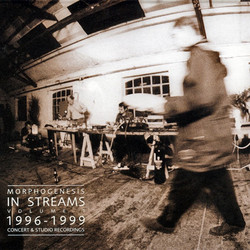
In Streams (Volume 1)
This is the fifth CD release by Morphogenesis, and the first since 1998. Although Morphogenesis do not play live very often, it is certainly their preferred working situation, where the interaction between the space, the people present and the available equipment create a variety of different situations. Substantial extracts from nearly all of their recent concerts appear on this, and a second volume. There is also the inclusion of one studio recording per CD. Perhaps one reason for their infreq…

Triptych of poisoners
2005 release. Milk From Cheltenham is the first in a series of Alga Marghen editions documenting the activities of the It's War Boys underground label, founded by Amos (of The Homosexuals fame) in the late 1970s. The original LP was issued in an edition limited to 300 copies. The material was recorded from 1979 to 1981 but wasn't released until 1983 due to problems with the silkscreened sleeve. The band only put out this record, a real hidden gem. Lepke said that he wanted it to sound like …
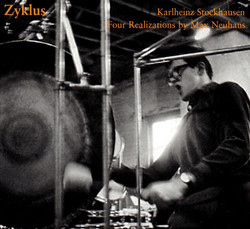
Zyklus - Four Realizations By Max Neuhaus
2004 release. Four previously unreleased realizations of Karlheinz Stockhausen's "Zylus" (different recordings than the one featured on the Columbia LP Electronics and Percussion -- Five Realizations. Recorded 1959-68. The term "New York School" refers to a circle of composers. "Zyklus" was written in 1959 and is one of the first solo pieces to utilize such a large number of percussion instruments (twenty-one). When Max Neuhaus first started to play this piece there were only three percussi…
Logos works
Logos Works contains eight works by the Logos Duo featuring both Darge and Raes on various instruments, as well as other performers on a wide range of instruments. "This latest recording comes as they look back upon 25 years of collaboration as the Logos Duo. More than a retrospective, we see them affirming a long artistic relationship and forging new horizons--together and on divergent musical paths. In this, their work is a metaphorical journey: an inward exploration of the elegance of algorit…
Lingual Music
Double CD, comes with 12 page booklet. Britain's best-known sound poet is Bob Cobbing, but it's hard to come up with a list of other sound poets working in Britain in the '60s and '70s. It's equally difficult to think of any female sound poets working anywhere. Lily Greenham was Danish, but spent her childhood in Vienna. After several relocations across Europe, she settled in London in 1972 with her British husband (musician and poet Peter Greenham), where she lived until her death in 2001. Near…
Composing Motion
“Sound crazy people vibrate to sound and this disc is for them; it’s got some of the sharpest astringent zings of sound that ever cut the air, maybe because it’s all made with doctor’s blade steel, some of it the sharpest. … All I know is that when it’s set up in motorized vibrating and shaking devices, and struck with strikers, it cuts a new sound groove.” Len Lye
Sei-jaku für Streichquartett
Documentation '20 Years Inventionen', CD III. The string quartet 'sei-jaku' by German composer Klaus Lang, documented on this CD, was performed on 6/30/2002 in the Großer Sendesaal of the SFB Berlin by the Arditti String Quartet during the festival Inventionen 2002.
Trauermusiken
Two compositions by the young Austrian composer/organist Klaus Lang who currently lives in Berlin/Germany. Der Wind und das Meer for viola (Barbara Konrad, viola) The Sea of Despair for String Quartet (Amras Streichquartett)
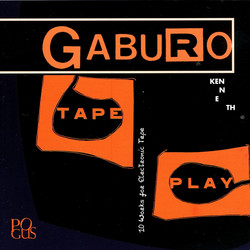
Tape play
The Ten Tape Compositions: Fat Millie's Lament, The Wasting of Lucrecetzia, For Harry, Lemon Drops, Dante's Joynte, Rerun, Mouthpiece II, Hiss, Few (in collaboration with Henri Chopin), and Kyrie. "Over his career, Kenneth Gaburo (1926-1993) produced a lot of electronic music. However, works for tape alone are fairly rare in his output. Over about a thirty-year period, ten works for solo tape were produced. Of the ten tape pieces, five were created in the mid-1960s at the University of Illinois,…
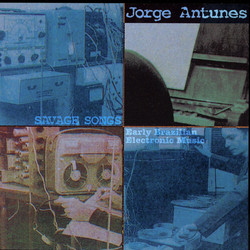
Savage songs
Jorge Antunes (b. 1942, Rio de Janeiro) studied violin, composition and conducting at the University of Rio de Janeiro, as well as studying physics at the same institution. He further studied composition with Alberto Ginastera and Luis de Pablo. From 1970-71 he attended the University of Utrecht (Gotfried M. Koenig). From 1972-73 he worked with Groupe de Recherches Musicales in Paris. In 1962 he began his research in electronic music thus becoming a pioneer in the development of this field in Br…
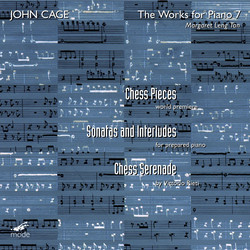
The Piano Works 7 - Chess Serenade
First recording of John Cage's Chess Pieces (1944), rediscovered in a painting and transcribed by Margaret Leng Tan, with her recording of Sonatas and Interludes and the first recording of Vittorio Rieti's Chess Serenade.
Sonatas and Interludes
This landmark recording of John Cage’s prepared piano works performed by Mario Bertoncini was recorded back in December 1991. The sonatas are divided into four groups, each divided by the less overtly structured, rhapsodic interlude pieces. Bertoncini sensitivity to the displaced sonic characteristics of the piano is remarkable and suggests a rigorous dedication to Cage’s work.
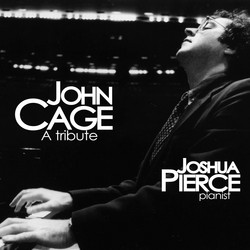
A tribute
From the liner notes of Eric Salzman: “John Cage wrote for keyboards throughout most of his life. Most famously, he invented the so-called "prepared piano" but he also wrote for unprepared piano in both traditional and untraditional ways. His later piano works employ an almost ferocious complication and virtuosity at the outer limits of performer possibility. Earlier he used electronic extensions, chance and performer collaboration in complex ways. His early keyboard music was written for himsel…
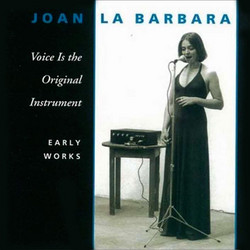
Voice is the original instrument
For Circular Song she adapted circular breathing to the voice and sang on the inhale as well as the exhale. For Hear What I Feel she was isolated beforehand, then performed with her eyes taped shut, responding to materials placed in front of her that she could not see.