Tracer - Chamber Works 1952-1999
Earle Brown first encountered the work of Alexander Calder in 1948, whose mobile sculptures Brown saw as a visual embodiment of the variable (impermanent) aesthetic that he was striving to create. This Calder aesthetic stayed with Brown throughout his several stylistic shifts. Whether he was writing twelve-tone serial music (Music for Violin, Cello, and Piano), conceptual graphic scores (Folio and Four Systems), composed material open form scores (String Quartet, New Piece and Tracer), or sponta…
The Marvelous Aphorisms of Gavin Bryars: The Eearly Years
Gavin Bryars' music, post 'The Sinking of the Titanic' and 'Jesus' Blood...', is well known and often performed today. Less known are the earlier works featured on this cd, created during the years 1969-71. At that time, Bryars became associated with Michael Nyman, John Tilbury and Brian Eno - marrying ideas from Cage, Fluxus, free improvisation and experimentalism. Some of the works recorded here appeared on Eno's avant-garde Obscure label in the mid-1970s. In 1, 2, 1-2-3-4, the musicians liste…
The Piano Works 1
Performed by Louise Bessette (piano). "This marks not only the first volume in Mode's new Scelsi edition, but also the initial disc of the traversal of his piano works. Written in 1939, Scelsi's 'Second Sonata' was premiered by Yvar Mikhashoff in London (1979). Marking a new compositional direction, Scelsi suspended thematic development and frequently introduced various kinds of repetitions: reiterated single tones, chords, and patterns, often suggesting the sounds of bells or Oriental gongs. Sc…
Silent Pieces - Live At Dacapo II
1995 release ** Special members-only edition for the sponsors' circle of dacapo. Music by: Anton Webern, Morton Feldman, John Cage, Hans Otte, Malcolm Goldstein, Dietrich Eichmann, Yoshikazu Iwamoto.
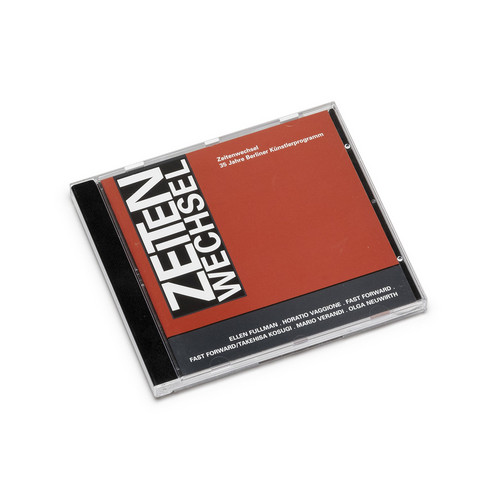
Zeitenwechsel 2
A beautiful sound art compilation featuring works by Ellen Fullman, Horatio Vaggione, Fast Forward, Takehisa Kosugi, Mario Verandi, Olga Neuwirth, celebrating the 35 years of the Berliner Künstlerprogramm. Comes with 32-page booklet.
Ellen Fullman: Transmission Particle 1 for Long String Instrument and Oboe (2001; 9:00 min)[Ellen Fullman, long string instrument; Eliza Slavet, oboe]Horatio Vaggione: Scir for contrabass flute and tape (1988; 11:37 min)Beate-Gabriela Schmitt, contrabass fluteFast F…
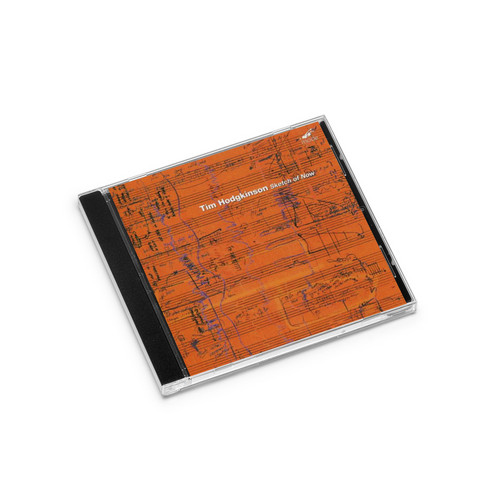
Sketch of Now
Tim Hodgkinson co-founded the politically and musically radical free-jazz/progressive rock group Henry Cow in 1968, which also featured guitarist Fred Frith. He regards his membership in this group, with the opportunity to work closely and collectively with other instrumentalists in developing new sound worlds, as the foundation of his musical education. In addition to composing, Hodgkinson continues to perform as an improviser (clarinets, saxes and keyboards) and considers the practice of impro…
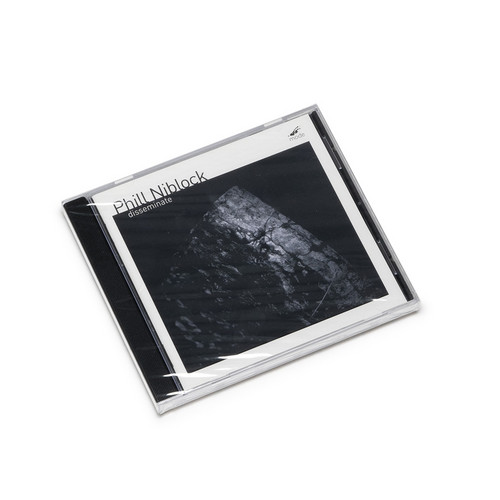
Disseminate
Phill Niblock (born in Indiana, 1933) is a seminal figure in "drone" music who crosses the Downtown and Improv scenes. A characteristic of Niblock's drone style is its subtle, gradual alteration of pitch which leads one to lose a sense of "time" and draws one deeper and deeper into the sound itself. The remarkable thing is that Niblock achieves this effect by almost always using traditional acoustic instruments. Niblock is an intermedia artist using music, film, photography, video and com…
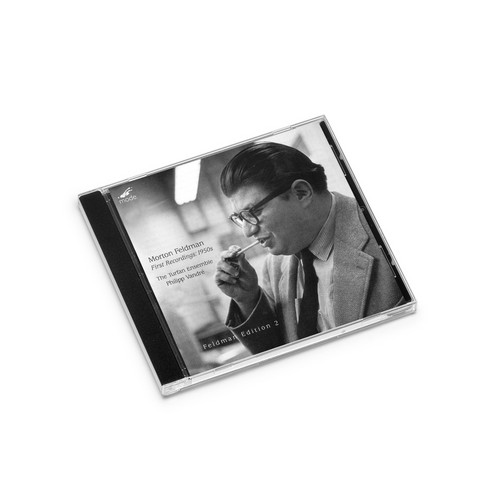
First recordings: 1950s
A remarkable discovery of over 75 minutes of Morton Feldman's music. This disc represents 13 unrecorded early works spanning 1950 to 1953, many previously unpublished. Highlights: his only works for magnetic tape, 'Intersection,' realized in 8-channels by Feldman with John Cage and Earle Brown. Considered lost, the work has been restored and presented here for the first time in 40 years. Also: his score for 2 cellos to Hans Namuth's film of Jackson Pollock, presented in its entirety including na…
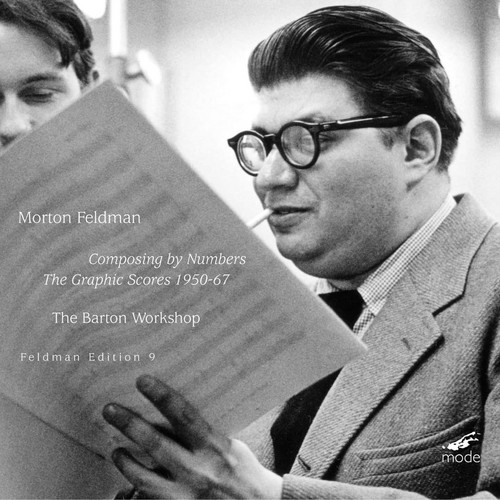
Composing By Numbers: The Graphic Scores 1950-67
This ninth volume of Mode's Morton Feldman Edition brings together 13 of the 17 works the composer notated using graph instead of normal manuscript paper (between 1950's "Projection I" and 1967's "In Search of An Orchestration", though Feldman temporarily abandoned his graphic notatio after 1953's "Intersection IV" and only returned to it five years later with "Ixion"), performed with customary aplomb by the Amsterdam-based Barton Workshop under the baton of Jos Zwaanenburg and their musi…
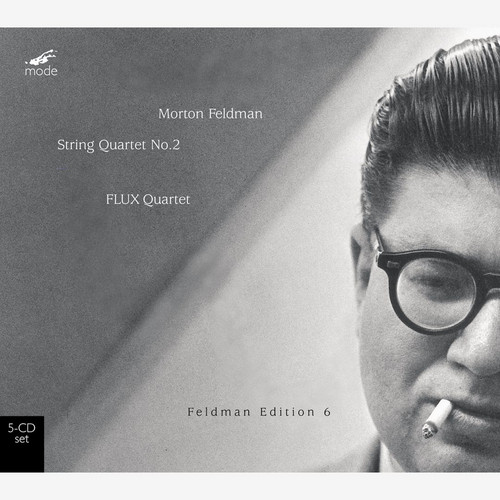
String quartet N°2
Dvd audio edition. In the 1970s Morton Feldman took up the study and collecting of antique Turkish rugs, a highly evolved and exquisite folk art. The rugs are intricately patterned, symmetrical in basic design but with constant variation and displacement in the detailed execution of that design; strikingly and subtly colored, including fine variegations of principal colors resulting from the dyeing process. Analogies are clear to Feldman's music as it takes up large-scale patterning, partly work…
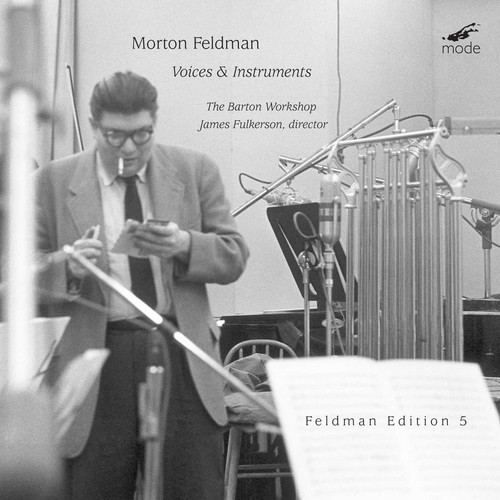
Voices and instruments
This CD is comprised of works from Feldman's Early Period (late 40's until the late 60's) and Middle Period (late 60's/early 70's until the early 80's). In the beginning, like all young creative artists, Feldman was working through alluring influences as well as the influence of his teachers, towards the moment when he would find his personal creative voice. With the exception of the vocal solo Only, this disc documents all the earliest works that Feldman chose to publish. Journey to the End of …
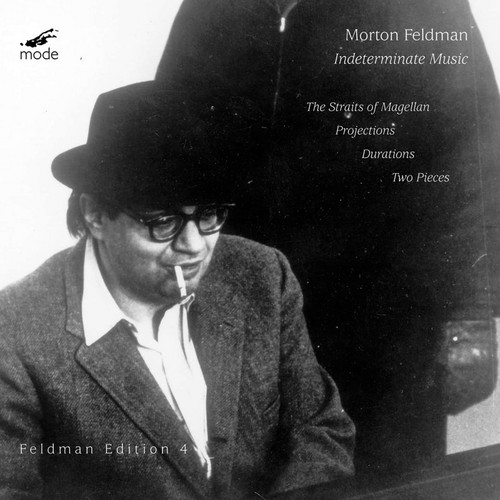
Indeterminate music
A unique collection of Feldman's 'indeterminate' works; incorporating new types of notation (including graph scores) and involving a considerable degree of indeterminacy in regard to pitch, dynamics, etc. This is the first time the complete Durations and Projections series have appeared on a single disc. It is a rewarding experience to hear the Durations and Projections played together, imparting a sense of Feldman's mastery of instrumentation and timbre while savoring the metamorphosis of its s…
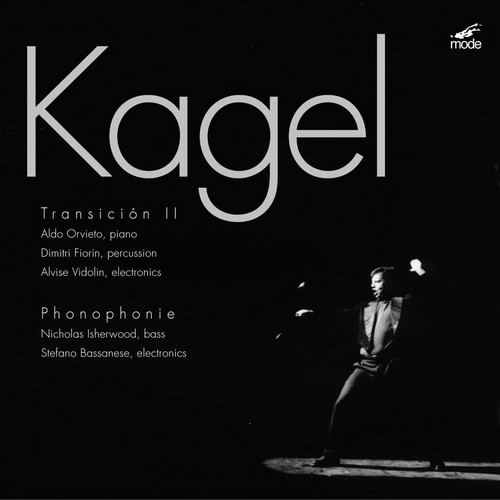
Transición II. Phonophonie
This disc collects two early, forward looking works by Argentine born Mauricio Kagel, now living in Germany. Both works are constructed in such a way so that no two performances can ever be alike. Transición II was an early exploration of what "live electronics" are now being used to achieve. The score is in individual pages which can be placed in any order by the performers. It works on three levels. LIVE: The pianist performs on the keyboard while a percussionist performs inside the pian…
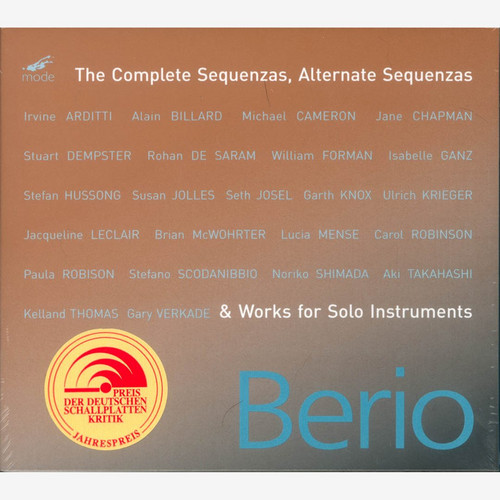
The Complete Sequenzas, Alternate Sequenzas
As a body of works for solo instruments, the series of Sequenzas written by Luciano Berio between 1958 and 2002 is without equal in the literature of late 20th century music. Though not the first recording of the complete Sequenzas - others have appeared on Deutsche Grammophone and Naxos - this four CD set, over ten years in the making, presents for the first time the final Sequenza XIV performed by its dedicatee, cellist Rohan De Saram, and the arrangement bassist Stefano Scodanibbio made…
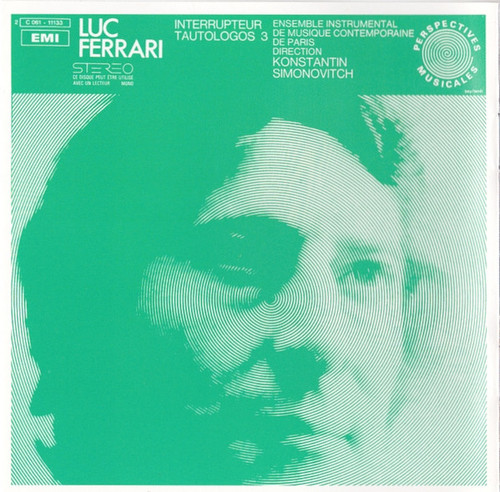
Interrupteur/Tautologos 3
Luc Ferrari -- along with Pierre Schaeffer, Pierre Henry, François Bayle, and others -- is one of the pioneers of the particular style of tape music known as 'musique concrète'. More significantly, he must be counted as one of the most complexly, most idiosyncratically compelling of post-War composers. Ferrari has time and again ranged far afield of musique concrète, and Interrupteur/Tautologos 3 is one such foray into instrumental music. But what a setting-forth! Mon dieu! These particular real…
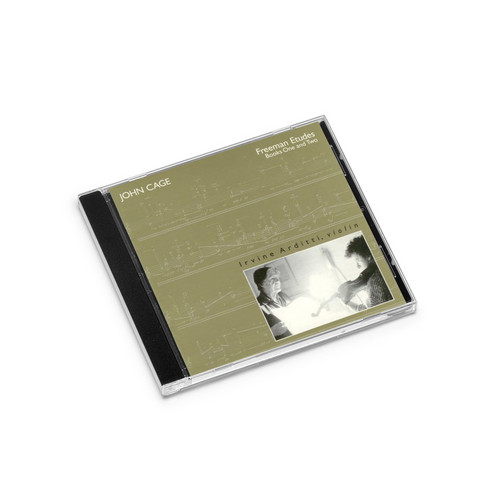
Freeman Etudes, Books One and Two
John Cage's Freeman Etudes are the modern equivalent of Paganini's virtuoso solo violin etudes. Each etude is completely notated down to the smallest detail, and the composer states "...are as intentionally as difficult as I can make them...So I think that this music, which is almost impossible, gives an instance of the practicality of the impossible." The detail and complexity of these etudes give them a unique and unusual spot in Cage's oeuvre.
These first two books (there are 8 etudes p…
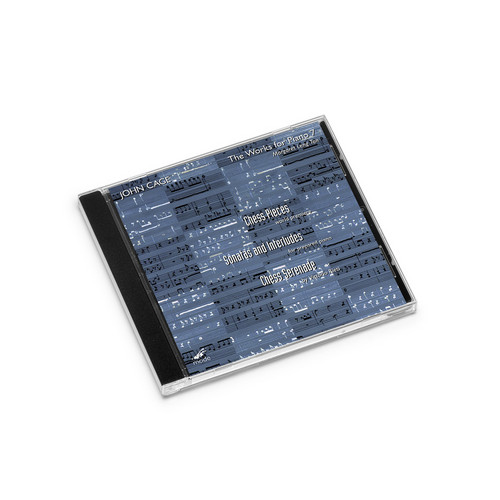
The Piano Works 7 - Chess Serenade
A major discovery and first recording of an important Cage piece from 1944. In 1944, John Cage was invited to participate in “The Imagery of Chess” exhibition at the Julien Levy Gallery in New York City. The artists included Calder, Noguchi, Motherwell, Breton, Duchamp, Ernst, Man Ray, Tanning and other leading surrealists.Cage contributed a painting entitled “Chess Pieces”. It was purchased at the show and went into a private collection. For decades it was deemed lost and was (almost) forgotten…
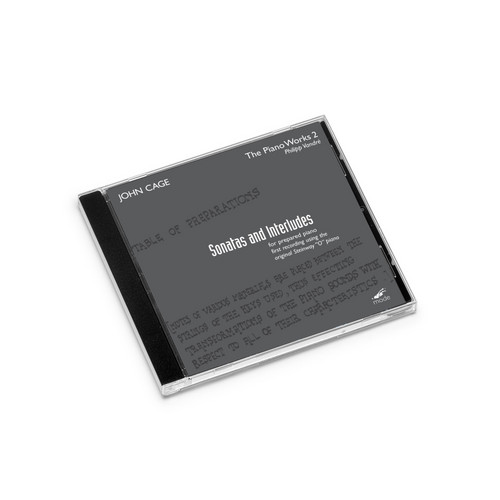
The Piano Works 2 - Sonatas And Interludes For Prepared Piano
The Sonatas and Interludes enjoy a well deserved reputation as a masterwork and as a repertoire piece. But this is not a masterwork in the sense of other keyboard masterworks: Bach's Goldbergs, Beethoven's Diabelli Variations, Ives' Concord Sonata.
John Cage's masterwork is quite different -- a big piece with a quiet voice. The prepared piano operates entirely by muting: by attaching objects to the strings of the piano. Cage alters their sounds in various ways, turning the piano into a percussio…
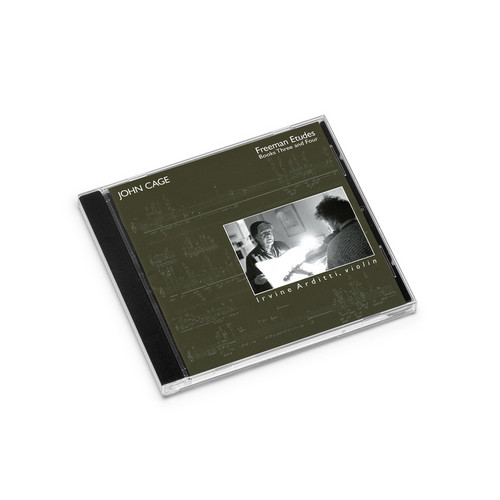
Freeman Etudes, Books Three And Four
This CD presents the first recording of the second half of John Cage's Freeman Etudes for violin. Those familiar with the previously-released volume of this work will already know what to expect: the bewildering complexity of the Etudes and the astonishing virtuosity of Irvine Arditti's performance.
Convinced that the later, more complex etudes were unplayable, Cage abandoned work on the Freeman Etudes in 1980, after completing the first sixteen and beginning the eighteenth Etude. It wasn't…
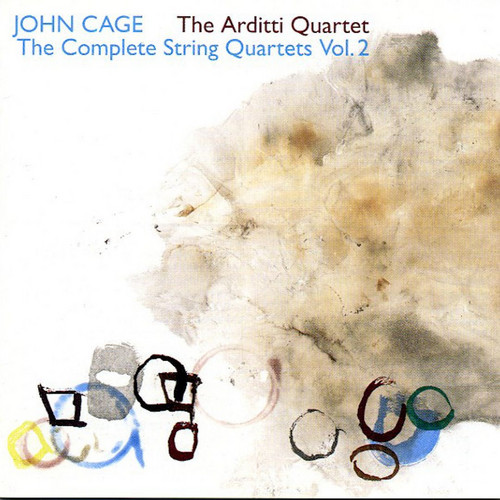
Complete string quartets, volume 2
The Complete String Quartets Vol. 2. “String Quartet in Four Parts” (1949-50). “Four” (1989). The Arditti Quartet. The second volume of Cage's String Quartets features his first and last works in this repertoire. The well known and exquisitely beautiful, serenely Zen-like early quartet receives its first new recording in 16 years. It is a pivotal work in Cage's oeuvre, showing the composer's transition between the rhytmically complex percussion works before it and the chance works of the 1950s. …