Faust
Faust formed in 1971 in Wümme, near Hamburg, where the producer Uwe Nettelbeck had installed them in a converted schoolhouse with a studio and a Polydor advance. The debut, Faust, sold poorly but its cut-up of tape collage, rock and noise won a devoted following; The Faust Tapes (1973), sold by Virgin for the price of a single, and Faust IV made them a leading krautrock band. The group broke up in 1975 and reappeared in the 1990s in two branches.
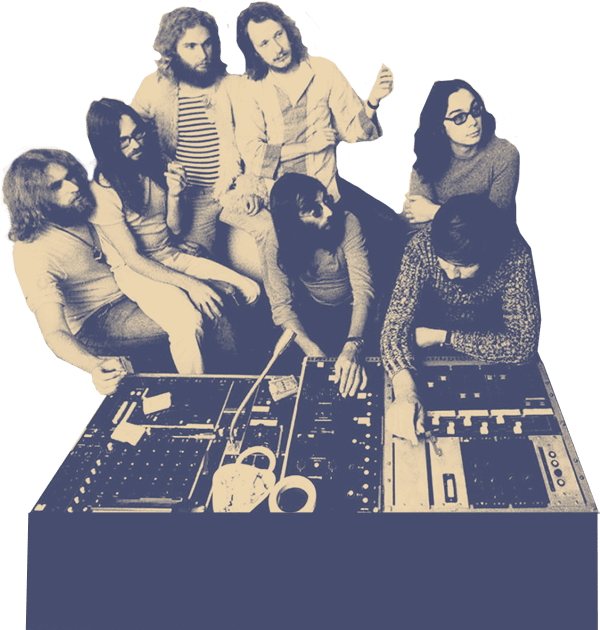

Ungebunden
Faust unbound, curated by keyboardist Hans-Joachim Irmler. Drones, grooves and collage roam free, another founder's window onto the collective's fearless, uncategorisable body of work.
Sold Out


Fliegen Lernen
Faust's vaults, opened by the band itself. Co-founder Gunther Wusthoff curates unheard tapes and fragments, motorik grooves, collage and pure invention from krautrock's great disruptors.
Sold Out

Something Dirty
Faust reactivated. 'Something Dirty' pairs founding members with new collaborators for grinding, groove-driven experiments: raw guitars, motorik pulse and studio mischief, the old subversive spirit alive and unbowed.


Momentaufnahme IV
The fourth trove of Faust rarities. Studio sketches, false starts and sudden brilliance from rock's great disruptors, proof that even the offcuts of this collective crackle with fearless, unrepeatable invention.

Momentaufnahme III
Volume three of Faust's archival 'snapshots'. More unheard fragments from the krautrock legends' vaults: collage, groove and glorious chaos, the sound of a band that treated the studio as both demolition site and playground.

Momentaufnahme I
Snapshots from the Faust vaults, unheard studio moments from krautrock's most anarchic band. Tape collage, motorik grooves and pure sonic sabotage sit side by side, a document of the collective's fearless early-'70s experimentation.

The Faust Tapes
There’s something perversely fabulous about the thought of this warped masterwork wandering into 60,000 unsuspecting British homes in 1973. Faust’s second-and-a-half album hit the shops to celebrate their signing to the nascent Virgin Records, who were looking to take advantage of the zeitgeist for German music at that time. Undeterred by the fact the band’s unwillingness to engage with the commercial landscape had seen them dropped from Polydor, Branson and co cooked up a suitably spectacular m…

Momentaufnahme II
Momentaufnahme II extends Faust’s recent excavation of their 1971–1974 archive, presenting a second volume of unheard and under‑heard material from the Wümme years. Compiled from recordings that didn’t make it onto the mammoth 1971–1974 (50 Years of Faust) eight‑LP box, this collection functions not as an outtakes bin but as a parallel narrative: how Faust sounded when the tape kept rolling between “official” takes, and how their anarchic, avant‑rock mission permeated even the most fragmentary e…

Faust
Few debut albums arrive with the kind of self-contained logic and radical spirit found on the self titled ‘Faust’. Released in 1971, it marked the beginning of a project that would sidestep genre and expectation, offering a fractured, exploratory take on rock music, blending tape experiments, improvised structures, and surreal collage. This Bureau B reissue offers a fresh opportunity to engage with one of the most curious and uncompromising records of its time.

Deutsche Elektronische Musik 2 (Record B) (2LP)
Second volume of the Soul Jazz's superb introduction to experimental German rock and electronic Musik from 1971 to 1983, a 2013 2LP set featuring A.R. & Machines, Gila, Neu!, Pyrolator, Sergius Golowin, You, Niagara, Popol Vuh, Rolf Trostel, Electric Sandwich, Asmus Tietchens, Faust.

By the Lake Festival
On By the Lake Festival, Faust bottle a singular Berlin afternoon: iconic early pieces - including a choral‑bolstered “Why Don’t You Eat Carrots?” - rendered raw, sun‑bleached and unrepeatable, preserved in a lovingly remastered document that leaves every glorious flaw intact.

Silberland Vol 3: The Ambient Side Of Kosmische Musik (1972–1986)
On their last trip to Silberland, hurtled along the chrome highways and glass skyways of the kosmische landscape, powered ever onwards in perpetual motorik motion. This time, however, the Hamburg imprint opt for an unhurried itinerary, coasting far beyond the familiar rhythmic terrain to immerse listeners in the ambient side of this alternative Allemagne. Building on the tape loops, tone poems, and minimalist compositions of the '60s avant-garde, these musicians utilized the sweeping scope of th…

Faust IV
Faust left Wümme's anarchic freedom for The Manor's professional constraints. Virgin wanted a hit. Faust IV was the answer: their most paradoxical album, accessible yet destabilizing, part studio work, part salvage. The sessions stretched, the budget vanished, the result endures—uneven, restless, compelling. Fifty years later: still mid-sentence, still profound, gloriously incomplete.
Sold Out

So Far
CD Digipack. Wümme, Lower Saxony. 1972. A converted schoolhouse. Inside: a tangle of cables, reel-to-reel machines, custom electronics soldered together by hands that refused manuals. This was not a professional recording studio. This was Faust's laboratory—and So Far was the experiment that proved you could rewire rock music's circuitry without killing the patient. Six months earlier, Faust had released their self-titled debut—a savage dismantling of what a rock album could be. Tape edits slice…

Faust
Few debut albums arrive with the kind of self-contained logic and radical spirit found on Faust's self-titled 1971 statement. Released at the height of rock music's imperial phase, it marked the beginning of a project that would sidestep genre and expectation entirely, offering instead a fractured, exploratory take on what popular music could become. This Bureau B reissue offers a fresh opportunity to engage with one of the most curious and uncompromising records of its time. Faust emerged from …

Silver Monk Time - A Tribute To The Monks
2006 release ** "Unlike many tribute projects that fall flat due to those involved being either overawed or ignorant of the original material, Silver Monk Time succeeds because the participants have taken the group´s primitive rock surge as a template to experiment with. As a result the sound of The Monks is treated to a 21st century workout with synthesizers and beat tracks threaded through the original quartet´s already way out psychotic minimalism". Featuring: fsk, the fall, faust, fehlfarben…

This Is the Right Path
Tip! Dec. 2015: I received an invitation from Old Heaven to participate with FaUSt to the 3rd edition of “Tomorrow Festival” at B10 Live, Shenzhen, China! A few months later, May 2016, we were on our way to the most exciting concert experience. A loooong flight-haul and then, such a warm welcome, such a perfect organization… the most charming, dedicated, competent crew around us… the largest cement mixer I ever used on stage, and an audience so vibrant, so focused. I was and still am in memory, …
Sold Out

Patchwork 1971-2002
Unplayed copy of 2002 Staubgold compilation of unreleased Faust recordings from 1971 to 2002 chosen by Joachim Irmler.

The Wumme Years, 1970-73
Essential 5CD+book box covering the classic years of Faust with all their albums, BBC sessions and unreleased material. The ultimate collection from the legendary inventors of krautrock.
Sold Out

Blickwinkel
Tip! CD version. After dipping into the archive to deliver a series of essential reissues, Bureau B continue to encourage the chaotic brilliance of Faust with an LP of brand-new music curated by originator Zappi Diermaier and a band of musical friends, including fellow founder Gunther Wüsthoff. Over the years Faust has become many things, each as separate as the fingers, but as together as the hand which makes up their eponymous fist. From 1971 to 1974 the Hamburg band blazed a bold sonic trail,…
Sold Out

71 Minutes
Packaged in a mini LP sleeve with obi. "With Magma, Faust was one of the most important of all the European groups of the '70s. Compiled from 'lost' and unreleased material, originally released as Munich & Elsewhere on the 10th Anniversary of their disbandment (inc. prophetic pre-dub mixing) as well as most of the unreleased Faust Party 3 LP. Intense, eccentric, hypnotic, a true timeless classic." 180 gram vinyl.
(After the Manor House recordings in 1972)... then chaos: Faust splits: some of us …
Sold Out

ADN 40th Anniversary - 40 Years 40 Tracks
*2024 stock. 250 copies limited edition* In 2023 we wished to properly celebrate the 40th anniversary of ADN’s birth. So, we have contacted groups and musicians that stimulated our curiosity through these 40 years. Some of them are good friends of us, some were already part of our music trajectories; others, never contacted in the past, are near to be seen as our myths. Anyhow to cover our multiple interests we should have brought to your attentionmany more tracks, but we think this is a good sy…

Outside The Dream Syndicate
Temporary Super Offer! Violinist, composer and filmmaker Tony Conrad started his career in New York in the early 1960s. As a member of the Theatre of Eternal Music (a.k.a. the Dream Syndicate) alongside John Cale, La Monte Young, Marian Zazeela and Angus MacLise, he participated in now-legendary and often legendarily loud drone performances with many pieces having no beginning and no end. During a fateful trip to Germany in 1972, Conrad met with avant-rock visionaries Faust and made the very fir…
Sold Out

Radio music (1956)
Four different versions of Radio Music (1956) from John Cage performed by Faust’s Jean-Hervé, Zappi and Steve Pittis who recorded their interpretations of Radio Music independently in 2007 and 2010. They all felt it important to keep to the score as much as possible, given the obvious ambiguities of having to adapt it from Cage’s original 1956 score. These recordings were released as a 10” vinyl EP and sold out instantly, so here they are on CD format with some extras. During “lockdown”, it was …

Issue 81: Faust - Freakatronica 1971-74
Viva freaktronica! For this edition of Electronic Sound cover stars are the legendary Faust, the wildest and weirdest of the 1970s krautrock outfits.
Sold Out

Acnalbasac Noom
Acnalbasac Noom -- meant to be the German-English-American avant-pop group Slapp Happy's second album -- was originally recorded in 1973 but did not see release originally until 1980. Recorded with legendary German art-rock group Faust accompanying the Slapp Happy core of Anthony Moore on keyboards, Peter Blegvad on guitar, and Dagmar Krause on vocals, and with Faust's brilliant producer Uwe Nettelbeck at the helm, Acnalbasac Noom was initially rejected by the group's label Polydor as not being …
Sold Out

1971-1974
* Few copies back in stock. US Import * This box is the first virtually complete collection of Faust official studio releases from the years 1971-1974. In addition to the debut album, it includes the 1972 album So Far, the legendary 1973 Virgin UK release The Faust Tapes ("Some chose to play frisbee with the LP, others said it changed their lives" as Jean-Hervé Peron noted), Faust IV and, for the first time ever, the mythical, so-called "Munich album" Punkt, which Faust recorded at Giorgio Morod…
Sold Out

Fresh Air
Orange vinyl version with bonus 7". Includes CD. Faust's new album Fresh Air differs in several respects from its predecessor, Just Us (BB 182CD/LP, 2014). The recordings were made at Jean-Hervé Péron's rehearsal studio in Schiphorst in northern Germany, hypnotic pieces with the kind of noisemaking the band is known for. For the new album, Péron and Werner "Zappi" Diermaier were looking for communication with musician friends and the audience. The tracks were recorded in changing ensembles …
Sold Out

BBC Sessions +
The radio session was first broadcast 1/3/73, and is 20 minutes of pure Faustian hell. The Lurcher is a kind of electric period Miles Davis slouching drum rhythm, augmented by stabs of horn and electric guitar. Krautrock is a 12-minute post Velvet Underground riff, drone and noise-driven meditation, far superior to the version on the Virgin release Faust IV. The session ends with Do So, an outrageously corny slice of sixties pop. The remaining 30 minutes of the CD is prime Faust, culled f…

So Far / It's a Bit of Pain
First reissue of Faust's only 7", originally released only in Germany, France, and the UK in 1972. This reissue bears the original artwork and was remastered by Faust member Hans-Joachim Irmler from the original recordings. Both tracks are non-LP versions. It is said that "It's a Bit of Pain" was John Peel's favorite Faust track. Archive your music on vinyl! "So Far’ is an instrumental: a simple rhythm chugs along, a sax stabs away, guitars and synth wail in and out. It’s a mesmerising drone, th…

j US t
Faust for all. The Krautrock legends lay down the musical foundations for everyone else to make something of their own. "j US t" -- pronounced "Just Us" -- is the new album from legendary Hamburg band, Faust. Founding members Jean-Hervé Peron and Zappi Diermaier have laid down 12 musical foundations, inviting the whole world to use them as a base on which to build their own music. The tracks presented by Peron and Diermaier are clearly, intrinsically typical of Faust in their own right, ye…

Faust is last
Could it be that there's something a bit final about this album? Apart from the fact that it has the word "Last" in the title, the sleeve features a similar image to that of the very first Faust album, suggesting that the group have finally come full circle. Confusingly however, there are two Fausts knocking about at the moment, one featuring Zappi Diermaier and Jean-Herve Peron, the other (this one) 'fronted' by Hans-Joachim Irmler. It has been suggested in certain reports that Faust …
Something Dirty
Faust reactivated. 'Something Dirty' pairs founding members with new collaborators for grinding, groove-driven experiments: raw guitars, motorik pulse and studio mischief, the old subversive spirit alive and unbowed.

IV
The fourth and final album to be released during Faust's original lifespan, originally released by Virgin Records in 1973. "As an album, IV matches the band's trajectory: Jumbled, fragmented, with random data integrity issues, but seeming more the brainchild of inspired pop anarchists than calculating avant-gardists. Yes, the record sounds more 'professional' than any of their others, but somehow that doesn't actually equate to slick sounds: Opener 'Krautrock' (which Irmler says wa…


Faust Wakes Nosferatu
It was a marriage made in heaven (or perhaps hell): the Krautrock legends Faust and FW Murnau's classic silent horror movie Nosferatu, made in 1921. Drawing on music from their 1997 album, Faust Wakes Nosferatu, which was itself inspired by the film, Faust accompanied a screening of the movie with an enthralling, apocalyptic river of sound. The audience was more Faustian than silver-screen. Indeed, a number of Nosferatu purists soon abandoned their seats in horror. Even Faust\\'s fans seemed unc…