Morton Feldman
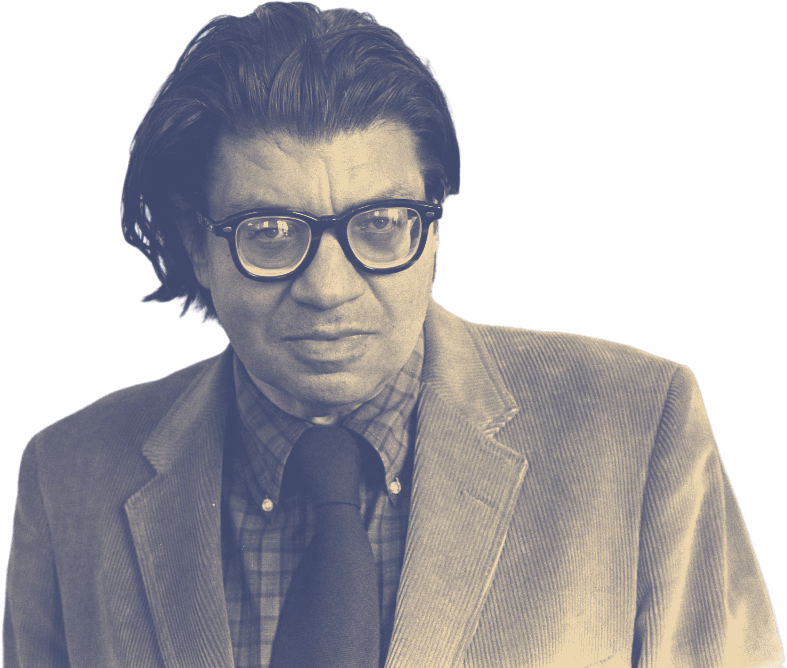
Morton Feldman (1926 to 1987), born in New York, was a major figure of twentieth century music and, with John Cage, Christian Wolff and Earle Brown, a member of the New York School. An early experiment with graphic notation gave the performers freedom over pitch, but he soon returned to precisely notated music of extreme quietness and slowness. His work is defined by soft dynamics, floating chords and, in the last years, enormous length: the String Quartet No. 2 runs some six hours, For Philip Guston past four.
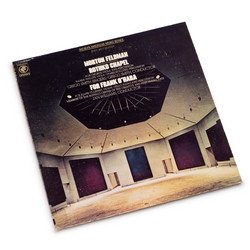
Rothko Chapel / For Frank O'Hara (LP)
Two of the composer's most beautiful and beloved immersive compositions from the early 1970's, respectively for chorus, viola and percussion, and for flute, clarinet, violin, cello, piano and percussion, released on Columbia Odyssey's "Modern American Music Series" in 1976. Essential.
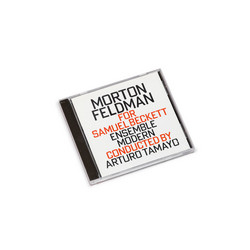
For Samuel Beckett (CD)
1992 CD-only release on Hat Art of a haunting performance of the 1987 micro-tonal masterpiece by the Ensemble Modern conducted by Arturo Tamayo.
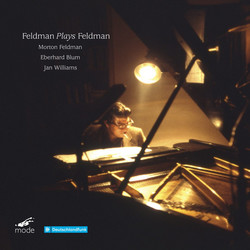
Feldman Edition 15: Morton Feldman Plays Feldman
Morton Feldman plays piano in a 1978 Deutschlandfunk concert recorded in Cologne, with flutist Eberhard Blum and percussionist Jan Williams: Why Patterns?, Extensions 3, Intermission 5 and The King of Denmark.
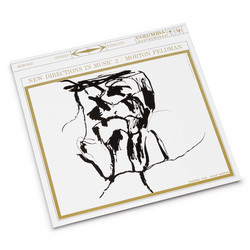
New Directions In Music 2
Morton Feldman’s New Directions in Music 2 is one of the true cornerstones of modern classical music. Originally released in 1959, the album captures Feldman at the very beginning of his radical journey into sound, space and silence, developing the sparse, floating language that would go on to influence generations of experimental composers and ambient musicians alike. With cover artwork by abstract painter Philip Guston and clear parallels to the chance-based ideas of John Cage, the record perf…
Palais de Mari
*300 copies limited edition* "Feldman used to say that music is not so much an ‘art-form’ as a ‘memory-form’. Scientific research informs us that personal memories are not stored in one stable unchanging state, but that each time we retrieve a memory, it is slightly modified. We hear the opening four-note gesture of this work, it soon passes, but the resulting resonance from the sustaining pedal remains a little longer, and then only a delicate memory trace is left. This opening gesture is heard…
For Bunita Marcus
*300 copies limited edition* "Technique and art both take time, so nothing durable happens by accident. But, is durability enough once appearance and disappearance become important? Can ebb and flow be set in stone? Or cut to vinyl? Or digitised? Perhaps we have only become habituated to the possibility. A pianist depresses a key, strings are hammered. At what point does the sound begin? It is not quite right to say that, in this moment, there was no sound but that now, in this moment, there is.…
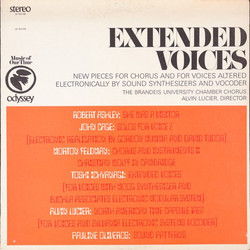
Extended Voices (LP)
1970 re-press of the 1967 fantastic, mind-blowing and essential compilation of pieces for chorus and for voices altered electronically by sound synthesizers and vocoder, conducted by Alvin Lucier and released on Odyseey's "Music Of Our Time" avant-garde music series curated by David Behrman.
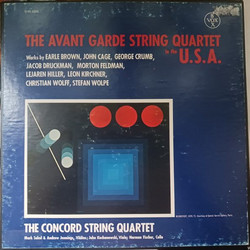
John Cage, Earle Brown, Morton Feldman, George Crumb, Lejaren Hiller, Christian Wolff, Stefan Wolpe, Jacob Druckman, Leon Kirchner
The Avant Garde String Quartet In The U.S.A. (3LP box)Cage's beautiful and unusual 1950 string quartet in a monumental compilation released as a 3LP box set by Vox in 1973 with a who's who of the American avant-garde, including Crumb's and Kirchner's outstanding quartets with electric amplification and electronics, with impeccable performances by the Concord String Quartet. With insert.
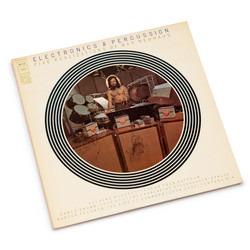
Electronics & Percussion (LP)
1970's re-press of the 1968 LP with five superb realizations for percussion and electronics of as many classic avant-garde compositions, including Cage's Fontana Mix-Feed, spanning from 1958 to 1965, released on Columbia's "Music Of Our Time" avant-garde music series curated by David Behrman.
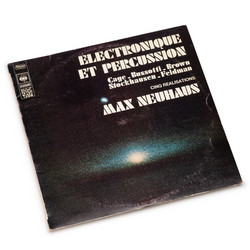
Electronique Et Percussion (LP)
French edition of the 1968 LP with five superb realizations for percussion and electronics of as many classic avant-garde compositions, including Cage's Fontana Mix-Feed, spanning from 1958 to 1965, released on CBS' "Music Of Our Time" avant-garde music series curated by David Behrman.
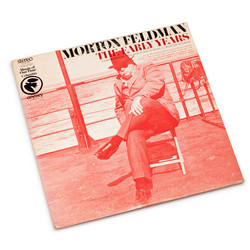
The Early Years (LP)
1968 re-issue on Odyssey's "Music Of Our Time" avant-garde music series produced by David Behrman of the 1959 LP New Directions In Music 2 with historical recordings of the composers' early pieces from the 1950's performed by David Tudor and the composer himseld among others.
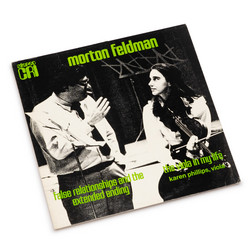
Viola In My Life / False Relationships (LP)
Two breathtakingly beautiful meditative copmpositions for small ensemble from the late 1960's and early 70's, performed by David Tudor and Karen Phillips among others, and released by CRI in 1971. Essential.
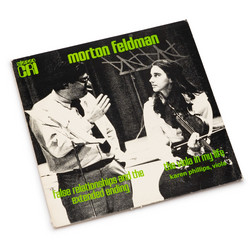
Viola In My Life / False Relationships (LP)
Two breathtakingly beautiful meditative copmpositions for small ensemble from the late 1960's and early 70's, performed by David Tudor and Karen Phillips among others, and released by CRI in 1971. Essential.
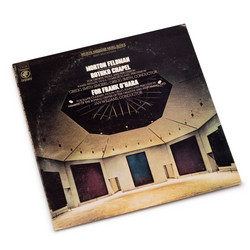
Rothko Chapel / For Frank O'Hara (LP)
Two of the composer's most beautiful and beloved immersive compositions from the early 1970's, respectively for chorus, viola and percussion, and for flute, clarinet, violin, cello, piano and percussion, released on Columbia Odyssey's "Modern American Music Series" in 1976. Essential.
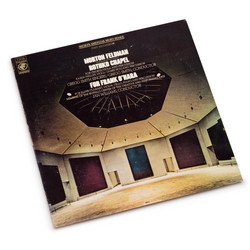
Rothko Chapel / For Frank O'Hara (LP)
Two of the composer's most beautiful and beloved immersive compositions from the early 1970's, respectively for chorus, viola and percussion, and for flute, clarinet, violin, cello, piano and percussion, released on Columbia Odyssey's "Modern American Music Series" in 1976. Essential.
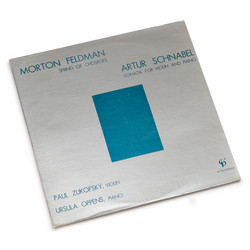
Spring Of Chosroes / Sonata For Violin And Piano (LP)
Feldman minimal 1977 composition for violin and piano backed with Schnabel's 1931 avant-garde piece for the same instruments, performed by Paul Zukofsky and Ursula Oppens and released by CP² Recordings in 1981.
Triadic Memories (CD)
1989 CD on ALM with Aki Takahashi performing the 1981 composition for piano in 1983. With OBI.
For John Cage (2CD)
1993 2CD set on ALM with Aki Takahashi and Yasushi Toyoshima preforming the 1982 composition for piano and violin in 1991. With OBI and insert.
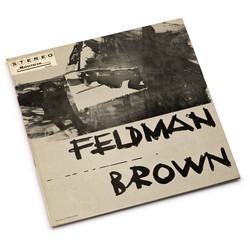
Feldman / Brown (LP)
1970 re-issue on Mainstream's "Contemporary Sound Series" of the 1962 lLP on Time's superb "Series 2000" curated by Earle Brown with Feldman's seminal early 1960's partly indetermined compositions for solo instruments and Brown's experimental 1950's pieces for small ensembles, performed by David Tudor among others.
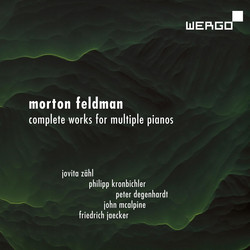
Complete Works for Multiple Piano
In Complete Works for Multiple Piano, Morton Feldman’s quietly radical writing for three or more hands is heard as a three‑hour continuum of hushed, hovering sonorities, where time dilates and the piano becomes a shared, breathing instrument.
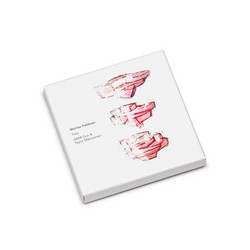
Trios (6CD Box)
In the final decade of his life, Morton Feldman turned his attention to the trio format with an intensity that would yield some of the most profound and uncompromising music of the twentieth century. Between 1978 and 1984, he composed three monumental works for flute, piano and percussion that together constitute an immense meditation on time, memory and the irreducible strangeness of sound itself. This landmark 6CD box set from Another Timbre presents all three pieces — totalling six and a half…
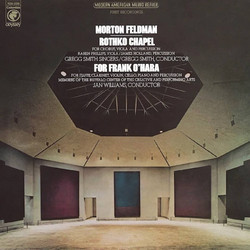
Rothko Chapel / For Frank O'Hara
Morton Feldman’s Rothko Chapel is a hushed yet monumental soundscape that resonates with the spiritual austerity of Mark Rothko’s paintings. Combining solo viola, voices, celesta, and percussion, the LP explores silence and timbre with a reverence that transforms listening into a meditative experience, while the composition For Frank O'Hara offers a tender lyrical counterpoint to its profound stillness.

Intermission 6
Morton Feldman's Intermission 6 (1953) is a sparse piano piece that typically lasts between 3 and 12 minutes in standard performances. Finnish experimental musician Antti Tolvi has created a radical 72-minute realization that extends the work's meditation on silence and resonance to an unprecedented duration. Tolvi discovered the piece through Philip Thomas's five-CD Feldman Piano box set on Another Timbre, becoming fascinated by Intermission 6 as "the piece which has the most silence in it, and…
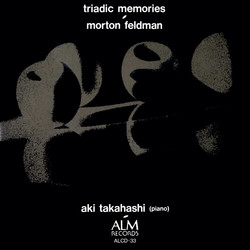
Triadic Memories
*2025 stock* The celebrated pianist Aki Takahashi presents an essential interpretation of Morton Feldman’s monumental work "Triadic Memories", a cornerstone of late 20th-century piano music. Known for its meditative expansiveness and delicate shifts in color, this composition stretches the boundaries of time, inviting listeners into Feldman’s unique sound world where silence and resonance carry as much weight as the notes themselves.
Recorded with Takahashi’s characteristic sensitivity and tec…

Intermissions
Feldman and Tobias Hume (performed by Luciana Elizondo and Guy Vandromme).
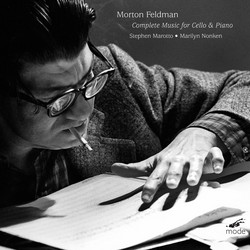
Feldman Edition 14: Complete Music for Cello & Piano
The complete music for cello and piano by Morton Feldman, played by cellist Stephen Marotto and pianist Marilyn Nonken, including unpublished pieces, a first recording of the 1946 Sonatina and the 89-minute Patterns in a Chromatic Field (1981).
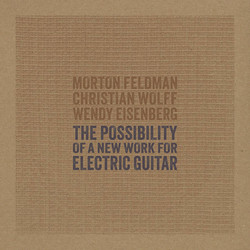
The Possibility of A New Work for Electric Guitar
Other Minds is proud to present The Possibility of a New Work for Electric Guitar, a new limited-edition 12” 45 RPM vinyl disc of music by Morton Feldman and Christian Wolff, performed by Wolff and Wendy Eisenberg. Side A features two performances of Morton Feldman’s The Possibility of a New Work for Electric Guitar, written for Wolff (who professes to be “not really a guitar player”) in 1966 as an experiment on the instrument. On his way to perform The Possibility of a New Work for Electric Gui…

For Bunita Marcus (1985)
Proudly co-produced with Teriyaki records, this volume is simply Unique!

Piano, Violin, Viola, Cello
Tip! "Feldman's last composition, Piano, Violin, Viola, Cello, was completed in 1987; although its instrumentation largely corresponds to that of Piano and String Quartet, with one instead of two violins, it differs in almost every other respect from the composition written only two years earlier, for here, in contrast to Piano and String Quartet, Feldman makes every effort to integrate the piano into the string section, and the basic formal components of the composition are no longer staves, as…

Violin and String Quartet
A double CD for one of the late monuments by Morton Feldman: Violin and String Quartet, a 140-minute work composed in 1985, two years before the American composer's death. A work of extreme maturity, in which Feldman pushes his aesthetics of duration and sonic rarefaction to their ultimate consequences, creating a suspended space-time where every sound acquires an almost physical presence.
Apartment House – the London-based ensemble specialized in experimental and minimalist repertoire – offers …
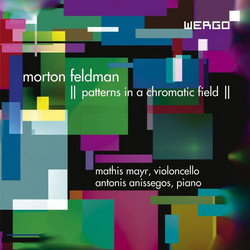
Patterns In A Chromatic Field
'Morton Feldman has proved one of the 20th century’s most influential composers. Yet he remains one of its most enigmatic, and his late works retain an aura of mystery steeped with the grandeur, anxiety and quietly changing colour he adored in abstract expressionist painting and, latterly, Anatolian rug design. Patterns in a Chromatic Field (1981) is perhaps the most rhythmically active of these famously long, static pieces, which showed his increasing preoccupation with matters of form, scale a…
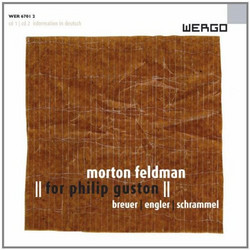
For Philip Guston
*2022 stock* Performed by Julia Breuer (flutes), Matthias Engler (vibraphone, marimba, glockenspiel, tubular bells), Elmar Schrammel (piano, celesta). Recorded 2007. One of Feldman's classic long-term late works, written in 1984. Wergo is proud to present Morton Feldman's four-hour-long trio For Philip Guston, performed by the ensemble Breuer-Engler-Schrammel. Feldman disagreed with those who regarded his works since the 1970s as being too long. 'In music, it's very difficult to distinguish betw…

For Franz Kline · For Frank O'Hara · De Kooning · Piano Piece To Philip Guston
*2022 stock* Wergo presents Moton Feldman's compositions For Franz Kline · For Frank O'Hara · De Kooning · Piano Piece To Philip Guston. Performed by Ensemble Avantgarde.
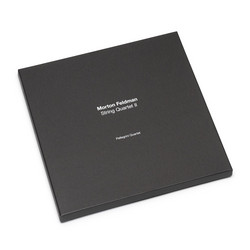
String Quartet II
* 2021 Stock ** During the decades following the Second World War, all eyes shifted toward New York, a city which, at that moment, played host to some of brightest creative minds of the century. Innovations were abound. Visual artists, writers, thinkers, musicians, and composers continuously pushed into previously unthinking ground. While the United States had been previously known to give birth to a wild and distinct breed of composer, from Charles Ives to Nancarrow, Harry Partch, Cowell, and b…
Sold Out
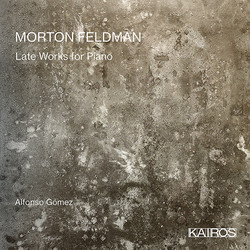
Works for Piano
"The piano was the favourite instrument of Morton Feldman (1926 – 1987). “What is the difference between an orchestra and a piano? A piano has pedals”, he once said. The three works on the CD – Triadic Memories (1981), For Bunita Marcus (1985) and Palais de Mari (1986) – are iconic of Feldman’s compositional trajectory. Firstly, because of their length. The first two pieces each last almost an hour and a half, Palais de Mari 25 minutes. Furthermore, the limitation of the musical material is stri…

Piano and String Quartet
Apartment House once more, here with their exceptional interpretation of Morton Feldman’s celebrated late work. 80 minutes of extraordinary beauty. Piano and String Quartet, one of Feldman’s final works, is a seemingly simple work and yet it isn’t. As Philip Guston, a great friend of Feldman, wrote ‘Frustration is one of the great things in art; satisfaction is nothing.’ The length of the work (nearly 80 minutes) and the erasure of musical memory (What did we just hear?) is in fact its identity…
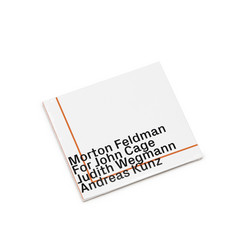
For John Cage
Temporary Super Offer! John Cage was an evangelist for a new mode of listening in which we would listen to everything with the same attention that we bring to music. For John Cage proposes instead that we listen to this music as if it were everything. While these two instruments are playing there is nothing else, just a violin and a piano. Even the process of remembering, normally so important in helping us make sense of what we hear, is altered: the ‘tenuous’ rhythms of For John Cage articulat…
Sold Out
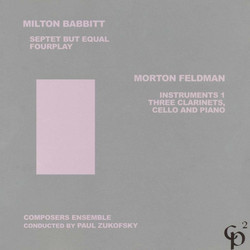
Septet But Equal & Fourplay / Instruments 1 & Three Clarinets, Cello and Piano
** 2021 Stock ** CP² Recordings presents Milton Babbitt: Septet But Equal; Fourplay; Morton Feldman: Instruments 1; Three Clarinets, Cello and Piano. Perfomed by b, conductor; Composers Ensemble. All works recorded at Studio 2, BBC Maida Vale, Delaware Rd., London, W9, July 20-21, 1997.
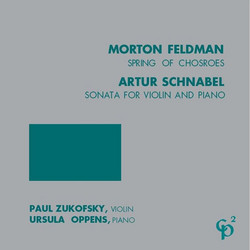
Spring of Chosroes / Sonata for Violin and Piano
** 2021 Stock ** CP² Recordings presents Morton Feldman: Spring of Chosroes and Artur Schnabel: Sonata for Violin and Piano by Paul Zukofsky, violin; Ursula Oppens, piano. Recorded at the Library of Congress, May 11-12, 1979. Spring of Chosroes is published by Universal Edition, Ltd., and was commissioned by the McKim Fund of the Library of Congress which also assisted with this recording. The Schnabel Sonata for Violin and Piano is published by Boosey and Hawkes, Inc. Recording Engineers: John …
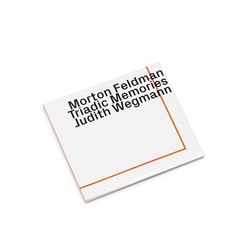
Triadic Memories
Perhaps more than any of Feldman other piano music Triadic Memories is about that reality, the acoustic space created bythe piano’s strings and soundboard, and in Judith Wegmann’s recording that space is withina magnificent Bösendorfer 280VC piano
Sold Out