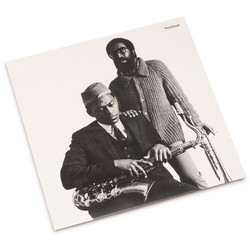
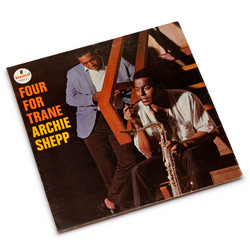
August 10, 1964. Van Gelder Studio, Englewood Cliffs, New Jersey. A young saxophonist from Philadelphia enters the studio to record his first album as a leader for Impulse! Records. At his side, as co-producer, stands the man to whom he owes everything: John Coltrane. Archie Shepp was twenty-seven years old when Four For Trane was recorded - an age that in 1964 jazz still meant being an emerging voice. Born in Fort Lauderdale but raised in Philadelphia - the same Philadelphia as Coltrane, eleven years his senior - Shepp had studied drama at Goddard College before surrendering definitively to the call of the tenor saxophone. He had served in Cecil Taylor's quartet, co-founded the New York Contemporary Five with John Tchicai and Don Cherry, absorbed everything the New York avant-garde scene could offer. But it was Coltrane's admiration that opened the doors to Impulse!.
The condition set by producer Bob Thiele was clear: an album of Coltrane compositions. Shepp accepted, but on his own terms. Together with trombonist Roswell Rudd, he rearranged four pieces from the Coltrane repertoire - three from Giant Steps (1960) and one from Coltrane Plays the Blues (1962) - transforming them into something radically new. "Syeeda's Song Flute," "Mr. Syms," "Cousin Mary," "Naima": material the world thought it knew, refracted through the prism of the avant-garde.
The sextet assembled for the session was a programmatic statement. No piano - a choice that granted the horns a freedom of movement unthinkable in the jazz of the era. Alan Shorter on flugelhorn (Wayne's younger brother, here in one of his rare recorded appearances), John Tchicai on alto saxophone (Shepp's companion in the New York Contemporary Five), Reggie Workman on bass (already a member of Coltrane's band), Charles Moffett on drums (fresh from his collaborations with Ornette Coleman). And Rudd, architect of the arrangements, weaving the frameworks that would hold freedom and structure together.
The band had rehearsed nightly for months. When they entered the studio, the takes flowed one after another without incident. Thiele, initially skeptical, brightened. He called Coltrane: "John, you've got to come hear this stuff, it's great." Coltrane drove from Long Island to Englewood Cliffs, arriving around eleven at night. He already knew what he would find - the avant-garde was everywhere in New York, and he was its spiritual father.
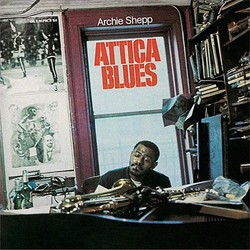
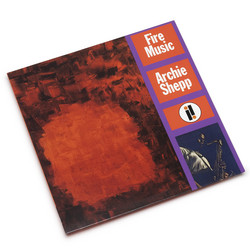
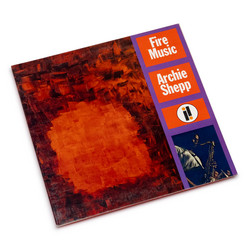
Four For Trane is not a covers album. It is a dialogue between generations, a passing of the torch that is also a declaration of independence. Shepp does not imitate Coltrane - he passes through him, metabolizes him, returns him transformed. His sound - gruff, vibrant, charged with an almost physical urgency - has nothing of Coltrane's transcendence. Where Coltrane sought the infinite, Shepp remains anchored to earth, to body, to struggle. The album's sole original composition closes Side B: "Rufus (Swung His Face At Last To The Wind, Then His Neck Snapped)" - a title that is already a poem, an image of violence and liberation that anticipates the political consciousness that would define Shepp's subsequent works, from Fire Music (with its elegy for Malcolm X) to Attica Blues.
The Penguin Guide to Jazz placed Four For Trane in its "Core Collection." AllMusic awarded it five stars. But rankings matter little. What matters is that in August 1964, in a New Jersey studio, a young saxophonist demonstrated that one could honor a master without imitating him - that the most sincere homage is transformation.
Recorded on August 10, 1964. Official reissue by Elemental music in collaboration with Impulse Records! Special Gatefold Edition.