Makoto Shinohara, Konrad Boehmer, Gottfried Michael Koenig, Luctor Ponse
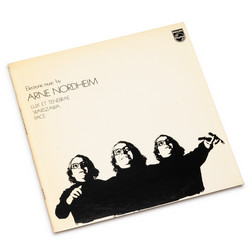
Mémoires / Aspekt / Terminus X / Nacht (LP)
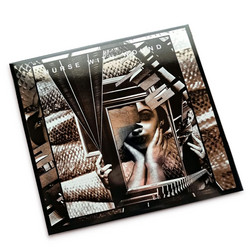
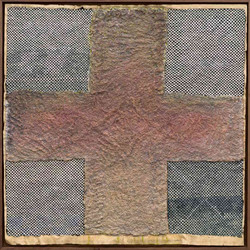
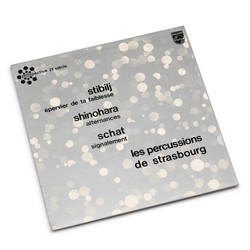
condition (record/cover): NM / NM | Four electronic works realized at the Institute of Sonology in Utrecht, released on Philips' legendary Prospective 21e Siècle series in the distinctive silver Heliophore sleeve. A document of the Institute's most concentrated period of activity in the mid-to-late 1960s, when under the directorship of Gottfried Michael Koenig the Utrecht studio became one of the two or three most advanced centres for electronic music research in the world - rivalling Cologne's WDR studio and the GRM in Paris, and developing tools and methods that neither of those older institutions possessed.
Makoto Shinohara's Mémoires opens the disc. Shinohara - born in Osaka in 1931, trained at the Tokyo University of the Arts, then a student of Messiaen's analysis class in Paris (1954-59) and subsequently Stockhausen's assistant in Cologne - came to Utrecht in the mid-1960s, where he realized both the four-channel Visions I (composed exclusively from sine tones) and this work. Mémoires takes a fundamentally different approach: its material combines synthetic sounds produced by tone generators with electronically processed vocal sounds, creating a texture in which the human voice is present but transfigured - remembered, as the title suggests, rather than heard directly. The result sits at a particular intersection of the Japanese and European avant-garde traditions, a meeting point that Shinohara would continue to explore when he later turned to combining Western instruments with koto, shakuhachi and shamisen.
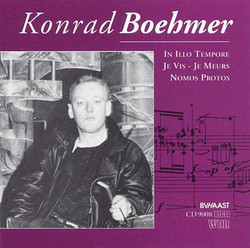
Konrad Boehmer's Aspekt (1964-67) fills the remainder of side one - fifteen minutes of what has been rightly described as one of the most radical pieces ever conceived in electronic music. Boehmer, born in Berlin in 1941, studied composition with Koenig and Stockhausen in Cologne, attended Boulez's and Pousseur's courses at Darmstadt, and completed a doctorate at the University of Cologne in 1966 on the theory of open form in new music. He worked at the WDR electronic studio from 1961 to 1963 before moving to the Netherlands, where he joined the Institute of Sonology from 1966 to 1968. Aspekt grew from the idea of an absolute unity between sound structure and large-scale form. None of the traditional procedures of electronic music - echo, filters, sinusoidal sound generators - are employed. Instead, the work's complex architecture arises from the application of principles that encompass every aspect of musical texture: sound-structure and form are identical. The piece made unprecedented use of the Variable Function Generator designed by Stan Tempelaars at the Institute, deployed in ways its inventor had not anticipated. Aspekt is dedicated to Nguyen Van Troy, a young Vietnamese resistance fighter killed in 1964. It was awarded the Grand Prize at the 5th Biennale de Paris in 1968. Boehmer - a self-declared Marxist and member of the Darmstadt School who later succeeded Koenig as director of the Institute of Sonology (1994-2006) and whose opera Doktor Faustus won the Rolf Liebermann Prize in 1983 - died in Amsterdam in 2014.
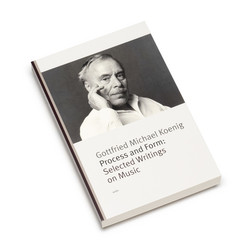
Side two opens with Gottfried Michael Koenig's Terminus X (1967), a two-channel electronic composition realized at the Institute he directed. Koenig - born in Magdeburg in 1926, trained in church music in Braunschweig, composition and acoustics in Detmold, computer technique in Bonn - had spent a decade (1954-64) at the WDR studio in Cologne, where he assisted Stockhausen, Ligeti, Kagel and Evangelisti and produced his own landmark electronic works Klangfiguren II and Essay. When he moved to Utrecht as artistic director in 1964, he brought with him an unrivalled understanding of both the possibilities and the limitations of studio-based electronic composition. Terminus X belongs to a series of works bearing the Terminus title - the name itself suggesting both endpoint and boundary. It was composed the same year Koenig began developing his pioneering computer composition programs (Project 1 and Project 2) and his experiments with the Variable Function Generator that produced the Funktionen series. Terminus X stands at the threshold between these two phases of Koenig's work - the last flowering of his purely studio-based electronic practice before the computer took over. Koenig died in Culemborg in 2021.
Luctor Ponse's Nacht (1965-66) closes the disc. Ponse is the least expected figure in this company - born in 1914 near Geneva to a Dutch father and a French-Swiss mother, he was a virtuoso concert pianist before he was a composer of electronic music, and his catalogue includes concertos, ballets for the Dutch Opera, and a recording of Stravinsky's Pétrouchka with Hans Rosbaud and the Concertgebouw Orchestra. He studied composition with Henk Badings, discovered the possibilities of electronic music around 1960, and from 1965 served as scientific collaborator and teacher at the Institute of Sonology - where Claude Vivier was among his students. Nacht - "on the threshold of night" - is purely electronic music, fourteen minutes of it, but made by hands trained on Liszt and Bartók. It brings a pianistic sense of drama and timing to a medium that more often favoured the systematic over the intuitive. Ponse died in 1998.
The four composers represent the full spectrum of the Institute of Sonology's international reach in its first decade: a Japanese composer who had passed through both Paris and Cologne; a German political radical who had fled the Federal Republic; the Institute's own director, the most systematic mind in electronic music; and a Swiss-French concert pianist who found in electronics a new instrument. All four works were realized on the same equipment, in the same rooms, within a few years of each other - and they sound nothing alike. That is the mark of a studio that served its composers rather than imposing a house style.
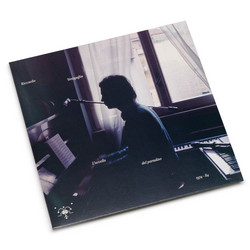
LP. Philips Prospective 21e Siècle, 836 993 DSY. Silver Heliophore sleeve.