Gottfried Michael Koenig, Zoltán Pongrácz, Rainer Riehn
Terminus II / Funktion Grün / Phonothese / Chants De Maldoror (LP)
condition (record/cover): NM / NM A second volume of electronic music from the Institute of Sonology in Utrecht, this time on Deutsche Grammophon's Avantgarde series - the label's ambitious attempt to document the postwar avant-garde that ran to six boxed sets between 1968 and 1972. Where the Philips Prospective 21e Siècle disc paired Koenig with visiting composers, this LP presents the Institute's director alongside two of his own students: a Hungarian who had studied with Kodály in the 1930s and a young German who would go on to co-found the most important journal of musical thought in the late twentieth century. Three generations, three radically different relationships to electronic sound, all realized in the same studio.
Gottfried Michael Koenig takes the entire first side with two works that represent the summit of his studio-based electronic practice. Terminus II (1966/67) is a two-channel composition in six sections - the title continuing a series begun at the WDR studio in Cologne, where Koenig had spent a decade (1954-64) assisting Stockhausen, Ligeti, Kagel and Evangelisti while producing his own landmark pieces Klangfiguren II and Essay. At Utrecht, Koenig was simultaneously developing the computer composition programs - Project 1 and Project 2 - that would define the Institute's future direction; Terminus II and its companion piece exist in the charged space between the handmade and the algorithmic, the last works in which Koenig shaped electronic sound entirely by manual means in the studio. Funktion Grün (1967) belongs to the series of pieces Koenig made using the Variable Function Generator designed by Stan Tempelaars - a machine originally built for acoustic research that Koenig repurposed as a compositional instrument. Each piece in the Funktionen series is named after a colour; Grün was the first, followed by Gelb (1968), Orange (1968) and Violet (1969). The VFG functioned somewhat like an analogue sequencer, generating sound through voltage control, but Koenig treated it as an oscillator, producing timbres of a rawness and directness that his earlier, more painstakingly assembled tape compositions had not attempted. The Funktionen remain among the most sonically striking electronic works of the 1960s - music that holds up beside any noise or drone composition made since.
Zoltán Pongrácz's Phonothese (1966) opens side two. Pongrácz's biography is one of the most remarkable in postwar electronic music. Born in 1912 in Diószeg (now Sládkovičovo, Slovakia), he studied composition with Kodály at the Budapest Academy of Music from 1930 to 1935, took conducting lessons from Rudolf Nilius in Vienna and Clemens Krauss at the Salzburg Mozarteum, served as music director of Hungarian Radio during the war years, and taught composition at the Debrecen Conservatory until 1958. Then, in his early fifties - after a career shaped entirely by the Central European tradition of Kodály and Bartók - he attended the Darmstadt summer courses (1964, 1965) and the Cologne Courses for New Music (1965-66) with Stockhausen, Pousseur and Ferrari. At Utrecht, working under Koenig, he composed Phonothese (originally titled Chryptothesiphon) as a kind of graduation piece. The work won first prize at the Bourges international competition, and Pongrácz returned to Budapest to become the country's first professor of electronic composition at the Academy of Music (1975-95), effectively founding the discipline in Hungary. He died in Budapest in 2007 at ninety-five. Phonothese carries within it the tension of a composer formed by one world and transformed by another - the dramatic instinct of a conductor and opera composer channelled through means he encountered only in his sixth decade.
Rainer Riehn's Chants de Maldoror closes the disc in the revised version of 1968/69 - an electronic translation of Lautréamont's hallucinatory prose poem, composed across four years (1965-69) during Riehn's time as a student of Koenig at the Institute. Born in Danzig in 1941, Riehn studied music theory in Mainz, Zürich and Berlin before arriving in Utrecht. At the 1965 Darmstadt courses he met Heinz-Klaus Metzger, the music theorist and polemicist, and the two became lifelong collaborators. Together they founded the Ensemble Musica Negativa in 1968 - dedicated to the most radical music of Cage, Feldman and Schnebel - and in 1977 launched the journal Musik-Konzepte, which they edited together until 2003 and which became the essential forum for advanced musical thought in the German-speaking world. In 1987, as co-dramaturges at the Oper Frankfurt, Metzger and Riehn commissioned John Cage to write his first opera - the resulting Europeras 1 & 2 is one of the defining works of late twentieth-century music theatre. Yet Riehn's own compositional output remained almost entirely unpublished. The Chants de Maldoror on this disc was for decades the only publicly available recording of his music, until Edition Telemark's 2016 2LP set gathered all surviving Utrecht pieces. The work exists in two versions - the first (1965/66) and this revision - both scored for four-channel tape and both taking Lautréamont's text not as something to be set or illustrated but as a structural model, an architecture of delirium rendered in electronic sound. Riehn died in 2015.
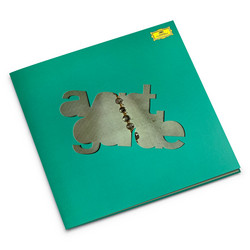
LP. Deutsche Grammophon Avantgarde, 643 545 (also issued separately as 137 011). Part of the six-LP box Avantgarde Vol. 2 (1969). All works realized by the composers at the Instituut voor Sonologie van de Rijksuniversiteit te Utrecht, Studio voor Elektronische Muziek (director: Gottfried Michael Koenig).