Karlheinz Stockhausen
Aus Den Sieben Tagen (7LP box)
condition (records/covers/booklet/box): NM / EX- / VG+ / NM) Booklet included. | The complete Aus den sieben Tagen - all fifteen text compositions Stockhausen wrote during seven days in May 1968, alone in Kürten after his wife Doris left with their children, reading Satprem's book on Sri Aurobindo, approaching what he later described as the edge of suicide. No notes, no rhythms, no score - only verbal instructions that begin with concrete directives ("play a vibration...") and dissolve into images that Stockhausen insists are not metaphorical but literal: when the text says "sound turns to gold," the performer is expected, through concentration, to generate color in the mind's eye. This is "intuitive music" - a term Stockhausen coined precisely to distinguish it from both improvisation and Cagean indeterminacy. His own formulation, from the 1968 Darmstadt courses: "I do not want a spiritualist séance - I want MUSIC!" And: "not indeterminacy, but intuitive determinacy."
The concept was not a rupture but a logical next step. Through the 1960s, Stockhausen had been progressively loosening the notational grip: aleatoric structures in Zyklus and Mixtur, verbal imagery governing performer interaction in Mikrophonie I, then the "plus-minus" scores of Prozession and Kurzwellen where his touring electroacoustic group - Aloys Kontarsky (piano), Harald Bojé (electronium), Johannes G. Fritsch (viola), Alfred Alings and Rolf Gehlhaar (tam-tams) - used shortwave radio signals as external material to transform in real time. Aus den sieben Tagen removed those external sources and replaced them with self-generated, poetically directed impulses. The compositional logic remains: cooperative imitation, gradual transformation of one sound structure into another, convergence toward synchronous moments. But since nothing is scored, those moments of collective alignment depend entirely on how well the performers are tuned to each other.
For these premiere recordings, made at the Georg-Moller-Haus - a Masonic lodge in Darmstadt - over six consecutive days in August 1969, Stockhausen deliberately mixed his regular group with three French musicians who had never played the plus-minus works: Michel Portal (clarinet), Jean-Pierre Drouet (percussion), Jean-François Jenny-Clark (bass), joined by Argentine pianist Carlos Roqué Alsina. The regular group members were reportedly skeptical of the text pieces at first - Michael Kurtz's Stockhausen biography describes the composer's pedagogical effort to convert them. The introduction of these outsiders, already attuned through their own improvisation practice, may have been partly practical and partly strategic: new ears, no habits, a different kind of listening brought into the circle. Stockhausen himself operates filters and potentiometers for tam-tam and viola. The fifteenth piece, Goldstaub (Gold Dust) - which requires four days of solitary fasting and silence before playing - was recorded separately in August 1972 at Stockhausen's home in Kürten.
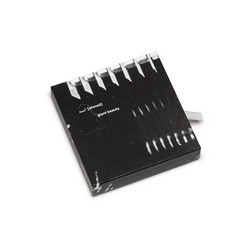
7LP box. Deutsche Grammophon 2720 073, 1973. Produced by Dr. Rudolf Werner, recorded by WDR Köln (1969) and DGG (1972). Trilingual booklet with texts and notes, English translations by Richard Toop.