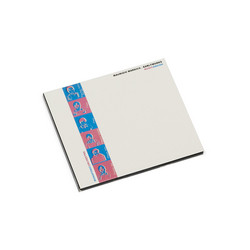
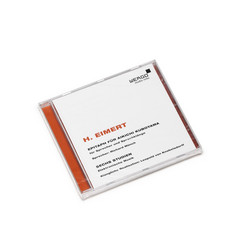
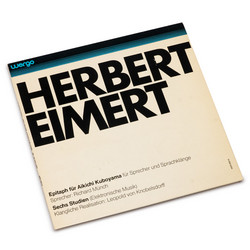
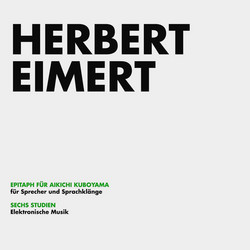
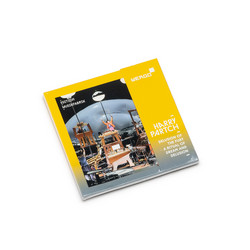
condition (record/cover): NM / NM Insert included. | Herbert Eimert's electronic works from the Studio für elektronische Musik des Westdeutschen Rundfunks, Cologne - the first electronic music studio in the world, which Eimert founded in 1951 and directed until 1962. This is music from the very beginning: the point where sound synthesis by purely electronic means became a compositional reality. Wergo LP with 12-page booklet, recorded at the WDR Studio Cologne. Eimert (1897 Bad Kreuznach - 1972 Düsseldorf) was a music theorist, critic, editor, and composer whose career traces the entire arc from atonality through twelve-tone technique to serialism to electronic sound. In 1924, still a student at the Cologne Musikhochschule, he published his Atonale Musiklehre and composed what may have been the first explicitly twelve-tone string quartet - an act of provocation that got him expelled from his composition class. From 1955 to 1962 he co-edited die Reihe with Stockhausen, the journal that became the theoretical organ of European serialism.
The WDR Studio was where electronic music as distinct from musique concrète was defined: where the principle of building sound from scratch using sine-wave generators, rather than manipulating recorded natural sounds as in Paris, was established as compositional method. Eimert's early studio works - Struktur 8 (1953), Glockenspiel (1953), Etüde über Tongemische (1954), Fünf Stücke (1956) - are among the founding documents of the medium. They sound austere, pointillistic, almost crystalline: pure tones organized according to serial principles, without the warmth or density of later tape music. Selektion I (1960) represents a more mature phase, and Zu Ehren von Igor Strawinsky (1957) is a characteristically intellectual homage. The technician throughout was Leopold von Knobelsdorff, whose role in realizing these compositions - translating serial parameters into actual electronic signals - was as essential as any performer's in acoustic music. Published Universal Edition, Vienna. An indispensable document for understanding where electronic music came from and what it was before it became what it became.