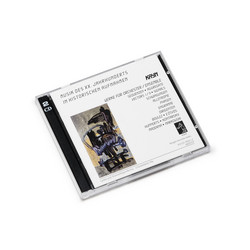
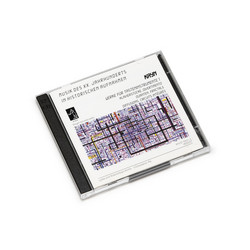
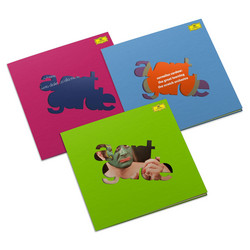
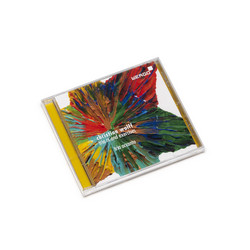
condition (records/cover): NM / EX Book-like sleeve. | Three-LP box from the monumental Hanns Eisler Edition on Nova, the contemporary music imprint of the DDR's state label VEB Deutsche Schallplatten. The full edition eventually ran to 42 LPs housed in linen boxes - one of the most ambitious composer retrospectives ever undertaken by a state recording enterprise. This "Kassette" (Nova 8 85 039 / 8 80 064 / 8 80 098) gathers chamber music, songs, and a complete side of the composer speaking, recorded in Berlin in 1971 with the conversation dating from 1961.
The first disc opens with the masterpiece: Vierzehn Arten den Regen zu beschreiben (Fourteen Ways to Describe the Rain) Op. 70, completed November 1941 in American exile. Written to accompany Joris Ivens's short film Regen (Rain) as part of a research project at the New School for Social Research in New York on the relationship between music and film, it became one of the great independent chamber works of the century. Dedicated to Schoenberg, scored for the Pierrot lunaire instrumentation - flute, clarinet, violin, viola, cello, piano - and built on fourteen variations of an anagram spelling out the letters of Schoenberg's name (A-Es-C-H). Eisler himself described it as "fourteen ways of being sad with decency." The disc continues with three Brecht Lieder and the Kammer-Sinfonie (1940), also from the exile years. The second disc covers the full span: Zeitungsausschnitte (Newspaper Clippings) Op. 11, the agit-prop songs of the late 1920s; Nonett Nr. 1 (1957), a late work; two Sonette on poems by Goethe and Schiller; and the Sonate für Klavier Op. 6 (1924), from the years when Eisler was still working within the orbit of his teacher Schoenberg's twelve-tone method. Performers include soloists of the Deutsche Oper Berlin chamber ensemble.
The third disc is entirely spoken word: Hanns Eisler spricht über Hölderlin - Eisler speaking about the poet Friedrich Hölderlin in conversation with Hans Bunge, recorded in 1961, a year before Eisler's death. Bunge was assistant director and dramaturg at the Berliner Ensemble under Brecht, later first director of the Brecht Archive. Between 1958 and 1962 he conducted fourteen tape-recorded conversations with Eisler, published as Fragen Sie mehr über Brecht (Ask Me About Brecht) - one of the essential documents of twentieth-century musical thought, compared in importance to Brecht's own writings on theatre and Walter Benjamin's theoretical works. The Hölderlin discussion has particular weight: Eisler's suppressed Johann Faustus opera project, which drew Walter Ulbricht's fury, engaged with the same questions about German literary tradition, political commitment, and the uses of the classical heritage that Hölderlin's poetry embodies. To hear Eisler speak - witty, erudite, dialectical, combining rigorous Schoenberg-school intellect with Marxist fire and Viennese charm - is to understand something that the music alone cannot communicate. Eisler (1898 Leipzig - 1962 Berlin), Schoenberg's most gifted and most wayward pupil, Brecht's closest musical collaborator, composer of the DDR national anthem and of the Hollywood Songbook, deported from America by HUAC in 1948, remains one of the great unresolved figures of the century.