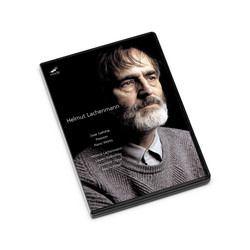
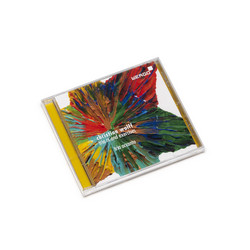
Helmut LachenmannFeaturing: Michael Ranta
Accanto / Consolation I / Kontrakadenz (LP)
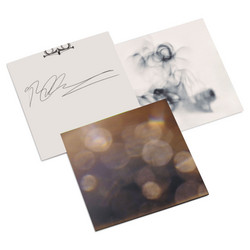
condition (record/cover): NM / NM | Gatefold sleeve. Three key works by Helmut Lachenmann spanning a decade of his most radical period, 1967-1976 - and one of the first LPs devoted to his music. Accanto (1975-76), "music for a clarinettist with orchestra," is Lachenmann's reckoning with Mozart. A tape of the Clarinet Concerto runs secretly alongside the live performance, surfacing briefly at rare, precisely calculated moments. The rest of the time you hear what Lachenmann describes as "the paranoid arc of veneration and anxious love" his music makes around that hidden point of reference. Mozart's Concerto, he wrote, is "the embodiment of beauty, humanity, purity - but also, simultaneously, the example of a fetish, a means of flight from oneself: an 'art' seemingly on intimate terms with humanity, in reality become a commodity for a society on oh-and-ah terms with art." The title means "beside" - his music is accanto, next to Mozart, beside it, alongside it, never touching. Eduard Brunner, clarinet, with the Rundfunk-Sinfonieorchester Saarbrücken conducted by Hans Zender. Recorded 29 May 1976, premiere performance.
Consolation I (1967) for 12 voices and 4 percussionists is the earliest work here and the most directly political. The text comes from Ernst Toller's Masse Mensch (Mass and Man, 1921) - Toller, the expressionist poet and revolutionary who led the short-lived Bavarian Soviet Republic in 1919 and was imprisoned after its defeat. The message - that no one should kill another person in the name of a cause - is fragmented into sibilants and vowels, the words decomposed into their physical sound-components. Performed by the Schola Cantorum Stuttgart directed by Clytus Gottwald, the great choral conductor who was also one of Lachenmann's most articulate advocates. Recorded 30 January 1968, SWF Baden-Baden.
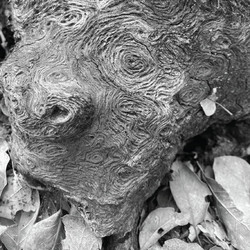
Kontrakadenz (1970-71) for large orchestra is what Lachenmann calls "a cascade of acoustic situations" - each sound signals the physical energy of the musician's action, makes audible the mechanical conditions and resistances of sound production. Michael Gielen conducts the Radio-Sinfonieorchester Stuttgart. Recorded 23 April 1971. LP on Wergo WER 60122, 1985. Cover: Karl Bohrmann collage Für Helmut Lachenmann (1984). Published Breitkopf & Härtel. Three conductors essential to new music - Zender, Gottwald, Gielen - each bringing their own understanding to one of the most uncompromising bodies of orchestral work in the second half of the twentieth century.