Karlheinz Stockhausen
Drei Lieder / Sonatine / Spiel / Schlagtrio (LP)
condition (record/cover): NM / EX- (light creasing) Insert included. | The young Stockhausen before he became "Stockhausen" - four works composed between 1950 and 1952, before Kontra-Punkte, before the Cologne electronic studio, before Darmstadt changed everything. The Drei Lieder (1950) for alto voice and chamber orchestra are the most revealing: Stockhausen submitted the score to the Darmstadt jury, who rejected it as "too old-fashioned." The texts of the songs were too gruesome, the language too tethered to late expressionism. In response, he replaced the first song's text with a Baudelaire translation. The work then remained unperformed for over twenty years until Maurice Fleuret requested a premiere for his Paris concerts - Stockhausen, curious to hear what this student work actually sounded like, offered it up. The Sonatine (1951) for violin and piano was one of two examination papers he submitted for admission to Frank Martin's composition class at the Cologne conservatory. These are not minor curiosities: they are the evidence of an extraordinary musical intelligence already fully operational, searching for a language it hadn't yet found.
Spiel (1952) for orchestra marks the transition - Stockhausen's first orchestral work after his encounter with Messiaen in Paris, the serial thinking now fully absorbed, the two movements (fast/slow) already pushing toward the dissolution of traditional formal categories that would define Punkte and Gruppen. The Schlagtrio (1952) for piano and two sets of three timpani is the most prophetic piece here: a work about rhythm and resonance that anticipates by decades the concerns of the spectral composers, the piano and six timpani creating a sound-world of extraordinary physicality where pitch and rhythm become aspects of the same phenomenon.
All four works are conducted or directed by Stockhausen himself, recorded between 1975 and 1976 - the composer revisiting his earliest pieces a quarter century later, with the authority to make them definitive. Sylvia Anderson sings the Drei Lieder with the Sinfonie-Orchester des Südwestfunks Baden-Baden. Saschko Gawriloff (violin) and Aloys Kontarsky (piano) play the Sonatine - the same Gawriloff who recorded Isang Yun's Gasa, the same Kontarsky who is the pianist of the Klavierstücke and Mantra. Kontarsky returns for the Schlagtrio with timpanists Georges van Gucht and Jean Batigne - Batigne being the founder of Les Percussions de Strasbourg.
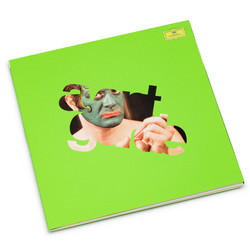
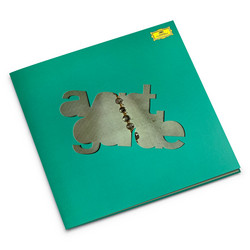
LP. Deutsche Grammophon 2530 827, 1977. Sleeve notes by Stockhausen, with song texts.