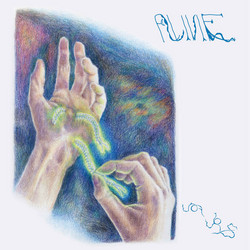
Nicola Di Croce, Ramona Ponzini
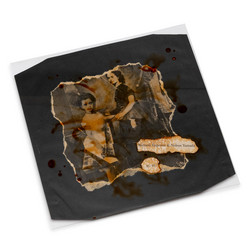
Millesuoni (LP)
Tracked express shipping from Italy, no customs or import VAT in the EU. Shipping costs
In Millesuoni, Deleuze Guattari e la musica elettronica (2008), Emanuele Quinz distills some of the key ideas on the nature of sound formulated by Deleuze and Guattari over the course of their work. Central among them is the dynamic of territorialization and deterritorialization—a strategy of appropriation and subsequent release, activated in the alternation between refrain and music.
A child humming alone to ward off the fear of the dark is engaging in a process of territorialization, marking a boundary within which they situate themselves as a subject. If territorialization belongs to the refrain, music—of which the refrain is an integral component—sets in motion the opposite movement: deterritorializing the forces that define the refrain. Music tends toward abstraction and dissolution, eluding territoriality altogether.
As Deleuze and Guattari write: “A child reassures himself in the dark, or claps his hands, or invents a way of walking […] or else chants ‘Fort-Da’ […]. Tra la la. A woman hums… A bird launches its refrain” (A Thousand Plateaus, 415)—revealing a continuous alternation between subjectivation and transformation, between flow and becoming.In the works of Nicola Di Croce, Nicolò Pellarin, and Ramona Ponzini presented in Millesuoni (curated by Lisa Andreani, Neun Kelche, Berlin, 1–13 July 2025), this interplay of the two movements is clearly perceptible. It manifests as a constant shifting of perception—from listening to touch, from listening to vision—and as a continual repositioning of the body within space