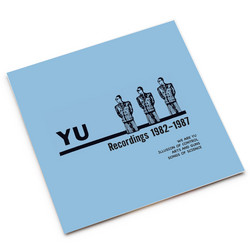
Recordings 1988 focuses on a pivotal year in the brief but remarkably stubborn life of YU, the Austin trio of Dwaine Woodliff, his brother David Woodliff and Gaylon. When the “do it yourself” punk ethic hit Austin in the early 1980s, the three didn’t just form a band – they built a small, self‑contained ecosystem around a Teac (and later Fostex) machine, a handful of instruments and their own imprint, Home Productions. The first evidence was the cassette We Are YU in 1982, followed by a steady trickle of tapes - Art & Guns, Illusion of Control and Songs of Science - that sketched out a world of oblique hooks, brittle electronics and deadpan vocal presence, all captured in the grainy fidelity of a bedroom studio.
By 1988 that world reached its most concentrated form. In the space of a single year, YU produced two further cassettes, Family and I Hope I’m Dreaming, both issued on Home Productions and now gathered for the first time on this LP edition as Recordings 1988. If the earlier tapes documented a group feeling its way through post‑punk, synth‑pop and mutant art‑rock, these releases sound like the moment everything locks into a singular, oddly coherent voice. Songs are shorter, stranger and more focused; arrangements hinge on minimal drum patterns, wiry bass, stark keyboard lines and guitars that flicker between skeletal chords and needling figures. The home‑tape aesthetic remains intact - you can hear the room, the hiss, the sense of ideas being worked out on the fly - but the writing bites harder, with lyrics that tilt from domestic scenes to science‑fiction unease and black humour.
The LP draws directly from the 1988 tapes, sequencing material that originally unspooled across Family and I Hope I’m Dreaming into a narrative arc that highlights their shared preoccupations. Tracks like “A Reading/Naked Ladies”, “You”, “Sperm Count”, “Babies” and “He Wonders Why” sketch the contours of a world where intimacy, surveillance, paranoia and absurdity coexist in the same cramped space. YU’s songs are rarely straightforward; even when a chorus emerges, it tends to arrive slightly off‑centre, destabilised by an extra bar, an unexpected chord or a vocal delivered just a shade too flat or too bright. That tension between catchiness and disorientation is the heart of their appeal. Everything feels a little misaligned, as if the trio were deliberately nudging familiar forms into a parallel, skewed timeline.