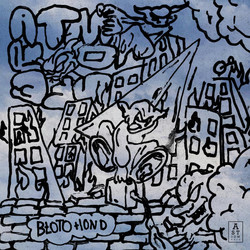
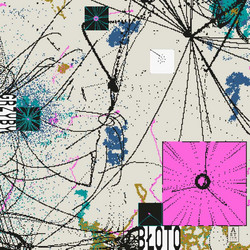
Błoto has never cared much for dominant aesthetics. Instead, the band has consistently chosen paths less travelled, unexplored territories and uncharted routes where experimentation is not so much a conscious decision as a natural state of being. After years of a rather hermetic approach to recording their albums, the time for change has come. A trip to Bucharest and the opportunity to collaborate with the community of musicians associated with the underground label Future Nuggets, led by Ion D, resulted in many hours of recordings, which will be presented by Astigmatic Records in a series of releases across 2026. It opens with a 7-inch vinyl titled Zmiany / Schimbări, recorded in collaboration with Ion D and Plevna.
During the recording sessions in Romania, the musicians remained true to their method of collective
improvisation, while consciously taking a step further. Moving beyond their own limitations, they opened up to other artists and to an entirely new environment. A warm autumn in Bucharest proved to be a change of climate in the most literal sense, becoming a direct impulse for action. Working solely with their skills and the equipment available at Ion D’s N-am studio, the musicians quickly entered an intense creation mode. It is precisely there that the recordings centered around the Bucharest-based label Future Nuggets are created: a place built on a foundation of experimentation and the consistent cultivation of a local, broadly defined psychedelic scene. It is no wonder that during these sessions everyone gladly abandoned the word "jazz", which gave room for a sense of creating something new and free from labels or any need for classification.
The hospitality, openness and personality of Ion D filled the studio in a palpable way. As a creator and researcher, he moves between new musical inventions and the history of the region, its folklore and traditions, and these worlds naturally permeated the recordings. Long discussions and exchanges of experience found their reflection in sound. Time gradually lost its meaning, and the sessions extended almost unnoticed late into the night. In this atmosphere of creative focus, electronic music producer Plevna quietly emerged at the synthesizers, leaving a distinct mark on the tracks "Zmiana czasu" and "Zmiana klimatu" with his melodic and catchy motifs.
To better understand the metaphorical dimension of the music, it is worth looking at the place where it was recorded. The sessions took place at the intersection of the Dorobanți and Floreasca districts, an area where traces of earlier times are still visible. Ion D’s studio is located in an old house from the turn of the 19th and 20th centuries, repeatedly rebuilt and bearing the marks of successive eras. At that time, Floreasca functioned under the name Mahala. It was simply a slum, also known as Groapa Floreasca, meaning a pit or hell. As Ion notes, it is striking that both Dorobanți and Floreasca have become some of the most expensive districts in Bucharest.
Rather than representing genuine revitalization, this is an experience well known not only in Romania, but
across Poland as well. The gentrification of places where we grew up has become a defining feature of every major city. From extreme poverty to demonstrative wealth following the political transformations of 1989, this is where the traumas of transition and late capitalism lead us. We have more in common than it might initially seem. The artistic residency of Błoto and the collaboration with Ion D and Plevna would not have been possible without the Poland–Romania Cultural Season 2024–2025. The programme was organized by the Polish Ministry of Culture and National Heritage and the Adam Mickiewicz Institute, with the support of the Polish Institute in Bucharest, together with the Romanian Ministry of Culture and the Romanian Cultural Institute.


























![Sous-sol [na podvale]](https://cdn.soundohm.com/data/products/2026-10/73291-jpg.jpg.250.jpg)