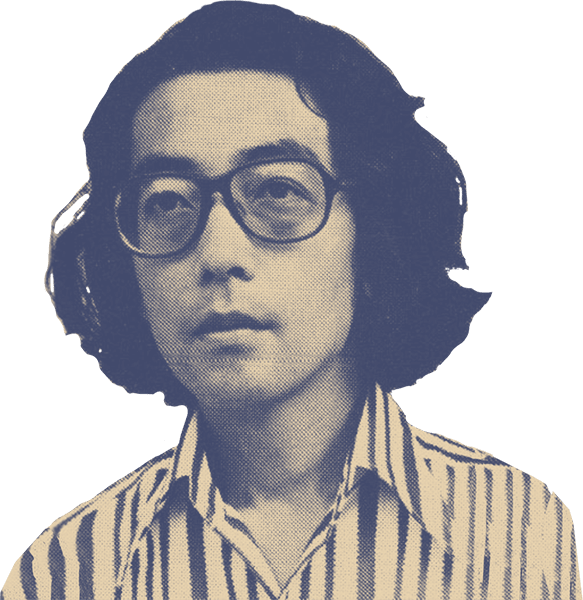
Toshi Ichiyanagi
Toshi Ichiyanagi (1933 to 2022) was a Japanese composer of avant-garde music, born in Kobe. He studied at Juilliard in the 1950s, met John Cage and, returning to Japan in 1961, brought chance and indeterminacy into Japanese new music. Distance (1961) makes the performers play from three metres away from their instruments. Married to Yoko Ono from 1956 to 1963, he later wrote operas, concertos and symphonies, and directed festivals and ensembles.

Cosmos Of Toshi Ichiyanagi (LP)
Sole vinyl edition of the 1984 album ob Camerata with four compositions from the early 1980's for piano solo or in duo (with marimba, harp and violin) by the eclectic experimental and multi-media Japanese composer initially associated with Fluxus. With insert and obi.

Piano Space 1 (LP)
1978 Jamanese promotional LP on Angel with a selection of experimental piano compositions from the box set with the same title, focusing on pieces by Japaniese composers from the 1970's, performed by Aki Takahashi. With obi.
Sold Out

The Min-On Contemporary Music Festival '83 & '84 (2LP)
Sole edition of the Japan-only 1984 2LP set on Camerarta presenting compositions for orchestra with soloist or chorus by eminent Japanese composers premiered at the "Minshu Ongaku" festival performed by the Tokyo Philharmonic Orchestra conducted by Tadaaki Otaka. With insert and obi.

Extended Voices (LP)
1970 re-press of the 1967 fantastic, mind-blowing and essential compilation of pieces for chorus and for voices altered electronically by sound synthesizers and vocoder, conducted by Alvin Lucier and released on Odyseey's "Music Of Our Time" avant-garde music series curated by David Behrman.

Appearance/Music for Solo Performer
A 1967 concert at Hope College, Michigan, found in a Japanese archive: Cage, Tudor and Ichiyanagi play Ichiyanagi's "Appearance" and an early realization of Alvin Lucier's "Music for Solo Performer", the first piece made with brainwaves.
Sold Out

Orchestral Space
2009 release ** "Japan-for-U.S. CD reissue of Varèse Sarabande LP configuration (VX 81060), featuring contemporary, avant-garde classical performances, recorded live at Tokyo's Nissei Theatre in 1966 by the Yomiuri Nippon Symphony Orchestra, conducted by Seiji Ozawa and Hiroshi Wakasugi, featuring performances of the works of nineteen separate composers, of which four were selected for this particular release. The packaging features an eight-page booklet with liner notes "based upon notes by Kun…

鷹 = Taka (Art Book + LP)
An extremely rare Toshi Ichiyanagi art edition LP. Deluxe art edition boxset only available for gallery exhibition in Tokyo in 1982 and not available elsewhere. Housed in silver box with book, outer sleeve and many inserts with calligraphic artYuichi Inoue (1916-85) was an avant-garde calligraphy artist. This remarkable collaboration was realized by a curator Masaomi Unagami in 1982. This edition is consisted of 6 calligraphy of Yuichi's 'Taka' (hawk), Shohei O'Oka's short novel 'Taka' and fanta…

An Anthology
Essential and visually stunning 1963 anthology edited by Young and Maciunas featuring most of the artist who would be take part in Fluxus. Very rare second edition published in 1970 of this important book.

Oto no Hajimari wo Motomete vol.12 - The World
Brand new issue of archive series of NHK electronic music studio. This issue will be a collection of Toshi Ichiyanagi's tape works at NHK studio as his memorial.

Toshi Ichiyanagi, A Pianist
Limited 80 copies. V.A “Toshi Ichiyanagi, A Pianist” (special edition) CD+CDR
1_Table tennis performance at Katsumi Asaba Exhibition / 2009 / 13’57”Influenced by Asaba, who even coached a Japanese national team player, Ichiyanagi is also known as a very good table tennis player. A ping-pong table was also brought to the event and a demonstration was held before Ichiyanagi's performance. A contact microphone was attached to the ping-pong table where audience members, as well as Ichiyanagi, played…

Improvisation Sep. 1975
**Ltd. 300 copies, perfect replica of the original packaging and newly remastered for optimal sound.** Toshi Ichiyanagi, Michael Ranta and Takehisa Kosugi originally got together in the summer of 1975 for an open-air concert in Sapporo. The concert felt like a great success but was unfortunately not recorded. As the desire arose to record together, they managed to arrange a studio session in the NHK Studio in Tokyo, with presence of sound engineers. What was supposed to be a soundcheck for this …

A Group for Experimental Music
Edition of 50. CD+CDR+poster CDR is included the following three tracks are recorded by using Rionocorder, a flexi disc cutting machine by Rion, released in 1962. Therefore, the sound range is narrow with a lot of scratch noises. Since there was a time limit to fix these issues, it was decided not to include the piece in the CD.The reason it was used despite this performance, is because they also had an experimental approach to the recording method.
tr.1_Hajime Yamashita : Mural (Abstract for Pi…
Sold Out

Aus Aller Welt Stammende / Transfiguration Of The Moon / Hymnkus
CP² Recordings presents Zygmunt Krauze: Aus Aller Welt Stammende, Toshi Ichiyanagi: Transfiguration Of The Moon, John Cage: (1912 - 1992) Hymnkus (version for violin). The Krauze was recorded at Hip Pocket Studios, N.Y.C., on Dec. 10 1993. It was mixed in 2005 at SoundByte Productions, Inc., N.Y.C. Produced & Engineered by Paul Zinman. Assistant Engineer: Gerry Volkerz. The Ichiyanagi was recorded at Master Sound, Astoria, N.Y.C., on Feb. 26, 1995. Produced & Engineered by Paul Zinman. Assistant…

Music for Tinguely
Last copies**50 copies** New designed cover version of Omega Point’s early Toshi Ichiyanagi LP appeared just now! Ichiyanagi is the best known composer for domestic and foreign avant-garde music fans. Especially during the brilliant 1960's, he created many great tape music pieces. This LP includes some of his most obscure tape works. Music for Tinguely was made from junk objects created by kinetic sculptor Jean Tinguely. Appearance is a piece of live electronic music and includes the participati…
Sold Out

Cloud Atlas/Vertical Study
Cloud Atlas is a collection of ten short pieces composed by Toshi Ichiyanagi between 1985 to 1999. Vertical Study gathers rare pieces composed by Claude Ledoux. Both are performed by Japanese pianist Kaoru Tashiro. "Kaoru
produces serene, yet rich sound texture; the fluctuation of beat and
the perspective of the motif are ingenious. I hope many more people will
taste this joy of finding a grain of gold with your own eyes and ears,
from her commercialism-unrelated, sincere and an experimental…

Computer Space
Premiere release! Two sound compositions discovered at Toshi Ichiyanagi’s home in 2018 to be released for the first time! One is an unknown early work created on a computer and the other is material for an experimental short film by Toshio Matsumoto. Particularly, the former piece was revolutionary. the quirky sound he made on the computer at the time was unheard of especially because a computer could only create simple sounds then. Moreover, it also includes an unknown electronic ambient piece …

Eros + Massacre (Ep)
Killer soundtrack by the legendary Fluxus composer Toshi Ichiyanagi, Eros + Massacre is one of the great unknown masterpieces of the Japanese New Wave. The film is a biography of anarchist Sakae Osugi, who was assassinated by the Japanese military in 1923. The story tells of his relationship with three women: his wife and his two lovers. Running parallel is a thread involving two students doing research on the political theories and ideas of free love that Osugi upheld. Almost Godard and Pasolin…

Duo Recital (art edition)
*Special art edition* In 1961, soon after Toshi Ichiyanagi returned from the USA, two concerts were performed at the Sogetsu Art Center; "Toshi Ichiyanagi Concert" [1], at which some member of 'Group Ongaku' joined, a s well as "Toshi Ichiyanagi and Kenji Kobayashi Duo Recital", which recording is used for this album. It was a major opportunity for its audience to experience the works of Toshi Ichiyanagi and the avant-garde philosophy directly in front of their eyes. Six months later, John Cage …

Duo Recital
In 1961, soon after Toshi Ichiyanagi returned from the USA, two concerts were performed at the Soget su Art Center; "Toshi Ichiyanagi Concert" [1], at which some member of 'Group Ongaku' joined, a s well as "Toshi Ichiyanagi and Kenji Kobayashi Duo Recital", which recording is used for this album. It was a major opportunity for its audience to experience the works of Toshi Ichiyanagi and the avant-garde philosophy directly in front of their eyes. Six months later, John Cage made his first visit …

Shikisokuzekuu-Kuusokuzeshiki
The details of Shikisokuzekuu-Kuusokuzeshiki (1964) are unknown except that it was created at the NHK electronic music studio. According to Toshi Ichiyanagi, there were various discussions about the title, but it would seem to have been eventually broadcasted on the radio with the title Kuu after a producer renamed it. Here, the original title is used, following Ichiyanagi's initial intention. This work has no relation to the short experimental film Shikisokuzekuu (1974), produced by filmmaker T…

Opera from the works of Tadanori Yokoo
2015 restock....Very last copies, long out of print: back in 1969 avant-garde composer Toshi Ichiyanagi hooked up with Uchida Yuya’s damaged psych rock group Flowers and illustrator Tadanori Yokoo to realise a double-LP set that would combine Fluxus-damaged pop art moves with abstract acid rock, avant electronic drone, frail almost-songs, rehearsal sketches, big band marches bisected by iron-blue drones, wildly evocative field recordings and intimations of limitless, hallucinatory space, all in …

Music from the Tudorfest: San Francisco Tape Music Center, 1964
In the spring of 1964 Pauline Oliveros organized a festival celebrating the work of pianist David Tudor, which featured compositions by Oliveros, George Brecht, Toshi Ichiyanagi, Alvin Lucier, and John Cage. The Tudorfest was a watershed event in the brief history of the San Francisco Tape Music Center, which not only provided its members with an opportunity to collaborate with Tudor, but also to promote their own work. Co-sponsored by KPFA, the Tudorfest demonstrated the artistic diversi…

Funakakushi (1963)
**2022 stock "Funakakushi" [1]: This electronic work was composed for the opening ceremony of the hotel "Funakakushi-en" in Kagawa prefecture in 1963. It was realized as a sound installation and used many speakers inside a built-in stone sculpture. They were designed by sculptor Mitsu-aki Sora (b. 1933) and were arranged here and there in the main garden of the hotel. The sound was made from a modified Japanese traditional instrument, biwa, as well as from a sea wave sound [2]. The engineer Juno…

Music for Piano 1959-1961. Obscure Tape Music of Japan vol. 11
The Music for Piano series was written under John Cage's influence in his New York years. This CD is the premiere complete recording without simultaneous playing. The series was played and recorded by pianist Takuji Kawai at KEN in Tokyo in October 27, 2012. "Music for Piano No. 1-No. 7" was composed between 1959 and 1961. All the works were written using graphic notations (No. 1, No. 2, No. 5 and No. 6) and instructions (No. 3, No. 4 and No. 6). "This period of my compositions such as 'Music fo…

GQ - Jean Tinguely
Beautiful and elaborate edition, a quarterly magazine for graphic work (GQ) issued in the 1970s. The magazine was re-produced in 2008, and the newest issue devoted to kinetic sculptor Jean Tinguely was completed in 2009. Unfortunately most of texts are in Japanese, but many pictures are so great! artwork by Ushio Shinohara (Neo DADA) dedicated to Tinguely (coloured version for this edition), his partner Niki De Saint Phalle's paintings, original photographs of his first one man show at Minami Ga…

Improvisation sept 75
Originally released on the Iskra label in 1975, Improvisation Sep. 1975 is a mind-bending slice of drone improv from two of Japan's post-war heavyweights; former John Cage student, Juilliard graduate, and Yoko Ono's former husband, Toshi Ichiyanagi, Takehisa Kosugi, considered by many to be the father of what some called "Japanese Krautrock," and Stockhausen percussionist Michael Ranta. Heavy layers of reverbed ring modulators, threaded vocals, melodicas, pianos, violins, gongs and Japanese biwa…

Drip Music. Obscure Tape Music of Japan vol. 9
This is volume 9 in Omega Point's Obscure Tape Music of Japan series. Yoji Kuri is one of the foremost and highly-regarded experimental animation artists in Japan, active since the early '60s. His name is well-known not only for his many works of "black humor" throughout the '60s and 70's, but also for the soundtracks to his materials, composed by avant-garde composers. Originally titled Synthesized Piano Space, it has been renamed Drip Music for this release. This new edition is combined with T…

Live Document
The first release in Omega Point's series, Experimental Music of Japan. This is the live recording of the music performance held at the installation exhibition of Chiharu Shiota in the gallery of Kanagawa Kenmin Hall in Yokohama, Japan in October 2007. The performance was defined as "art complex" by Toshi Ichiyanagi from a musical standpoint, and the content consists of live computer improvisation as well as some acoustic, programmed pieces performed on piano by Akiko Samukawa, Toshi Ichiy…

Electronic Field. Obscure Tape Music of Japan vol. 8
This is volume 8 in Omega Point's Obscure Tape Music of Japan series, featuring the recorded live performance of Japanese avant garde maestro Toshi Ichiyanagi. He has stood out from the other more moldy academic groups of composers due to his groundbreaking and mindblowing work during the '60s. Thus, he was invited to perform as part of the concert series "Japanese Experimental Music 1960s" at the Art Tower Mito in Ibaraki in 1997. The noisy and radical sound of this performance shows the compos…

Obscure Tape Music Of Japan Vol.5: Music For Tinguely
Limited edition of 300 copies. Music For Tinguely was composed in 1963, Appearance in 1967, Music For Living Space in 1969. "in 1967, i was staying in new york for about 10 months with my wife and 2 years old son as a composer in residence under the invitation of jdr 3rd fund. my position was quite free so i was enjoying stimulating new york life by meeting friends of various fields, participating concerts of john cage and david tudor and the members of sonic arts union and so on. one day i had…

Cosmos of Toshi Ichiyanagi III-1960\'s & 1990\'s
'Music For Electric Metronomes' (1960). 'For Strings' (1961) + 'Music For Piano No. 4' (1960) + 'Music For Piano No. 6' (1961) simultaneous performance. 'Duet' (1961). 'Parallel Music' (1962). 'Symphony No. 5 'Time Perspective' (1997). 'Piano Concerto No. 3 'Cross Water Roads' (1991). 'String Quartet No. 3 'Inner Landscape' (1994).Tracks 1.1 to 1.3 recorded on September 7, 1998 at Kimitsu Shimin Bunka Hall, Chiba, Japan. Track 1.4 recorded in 1962 at NHK Electric Music Studio, Tokyo Japan. Track…

Music For Living Process
Two pieces by Japanese avant garde composers, performed in 1973. ("Music For Living Process" for Shakuhachi, flute, harp, percussion) & ("Cho-Etsu" for Shakuhachi, shell horns, percussion, harp). "On Music for Living, both composers present pieces that reflect a prominent influence of John Cage, which can be accredited to the fact that Ichiagi was a premier interpreter of Cage's music. The experimental work for violin incorporates elements of chance and improvisation; traditional Japanese modes …