★Kairos
Works for Piano
"The piano was the favourite instrument of Morton Feldman (1926 – 1987). “What is the difference between an orchestra and a piano? A piano has pedals”, he once said. The three works on the CD – Triadic Memories (1981), For Bunita Marcus (1985) and Palais de Mari (1986) – are iconic of Feldman’s compositional trajectory. Firstly, because of their length. The first two pieces each last almost an hour and a half, Palais de Mari 25 minutes. Furthermore, the limitation of the musical material is stri…
Works for Ensemble
Wolfram Schurig's musical career began with instrumental playing. After basic training on the recorder, his concert studies with Kees Boeke, one of the protagonists of historically informed performance practice, left their mark on him. This experience plays an important role in Schurig's working method as a composer: "You simply write music differently when you are on stage yourself. You owe it to the performer to deliver something that is playable, and in which he can find himself as a co-creat…

Aggregate Forms
"The radically mind-expanding challenges of Catherine Lamb’s string quartets have given me great joy and satisfaction. Imagining and creating the sonic relations yields an integration of number and sound, offering a pathway toward ultimate oneness. Opening ears and mind to infinitely rich patterns, these resonances penetrate deeply to the core. The recording is not an endpoint, but part of a broadening process, a continuous evolution of abstract relationships becoming concrete, erasing artificia…

Krypta
The Swiss composer, sound and video artist Jannik Giger lifts the veils and creates access to the usually rather hidden, private worlds of music making on this album Krypta. The rage, teachings, interjections and body sounds of the mostly already deceased world-famous conductors are embedded like relics in the morbid-ritual accompaniment of the fictional orchestra.Can the ex-patriarchs one day be resurrected? At least they are brought to speak in a new way in their own requiem, come to unusually…

1. Keintate / Eine Letzte Art Chansons
Friedrich Cerha, whose monumental Spiegel cycle and his completion of Alban Berg's Lulu have secured him a place amongst the most eminent composers of our time, celebrated his 95th birthday on 17 February 2021. This album presents two of his lesser known very typical Viennese works, featuring chansonnier HK Gruber. While somehow in the tradition of the local music played at the Heurigen, both pieces dig deep into the musical and spiritual soul of Viennas folk and art music. This extraordinary …

Works for Piano
The music of Austrian composer Bernhard Lang (b. 1957) is one of in-betweens. Stylistically, Lang’s oeuvre occupies the space between a multitude of genres, ranging from contem porary composition and free improvisation to the wider realms of hip hop and DJ-culture. By virtue of Lang’s radical openness to creative conversation and collaboration, and to ideas and influences from other areas of artistic and scientific exploration, his oeuvre finds connections to the worlds of film, dance, theatre, …
Complete Acousmatic Works — Vol 1 (16CD Box)
Epic box set containing 16 CDs, presenting more than 40 works and 18 hours of listening, including never released before music by Denis Dufour and texts in a detailed booklet. There is a title buried in this collection that serves as its unspoken manifesto: Notre besoin de consolation est impossible à rassasier - Our Need for Consolation is Insatiable. Borrowed from Stig Dagerman, it names a 67-minute work from 1989, but it might equally describe the impulse behind this unprecedented undertaking…
Works for Flute
** In process of stocking ** Salvatore Sciarrino, speaking of his own art, refers to fascinating encounters and movements in Sicilian civilisation, recollections of cultures, layered one upon the other over the centuries in the land of Empedocles. His music is molten lava and basalt, music so taut and eminently dramatic, with incipient violence, yet the volcanic eruption perceived from a distance seems muffled. The music casts light, if not on absence, at least on the creation of a remote univer…

Works for Flute
Toshio Hosokawa explains his special interest in the flute as follows: “For me the flute is the instrument which can most deeply realise my musical ideal. The flute can produce a sound by means of the breath, and can be a vehicle by which the breath transmits the sound’s life-power.“ When playing the flute, the breath flow is directed upon a sharp edge or notch. The resulting vibrations excite the air contained in the resonant cavity within the flute, which can be heard as …

The Expanded Body
This CD by Alessandro Perini combines electronic sound manipulation with the creation of electromechanical and electroacoustic instruments and a reflection on sound environment, tending toward the exploration of unusual compositional solution. In short, it is experimental music and as such, it deserves to be listened to and commented upon. A few words about the composer. Alessandro Perini is a young musician: he studied composition (with Luca Francesconi and Ivan Fedele among others), electroni…

L'Afrique Et L'Asie D'Après Tiepolo
Inspired by frescos by Giovanni Battista Tiepolo painted in the residence of Würzburg, again two so rich universes of intoxicating sonorities. Let us quote the composer: “Nothing is more inclined to suggest space than color, which becomes the true mean of the musician”. Difficult to imagine two pieces as dissimilar as this Africa and this Asia. Tiepolo's allegorical depictions of Africa and Asia inspired the French composer Hugues Dufourt (*1943) to write two of his most powerful ensemble works.…

General Theory Of Relativity
Wojciech Błażejczyk’s music feeds on scientific theories, internet streams and civilization waves or scrap. It sometimes looks like a nerd’s diary. Full of different colors and fonts, notes, charts, exclamations and underlined words. This diary is the composer’s reaction to what surrounds him every day. Global news often appear together with local events, fake facts – with perceptual illusions, war strategy – with a pacifist message. All of that put in a new music idiom spiced up with a pinch of…

Mosaïque
Could you imagine music as a geyser? Erupting violently, waiting on tense standby, forever renewing itself... Or, just the contrary, as a sigh? An operatic sospiri, inhaling and exhaling, a tangible, rhythmic fluctuation... Or as walking with your eyes closed with full alertness to the sounds of unknown origin? That’s what Marcin Stańczyk’s music is like.The milestone of his career turned out to be the composition Sighs (2008–10, rev. 2012) for chamber- or symphonic orchestra. It got him the pre…

PhonoPhantomatics
Cezary Duchnowski, although perceived as a specialized composer with consciously chosen specialization, is very open to extremely versatile activity in the musical field. Apart from absolute music, he’s also keenly interested in relations between music and the word, music and theatre (or rather performance art) as well as visual arts in the wide sense. What he aims at with this kind of syncretism is a genuine interaction of various media. In his musical activity, he explores various areas of the…

Interialcell
Aleksandra Gryka is undoubtedly one of the most enigmatic and fascinating figures of the young generation of Polish composers. She does not comment on her works, does not give interviews, and does not provide critics with an insight into her scores (which even causes the occasional international scandal). She is also mysterious in her music: her works are like planets with their own atmosphere and laws. The narrative is usually torn, fragmentary and always incom plete, it leaves the listener uns…

Moult
At first I found it impossible to organise my thoughts about this disc. I listened in bed to Moult through headphones; it seemed an entirely different beast through speakers. The two pieces in the middle are quieter, and more consistent in their impacts with headphones or not. Listening to them for the fourth or fifth time under the duvet one really begins to perceive the extraordinary subtlety of Clara Iannotta’s schemes. They provide the kind of measured sensory stimulation which is exquisite …
Works for Violin and for Viola
** In process of stocking ** Giacinto Scelsi (La Spezia, 1905 – Rome, 1988) is one of the most original Italian composers of the twentieth century. Musician and poet of aristocratic descent, Scelsi spent his childhood in his family’s castle, in Valva, where he received “un’educazione medievale” in which he recalls “scherma, scacchi, latino”, 1 and developed an early attraction towards improvisation on the piano. “De l’age de trois ans et demi, j’ai commencé à improvisers au piano. [...] je ne s…

Parametrical Counterpoint
** In process of stocking ** Kairos presents Parametrical Counterpoint by José Luis Hurtado. Composer José Luis Hurtado’s music has been performed across continents by ensembles and soloists such as the Boston Modern Orchestra Project, JACK Quartet, International Contemporary Ensemble, Talea Ensemble, the Callithumpian Consort, CEPROMUSIC Ensemble, Piedmont East Bay Children’s Choir, Quatuor Molinari, Émile Girard -Charest, Lora Kmieliauskaite, Tony Arnold, Garth Knox, Claire Chase, Le Nouvel En…
Vingt Regards sur l’Enfant-Jésus
** In process of stocking ** “The mystery of incarnation is the most beautiful aspect of divinity – and it is the reason why I am a Christian. I do not consider the differences between Orthodox, Protestant or Catholic: a Christian is someone who understands that God has come.” This was taken from an interview with Olivier Messiaen (1908–1992) where he talked about Christmas being the one festival in the Christian calendar most important to him. In his music about the incarnation of God, Messiaen…

Cleopatra's Songs
“Give me some music!” These words from Shakespeare’s Antony and Cleopatra, which open Cleopatra’s Songs, seem particularly well chosen to characterize Agata Zubel’s relationship to music. Music: a vital need, a thirst, but also something that you give.
This portrait album with three major works, performed by leading ensembles, including the Klangforum Wien and Ensemble intercontemporain, follows her receipt of the Erste Bank Kompositionspreis in 2018.

Music For 18 Musicians
With Steve Reich’s Music for 18 Musicians, the French ensemble Links presents a classic of the 20th century: Written in 1978, it was Reich’s first work for a larger ensemble. From today’s perspective, it is an icon of American post-minimalism which has not lost any of its fascination.
Rhythmic precision, a large dynamic spectrum and a unique range of colors guarantee for an unforgettable listening experience.
Sold Out

Fluxus
“All works of this album are part of my Fluxus cycle, which is inspired by physical phenomena associated with fluid mechanics. Space is not a mere concept: It is an experienced reality where frames, forces and fluxes interplay in a creative dynamic – which I strive to convey in my music”, says Portuguese composer Jaime Reis about this recording.
Reis’ music is informed by both his keen interest in cutting-edge research in the natural sciences, and his abiding attention to Asian musical – and ind…
La lontananza nostalgica utopica futura
Experiencing La lontananza utopica futura has enriched my musicianship. The unusual openness of the original materials by Nono required the establishment of an interpretive path through tapes and scores. This need has led to the emergence of a creative approach to performance, where the lines between roles and figures are blurred; with La lontananza, we cannot identify the composer as the provider of clear and direct instructions, and the performer cannot remain an invisible score-reproducer. A …
Und Du... et al
** Und du… was composed in 1963, commissioned by the Austrian Broadcasting Co. It was supposed to be played “radiophonically,” i.e. on tape and with loudspeakers only, to reach and involve a group of listeners corresponding to the medium’s effective radius. My own involvement with the nuclear situation – the dangerousness of which against the background of Hiroshima was clear, but not nearly to the extent it is today among the broad public – prompted me to take the equally fundamental anxiety I …

Kurtág's Ghosts
** In process of stocking ** György Kurtág's and Marino Formenti's thinking about the course, state and future path of music history runs along similar lines. Formenti's 'Kurtág's Ghosts' enriches the experience from early polyphony to the present.
Perhaps György Kurtág will one day be remembered as one of the greatest composers of our time. Discovered late, the Hungarian has only been considered an essential representative of New Music since the 1980s. Only Luigi Nono, however, wrote such convi…

Confluence / Divergence
** In process of stocking ** Double meanings, allusions and strange mirrors appear throughout the music of the Finnish composer Sebastian Hilli. The titles of several of his pieces take the form of puns, such as Kohta (2013) for chamber ensemble (the Finnish word ‘kohta’ means both soon, and place, section or point); Delta (2012) for string quartet and percussion (referring to the Greek letter and the river feature); and Snap Music (2017 – 18) for orchestra, winner of the 2019 Teosto Prize (the …
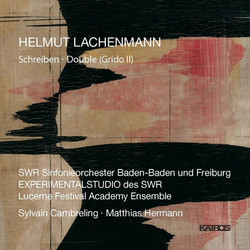
Schreiben
** In process of stocking ** If music’s relationship with reality is to be more than just a theoretical presumption, it cannot be limited merely to work titles, comments, dedications or quotations, but must also extend to permeate all musical dimensions: material, structure, form and content. And from the very beginning, Helmut Lachenmann has propagated the idea of a work that is based on the integral cohesiveness of all levels. For Lachenmann, thinking here in the tradition of Theodor W. Adorno…

Kaleidoscope
** In process of stocking ** Kairos presents Kaleidoscope by Eunho Chang. Born 1983 in Daegu, Republic of Korea, Eunho Chang began his musical studies with piano lessons at the age of seven. He studied composition at the Keimyung University, Fryderyk Chopin University of Music and obtained his PhD in musical composition at the Fryderyk Chopin University of Music under the supervision of professor Marcin Błażewicz. He has been selected for various workshops and masterclasses, such as Impuls Acade…

Dr. Futurity
Kairos presents Dr. Futurity by Bernd Richard Deutsch. Dr. Futurity for 16 instruments is the last and most complex of three works that were written in immediate succession (the other two works are Mad Dog and the 2nd String Quartet) and— to conceptual, musical and dramaturgical similarities—could be united to form a triptych. The new piece is divided into three movements: I. ...trip – from Mars to here II. Chimaera III. Red Alert! Although the character of the score is often orchestral, several…

Orchestral works
José M. Sánchez-Verdú was no more than 35 years old when Spain, his homeland, awarded him its national prize. That is certainly the highest distinction he has received thus far, but is by no means the only one. Three years earlier the Ernst von Siemens Music Foundation awarded him a composition prize and he has also received numerous other prizes in Spain, Germany, Japan and Latin America. His catalogue raisonné includes more than 120 works, he teaches composition at the Music University in Düss…

Scelsi Revisited
In the project Scelsi Revisited the tape material is for the first time reflected in the medium of art: seven composers (Ragnhild Berstad, Georg Friedrich Haas, Fabien Lévy, Tristan Murail, Michael Pelzel, Michel Roth, Nicola Sani) were commissioned by Klangforum Wien to create new works from Scelsi’s tape music; Uli Fussenegger had prepared data packages consisting of excerpts from two to three tapes each, which Scelsi apparently had not used for the elaboration of definitive works, the latter …

Flute and Bass
Kairos presents Flute and Bass, a Bernhard Lang's composition performed by Manuel Zurria on Flute and Dario Calderone on double-bass. Recording Date: 4 Nov 2018 & 16 May 2020. Recording Venue: tudioZ, Amsterdam/Netherlands. The work of Austrian composer Bernhard Lang (b. 1957) is difficult to fit into any one musical category. His oeuvre references a wide variety of musical styles and genres, ranging from free jazz and improvisation to hip hop and DJ culture. The three works on this release show…

Les Soliloques décortiqués
Les Soliloques décortiqués for 16 musicians is dedicated to the musicians performing this piece. Each instrument is a soloist for 90 seconds, time dedicated for him or her to experiment with instrumental techniques that I consider rather “daring”. Meanwhile, the other 15 instrumentalists try to put the soloist’s “discoveries” on their own instrument. - Vinko GlobokarVinko Globokar (born 7 July 1934) is a French-Slovenian avant-garde composer and trombonist. Globokar's work is noted for its use o…
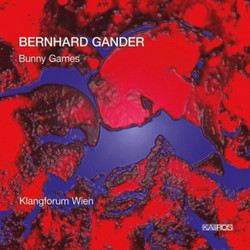
Bunny Games
Bunny Games is not only semantically loaded by the solo passages in the foreground in which the instruments constantly seek to draw attention to themselves, but also through references to the music of Domenico Scarlatti and Edgar Varèse as well as the Madonna numbers “Nothing really matters and Hangup”, the latter a cover version of the ABBA song “Give me a man after midnight.” The relation to popular music, which - between the lines - was always present with Bernhard Gander breaks through conti…

Iridescent Notation
Kairos presents Iridescent Notation by Samuel Andreyev. Recording Date: 22-27 Sep 2018. One of the most compelling voices to have emerged from the Canadian new music scene in the last decade is that of Samuel Andreyev. His music is equally communicative. The new disc offers half a dozen pieces which span his entire career. Luigi Gaggero conducts various combinations of the Ukranian Ukho Ensemble and provides an interesting booklet note which wavers between helpful explanation and subjective refl…

Noch sind wir ein Wort
I would like to refer to Annette Bik’s project Bach gedoubelt, which was the origin of this piece, putting Bach’s b-minor partita, BWV 1002, in direct context with contemporary musical comments. Bach wrote so-called “Double” movements to the standard dances Allemanda, Corrente, Sarabande and Tempo di Borea, connected to the original as a kind of variation. Annette Bik commissioned four composers to write such “Double” movements to the four main movements of the Partita. This lead to four contemp…

Makrokosmos I-III
Makrokosmos Volume I, whose title reflects Crumb’s admiration for Bartók’s piano series Mikrokosmos, contains 12 pieces, grouped into three parts of four each, and Crumb associates each piece with a sign of the zodiac. This is paired with Volume II, which is similarly structured, after the fashion of Debussy’s twenty-four Préludes. Volumes I and II are filled with references to the history of humankind, myths, Christianity, paganism, occultism, literary works, and the composer’s own mental pictu…
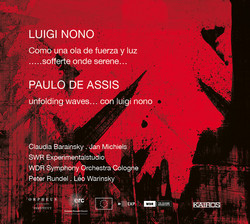
Como una ola de fuerza y luz - Unfolding Waves
Between April and June 1971, after the democratic election of Salvador Allende’s government, Luigi Nono visited Chile for three months, meeting several artists, composers and politicians, among whom was Luciano Cruz Aguayo, one of the leaders of the Movement of the Revolutionary Left (MIR, Movimiento de Izquierda Revolucionaria). Back in Italy, Nono started working on his next musical composition, which was meant to be a piece for piano and orchestra, for Maurizio Pollini and Claudio Abbado. In …
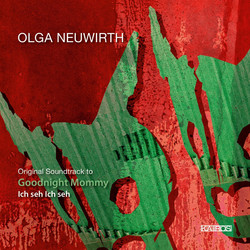
Original Soundtrack to "Goodnight Mommy"
** In process of stocking ** Written and directed by Veronika Franz and Severin Fiala in 2014, Goodnight Mommy (original title: Ich seh Ich seh) received outstandingly wide and positive international reviews. Even the two-minute trailer to this movie is dominated by Olga Neuwirth’s sounds, and the online journal dvd-forum.at when reviewing the cinema premiere particularly noted that Goodnight Mommy was “accompanied with mesmerizing music by Olga Neuwirth.” The fact that this is only partially tr…
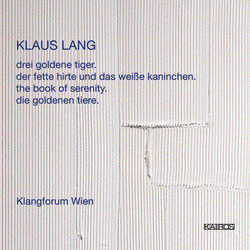
The Book Of Serenity
It was Ludwig Wittgenstein, another Austrian, who already in his debut work identified the borders: in his opinion, he wrote in the preface to his Tractatus logico-philosophicus, he had “essentially resolved” those problems accessible to rational thought, and precisely that would demonstrate “how little is achieved that these problems are resolved.” Even greater emphasis is lent to this insight in the famous sentence with which Wittgenstein closes his Tractatus not even a hundred pages later: „W…