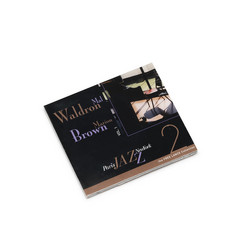
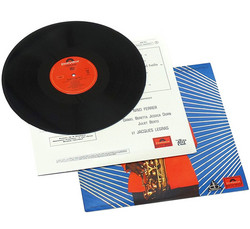
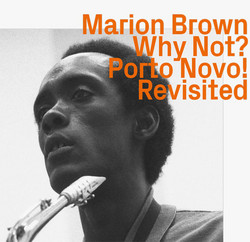
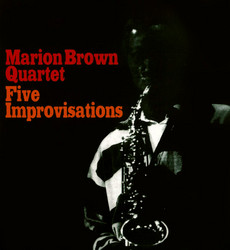
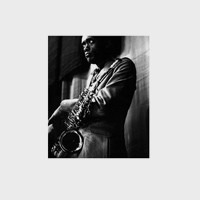
** First time reissue! Gatefold sleeve with liner notes and photos, insert ** Marion Brown – Awofofora resurfaces a long‑obscured chapter from the alto saxophonist’s most exploratory decade. The 1970s found Marion Brown moving beyond the eruptive free jazz that had first brought him attention, toward what he called “a more deliberate kind of music that had more structure to it.” After relocating from New York to Europe in 1967, he began pacing his pieces so that moods and modal frameworks could unfold gradually, treating rhythm as the primary organising force and harmony as a more recessive colour. Albums like In Sommerhausen, Afternoon of a Georgia Faun, Geechee Recollections and Sweet Earth Flying map this shift, revealing a composer increasingly focused on orchestrating interlocking rhythmic parts the way one might assemble polyphonic lines.
Released in 1976, Awofofora belongs squarely in that continuum, even if it was misunderstood on arrival. Its overt use of funk and reggae beats, electric guitars and grooves drawn from contemporaneous Black popular music led some listeners to file it next to jazz‑rock flirtations of the era. In hindsight, the record reads less as a detour than as a logical extension of Brown’s structural concerns. As he admired in the Art Ensemble of Chicago, the impulse here comes from within the community: rhythms and feels circulating in Black dancehalls, clubs and street parades are abstracted, recombined and re‑voiced according to Brown’s own internal logic rather than simply adopted as surface style.
The opening piece, “La Placita”, makes its first recorded appearance here and sets the tone. Distinct rhythmic phrases are layered in a way that echoes African drum choirs: overlapping cycles create a shifting grid, a living ground rather than a static backbeat. Over this, Brown and trumpeter Ambrose Jackson spin long, supple improvisations, their lines sometimes in tight dialogue, sometimes splintering off at oblique angles yet always tethered to the underlying polyrhythmic engine. Elsewhere, the standard “Flamingo” is gently but decisively transformed. Its familiar melody is threaded through diasporic rhythm and re‑accented by the band’s collective phrasing, allowing Brown’s lyrical alto to float between recognition and renewal.
“Pepi’s Tempo” and “Mangoes” lean more explicitly into crisp funk and reggae inflections, but again the point is not stylistic cosplay. Brown treats these grooves as frameworks for what he once described as a “manifestation of community”: the band’s collective improvisation turns each track into a miniature social space, where roles are elastic and attention is shared. Guitar, bass, drums and horns continually renegotiate foreground and background, with riffs rising, dissolving and reappearing in altered form. Even the overdubbed solo feature “And Then They Danced” reflects his structural thinking. Originally conceived as a duet for two alto saxophones, it is here realised by Brown alone, re‑voicing both parts in the studio so that call and response, unison and divergence all emerge from a single instrumental personality.
Historically, Awofofora is also the lone recorded document of a short‑lived band that caused consternation at festival appearances in 1976. Audiences expecting the “fire music” Brown had once been associated with sometimes bristled at the presence of backbeats and electric textures; others were unsettled by the way the group refused to conform to either straight‑ahead jazz or fusion categories. Brown, however, remained consistent in his aims. Across changing ensembles and sonorities, he kept returning to the same principles: rhythm as structure, melody as architecture, collective improvisation as a form of social practice, and above all, the primacy of tone. His sound – burnished, slightly rough at the edges, deeply human – remains the thread that ties together early free‑blowing sides and later, more rhythmically anchored work.
Reissued now for the first time, Awofofora can finally be heard as the vivid synthesis it always was. Rather than an outlier, it stands as a crucial link between Brown’s 1960s breakthroughs and his later explorations, a record where the lessons of Europe, the American South and the global Black Atlantic converge in grooves that feel both grounded and gently uncanny. Its layered beats, diasporic inflections and glowing alto lines embody music “drawn from life and from the world of experience” – full of movement, history and the quiet insistence of a voice still searching for new ways to sing.
| A1 | La Placita | ||
| A2 | Flamingo | ||
| A3 | Pepi's Tempo | ||
| B1 | Mangoes | ||
| B2 | And Then They Danced | ||
| B3 | Vista '76 |
- Marion Brown
- Alto Saxophone
- Fred Hopkins
- Bass
- Shoichiro Ono
- Consultant [Technical Consultant]
- Toshinori Goshono
- Design [Album Designer]
- Chris Henderson
- Drums
- David Stone
- Engineer
- Kathy Dennis
- Engineer [Assistant Engineer]
- Rene Arlain
- Guitar
- Billy Patterson
- Guitar, Bass Guitar, Lithography [Textural Colorations]
- Ruy
- Lacquer Cut By
- Jeroen Wille
- Layout [Cover Reconstruction], Design
- Ed Hazell
- Liner Notes
- Ed Blackwell
- Percussion
- Juuma Santos
- Percussion
- Gail Brown
- Photography By [Photographer (Cover Photo)]
- Edward Cohen
- Photography By [Photographer]
- Yoshio Ozawa
- Producer
- Ambrose Jackson
- Trumpet