Mega Tip! After six albums dedicated to refracting the music of Ahmed Abdul‑Malik, أحمد [Ahmed] - the quartet of Pat Thomas, Seymour Wright, Joel Grip and Antonin Gerbal - turn their attention to Abdul‑Malik’s one‑time bandleader, Thelonious Monk, in their ongoing search for “future music.” Monk and Abdul‑Malik are more than historical neighbors. In the late 1950s, Abdul‑Malik worked in Monk’s quartets, appearing on Thelonious in Action and Misterioso (both 1958) and on the long‑buried Thelonious Monk Quartet with John Coltrane at Carnegie Hall. Beneath the surface of those recordings lies a shared project: a radical engagement with time that refuses a simple linear trajectory, offering instead sites of synthesis and rupture where fragments of history can be scattered, recombined and heard anew.
That core idea - time as something to be grasped, folded and re‑layered rather than merely counted - has always been central to Ahmed. Over several decades, all four members have wrestled with Monk’s music in their own ways, solo and in other groups, but Play Monk is the first time their collective investigations into his work have been formally documented. Recorded at London’s Fish Factory studio over the same three‑day sessions that produced Sama’a (Audition), the album traces a line back to a spontaneous, explosive rendition of “Evidence” in Novara, Italy, in 2023. What began there as a single, unplanned leap into Monk’s universe has now unfolded into a sustained, two‑disc immersion.
Across 2CDs, Ahmed atomise Monk’s “standards,” treating each composition less as a fixed text than as a dense bundle of melodic, harmonic, rhythmic and spatial possibilities. Themes are shattered into cells, voicings stretched and inverted, bar lines smudged until they register as pulses rather than fences. In their hands, Monk’s familiar gestures become complex vernacular forms - shared languages that can be bent, mispronounced, spoken backwards. Each piece turns into what the band describe as a “shifting quantum time artifact”: something that holds multiple versions of itself at once, flickering between eras and potential futures.
Into the fissures of Monk’s forms, Ahmed pour their own history of listening and play. Duke Ellington’s elegance, Cecil Taylor’s explosive pianism, Caribbean diasporic musics, the long arcs of European free improvisation, and the thunderous sound system meditations of Jah Shaka all collide and dance inside these performances. Thomas might stretch a Monk voicing until it resembles a Taylor cluster; Wright’s alto lines can pivot from Bechet‑like lyricism to pure noise; Grip and Gerbal drive and fracture time with a logic that owes as much to dub and Sufi trance as to bebop. The result is not a collage of references but a living, spiralling continuum where swing, dhikr, skank and free jazz share the same pulse.
“Monk’s music is not played so much as grasped, condensed and catapulted through the vagaries of time,” writes Fielding Hope in the accompanying notes. The image fits. Monk famously danced in circles at the side of the stage; here, Ahmed chase that circling impulse to its limits, using repetition and elongation to shake loose the “numerical bind” of four‑square counting. Themes may loop for long stretches, but each revolution is slightly skewed, tugged forward or sideways by micro‑decisions in touch, dynamics and density. What could be mere vamp becomes, instead, a vehicle for collective levitation. There are moments when the music feels like it could float forever, suspended between past and future.
Play Monk is not a tribute in any conventional sense. It is an argument that Monk’s compositions remain among the most fertile terrains for new jazz, provided they are treated not as relics but as devices - machines for thinking about time, community, dissonance and joy. By routing them through Abdul‑Malik’s legacy, Sufi concepts of listening, Caribbean bass culture and the high‑wire practices of European free improvisation, Ahmed make good on their promise to seek “future music” in the archive. The result is a body of work that honours Monk’s radical spirit not by preserving it in amber, but by submitting it to the same process of imaginative risk and reinvention that defined his art in the first place.
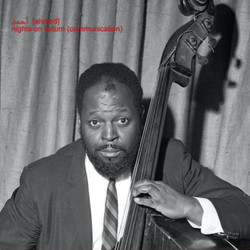
GHatefold, reverse board 2CD designed by Maja Larrson. Cover photograph of Thelonius Monk at Fisherman's Wharf in San Francisco in 1968 by Baroness Pannonica de Koenigswarter. Inside photographs of حمد [Ahmed] by Stefan Lacandler. Recorded and mixed by Benedic Lamdin on Saturday 1st and Sunday 2nd March, 2025 at Fish Factory Studios, London. Mastered by Andreas LUPO Lubich. Produced by Seymour Wright/OTOROKU.





![[AHAD]/[WAHID]](https://cdn.soundohm.com/data/products/2022-12/-AHAD-jpg.jpg.250.jpg)
![Super Majnoon [East Meets West]](https://cdn.soundohm.com/data/products/036/ahmed-super-majnoon-east-meets.jpg.250.jpg)