Tip! Connecters Vol. 1: Original Recordings, 1992–1999 opens a door onto the private universe of Larrison – the recording alias of Midwestern visual artist and musician Larrison Seidle – and lets three decades of secret music finally breathe. Working alone with a single Casio CZ‑5000 in the early 1990s, Seidle composed, programmed and recorded at home, treating the keyboard’s eight‑track sequencer and phase‑distortion engine as both laboratory and playground. The pieces collected here, newly restored and mastered from original sources, sketch a parallel history of early‑90s electronic music: 26 compact “space age pop” vignettes filled with hypnotic, ebullient synth melodies that constantly reconfigure themselves, side‑step trends and quietly transcend their moment.
Seidle’s path into this world began far from any recognised scene. Growing up in the working‑class Indianapolis suburb of Greenwood in the 70s and 80s, he didn’t come from a family of musicians, but from a household that encouraged musicality in small, crucial ways. His father bought an electric organ imagining that Larrison and his older brother would learn to play; instead, it was the father who sat at the keys at night, spinning a single made‑up song over and over, its first few bars still etched in Larrison’s memory. That combination of no formal training and total permission to dabble would shape his approach for years: music as something you simply start making, with whatever is at hand, long before you have a name for it.
Alongside the expected classic rock records, the Seidle living room played host to 35mm educational documentaries borrowed from the library, their images accompanied by whimsical instrumental cues that lodged in Larrison’s ear. As a teenager he recorded John Carpenter and Alan Howarth’s end theme for Escape from New York by holding a small cassette recorder to the TV speaker, and fell in love with Tangerine Dream’s darkly luminous score for Legend. These largely wordless, synthesizer‑driven soundtracks seeded an idiosyncratic sense of what music could do: not just mirror what you see, but hint at what’s happening in the recesses of consciousness.
In 1985, at thirteen, Seidle persuaded his father to buy him a Casio CZ‑5000. For years it remained a novelty object, much like the organ before it. Only after graduating high school in 1991 and enrolling at the Herron School of Art in Indianapolis did he stumble on the instrument’s built‑in sequencer and begin recording his own pieces to tape. “The CZ‑5000 and its 8 track sequencer is the only musical instrument I used. It has a nearly unlimited new sound creation feature,” he later explained. Discovering that he could design waveforms, envelopes and tunings inside the machine effectively meant he was inventing new “instruments” each time he wrote a song.
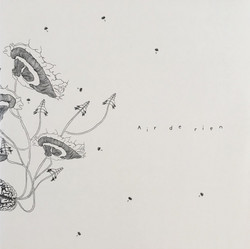
Herron also connected him to a wider sonic world. A campus concert led to a friendship with sound artist Michael Northam, who introduced Seidle to Severed Heads, Throbbing Gristle, Roger Doyle and other DIY electronics and industrial outliers. Before long, Northam had convinced him to move to Austin, Texas, then a hive of experimental art and music. They initially crashed with Daniel Plunkett, editor and publisher of ND, a globally circulating magazine devoted to cassette culture and underground sound. In a small apartment north of downtown, with little money but a surfeit of intuition, Seidle set to work: over several months in late 1993 and early 1994 he wrote and recorded a suite of CZ‑5000 pieces, hand‑drew a colourful insert in which some titles were rendered as lines or arrows, and submitted the resulting cassette, titled Connecters, to ND for review.
That single tape disappeared into a pile of roughly 1200 submissions received during ND’s run from 1982 to 1999, and might have stayed there. Decades later, Freedom To Spend co‑founder Jed Bindeman acquired the archive and began the painstaking task of listening through the collection. “I was getting major ear fatigue listening to the tapes in this collection,” he recalls. “But then I put on Larrison’s Connecters and was immediately like, ‘Whoa! What am I listening to?’ Beginning to end, the tape was just fantastic.” Connecters Vol. 1 presents music from that cassette alongside additional recordings from Seidle’s 1990s explorations, forming a broad but coherent survey of his instrumental practice.
Operating under what many would consider a severe limitation – one keyboard, one sequencer, no outboard gear – Seidle developed technically inventive ways of abusing and extending the CZ‑5000’s architecture. By manipulating waveforms, envelopes and key ranges via phase‑distortion synthesis, he effectively designed bespoke instruments in real time, then used them to build songs that are by turns lo‑fi and symphonic. Some tracks shimmer like budget sci‑fi cues, others pulse with motorik arpeggios or dissolve into soft, pointillist chords. Throughout, there’s a sense of someone playing with sound as a child might: turning knobs just to see what happens, following delight and curiosity rather than genre templates.
That experiential quality makes Connecters Vol. 1 resistant to easy categorisation. It brushes up against ambient, early techno, new age and library music without settling comfortably into any of them. What holds it together is Seidle’s will to transform limited tools into a personal language. The music carries a quietly enchanted mystique, as if each piece were both a self‑contained world and a fragment of a larger, unspoken narrative. Hearing it now, thirty years after the fact, underscores how personalised production methods can bend time: these tracks sound unmistakably of their era yet strangely outside it, like memories resurfacing with unexpected clarity.