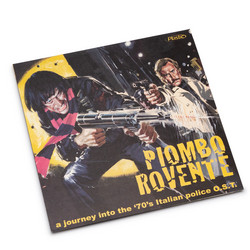
Daniela Casa, Bruno Battisti D'Amario, Berto Pisano, Stefano Torossi
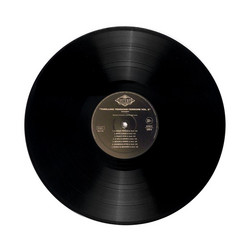
Masoch Club Entertainment (LP)
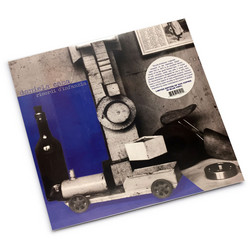
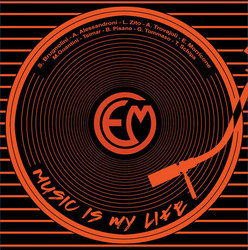
Hammond organs swirl through sun-drenched compositions. Wah-wah guitars dance with bossa nova rhythms. Edda Dell'Orso's ethereal vocals drift over psychedelic instrumentals. This is Masoch Club Entertainment, one of the finest compilations ever issued by Plastic Records - a swinging assemblage of mod numbers, funky groovers, and jazzed-up instrumentals that collectively define the sound of Italian easy listening at its most sophisticated. Compiled by Dave Masoch with liner notes by Michael Myers and artwork by Free Spirit And Masoch Ent., this 18-track collection excavates the vaults of Italian production music libraries from the late 1960s and early 1970s, offering essential listening for anyone interested in the golden era when session musicians moved fluidly between backing pop stars, scoring films, and creating anonymous works of genuine artistry for television and advertising.
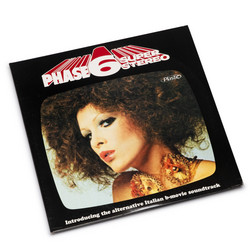
The compilation opens with "Spiaggia Libera," a beachside groove from Paolo Ormi (1936-2013), the Florentine maestro who served as arranger and orchestra director for Italian television throughout the 1970s and 80s and is best remembered as the personal arranger and conductor for Raffaella Carrà and Rita Pavone. His work appeared in Quentin Tarantino's Kill Bill: Vol. 2 through his conducting of Nora Orlandi's "Dies Irae 2" from Lo strano vizio della Signora Wardh (1971). The Vedette Records connection runs deep throughout this compilation: Armando Sciascia (1920-2017), who founded Vedette in 1962 after graduating from the Conservatory of Pesaro and playing first violin with RAI, appears here with "Vine Street." Sciascia launched the careers of I Pooh and Equipe 84, became the first Italian label to release The Doors domestically, and created the innovative Phase 6 Super Stereo series. His artistic director at Vedette was Francesco Anselmo, the keyboardist who appears twice on this compilation under his pseudonym Lee Selmoco ("Quiet River" and "Chemin De Fer") and once more as Pinto Varez ("Hippy Tree") - just two of the many aliases (including Dorsey Dodd, Alex Brown, and Arsenio Bacco) that Anselmo used throughout his career. His 1971 album Mosaico for Vedette features killer electric organ grooves alternating with fuzzy guitars and spacey psychedelic passages, written alongside Guido Baggiani.
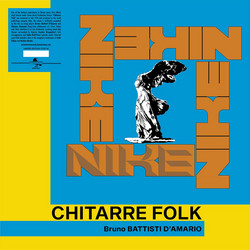
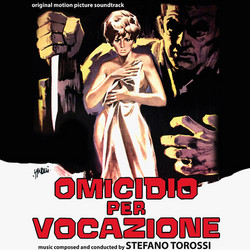
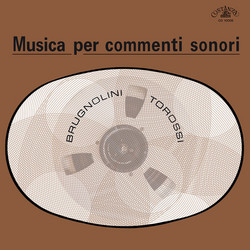
Stefano Torossi, born in Rome in 1938, contributes "Vela," bringing his classical training at the Conservatory of Rome and his time studying in Massachusetts at Williams College - where he briefly played in the college rock band Hap Snow's Whirlwinds - to the Italian library music scene. Drawn to Bach, Mozart, and Stravinsky from an early age, Torossi began playing double bass with The Flippers before transitioning to composing for RAI in the 1960s, eventually releasing more than two dozen albums for Costanza Records. His soundtrack for Omicidio per vocazione (1967) featured the legendary singer Edda Dell'Orso, whose unmistakable voice also graces this compilation on the closing track "Playa Sin Sol" by Bruno Battisti D'Amario. D'Amario, born in Rome in 1937, became Ennio Morricone's favorite guitarist - Morricone stated he was "able to conjure up extraordinary sounds with his guitar" - and his performances grace The Good, the Bad and the Ugly before he became Professor of Classical Guitar at the Santa Cecilia Conservatory. He contributes both "Show Samba" and the Dell'Orso collaboration, having studied composition with Domenico Guaccero, Morricone himself, and Gianfranco Pernaiachi, while also joining the experimental Gruppo di Improvvisazione Nuova Consonanza.
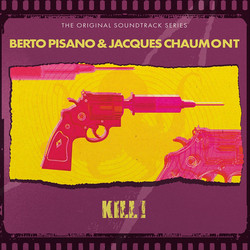
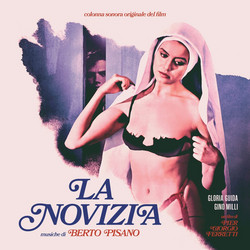
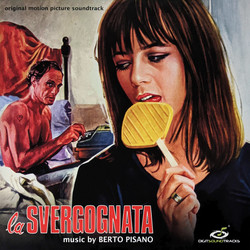
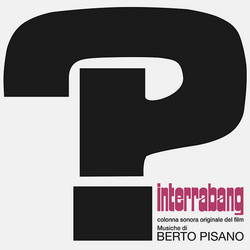
The Sardinian connection emerges through Berto Pisano (1928-2002), born Umberto Pisano in Cagliari, who began as a jazz double bassist with Quartetto Astor and Orchestra Gli Asternovas before becoming a sought-after songwriter for Mina and Edda Dell'Orso. The younger brother of composer Franco Pisano, Berto (sometimes credited as Burt Rexon) scored over fifty films including Kill! Kill! Kill! Kill! (1971) and Death Smiles on a Murderer (1973); his "Il Colore Degli Angeli" demonstrates his gift for evocative mood pieces. Italy's premier backing band I Marc 4 returns with two contributions: "There's A River" and "Slow Down." Originally formed by RAI orchestra musicians circa 1950, the quartet's name derived from the initials of its members - Maurizio Majorana (bass), Antonello Vannucchi (Hammond organ, piano), Roberto Podio (drums), and Carlo Pes (guitar) - though sometimes the "A" stood for Armando Trovajoli, with whom they recorded I Solisti Di Armando Trovajoli in 1969. Combining beat music, jazz, bossa nova, psychedelic rock, and funk, I Marc 4 defined the sound of 1970s Italian soundtracks while working as session musicians for Morricone, Nino Rota, Piero Piccioni, and Piero Umiliani.
"Arcipelago" comes from The Underground Set, a band long thought to be English due to their albums appearing across European markets. In fact, as revealed by drummer Paolo Siani in Italy's Musikbox magazine, the musicians were actually members of Nuova Idea, working pseudonymously because Radio Records was distributed by Nuova Idea's label Ariston. Gianfranco Reverberi (1934-2024) and his brother Gian Piero were driving forces behind the so-called "Genoese School" of singer-songwriters that included Luigi Tenco, Gino Paoli, Bruno Lauzi, and Fabrizio De André; the Reverberi Orchestra's "Maledettamente Donna" captures the sophisticated arrangements that Gianfranco developed while producing at Ricordi and CGD, where he launched the career of Piero Ciampi and later introduced Lucio Dalla and Nicola Di Bari to Italian audiences at RCA. The Reverberi brothers' biggest success came with the soundtrack for Preparati la bara! (1968), famously sampled by Gnarls Barkley for their hit "Crazy."
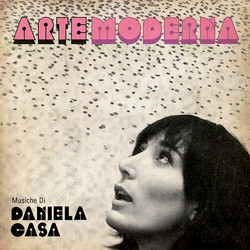
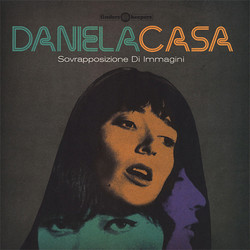
Perhaps the most remarkable story belongs to Daniela Casa (1944-1986), credited here with the masculine spelling "Daniele," a genuine pioneer of experimental pop, abstract electronics, and giallo jazz who stands as one of Italian library music's few prominent female composers. Born in Rome, she began as a singer with Fonit in 1963 before forming the duo Dany & Gepy at the famous Piper Club in 1965. In the 1970s, she composed at her home studio using a Roland 808 and Yamaha DX7, providing scores for Italian thrillers, nature documentaries, and commercials. Her 1975 library LP Società Malata remains a cult classic. Casa married musician Remigio Ducros and formed the hippie pop group Mariposa in 1977, but died tragically of breast cancer at age 42 in 1986. Her playfully titled "Kentucky Fried Chicken" here offers a glimpse of the wit and inventiveness she brought to the Italian library scene.
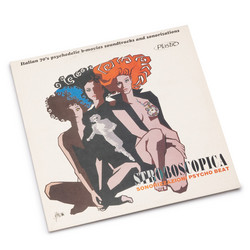
"Italian 70's psychedelic b-movies soundtracks and sonorizations" as subtitle. On tracks A2, A7, B2 and B6, artist name is given as the title of the compilation
| A1 | Spiaggia Libera | ||
| A2 | S.O.S Z2 | ||
| A3 | Hippy Tree | ||
| A4 | Kentucky Fried Chicken | ||
| A5 | Un Moscovita A Roma | ||
| A6 | There's A River | ||
| A7 | Maledettamente Donna | ||
| A8 | Il Colore Degli Angeli | ||
| A9 | Quiet River | ||
| B1 | Rock Drill Shake | ||
| B2 | Arcipelago | ||
| B3 | Vela | ||
| B4 | Vine Street | ||
| B5 | Breid 115 | ||
| B6 | Show Samba | ||
| B7 | Chemin De Fer | ||
| B8 | Slow Down | ||
| B9 | Playa Sin Sol |