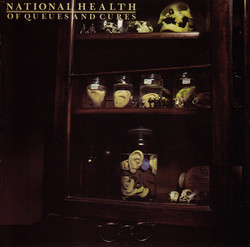
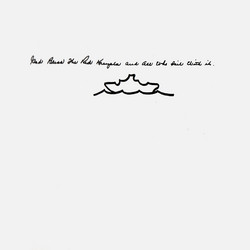
First-ever vinyl reissue. Half-speed mastered. By the time National Health entered Ridge Farm Studio in July 1978 to record their second album, the Canterbury scene was already supposed to be over. Soft Machine had splintered. Caravan had gone pop. Hatfield and the North, whose final line-up supplied three-quarters of National Health's core, had disbanded two years earlier. And yet here, at the supposed tail end of a movement, four musicians produced what many consider its single most fully realized statement - an album of such compositional wit, rhythmic audacity, and sheer ensemble intelligence that it made everything that came before sound like a warm-up.
The line-up tells the story. Dave Stewart on organ, electric piano, and minimoog - the architect, the man whose restless harmonic imagination had already driven Hatfield to its limits and would soon carry him into Bruford's orbit. Phil Miller on guitar, threading lyrical lines through the most complex metric shifts with the ease of someone humming in the shower. Pip Pyle on drums, whose polyrhythmic sense owed as much to Elvin Jones as to anything in the prog tradition. And the crucial addition: John Greaves on bass, arriving directly from Henry Cow and bringing with him a rigour, a weight, a compositional seriousness that tilted the band's centre of gravity toward something new. The Canterbury playfulness was still there - it never left - but now it had to coexist with a darker, more structurally ambitious impulse. The tension proved extraordinarily productive.
The guest list deepens the picture further. Georgie Born, also from Henry Cow, contributes cello across four tracks, her lines weaving through the ensemble with a chamber-music precision that pulls the sound away from rock entirely. Jimmy Hastings adds clarinets, bass clarinet, and flute. Phil Minton brings his trumpet. Paul Nieman plays trombones. Keith Thompson, oboe. And on "The Collapso" - a piece that earned the unforgettable description of Stravinsky meeting calypso - Selwyn Baptiste's steel drums crash into the composition like sunlight through a Gothic window. Peter Blegvad, of Slapp Happy, delivers a characteristically deadpan spoken-word passage on "Squarer For Maud." The record is a meeting point, a crossroads where the Canterbury scene's melodic generosity collides with the European avant-garde's structural ambition - and, miraculously, both survive intact.
What holds it all together is the writing. "The Bryden Two-Step (For Amphibians)," which bookends the album across its two parts, is among the most episodic, unpredictable, and thrilling long-form compositions in the Canterbury canon - nine minutes that contain more ideas, more shifts of texture and mood, than most bands manage across an entire career. "Dreams Wide Awake" opens with some of the wildest organ playing Stewart ever committed to tape before dissolving into something entirely different. "Binoculars," with its vocal and emotional directness, cuts through the album's complexity like a blade. And underneath it all, a humour that is quintessentially, irreducibly English - present in the song titles, in Stewart's legendary liner notes, in the very names the band gave to its members' instrumental roles ("breakage," "crooning," "piano innards").
The original 1978 Charly Records pressing - famously issued with a typographical error on the label, reading "Of Queues And Qures" - has long been a sought-after item. No vinyl reissue has ever followed, until now. This half-speed mastered edition, released by Charly Records for Record Store Day 2026 following the success of last year's RSD reissue of the debut, reveals the album's extraordinary depth of detail as never before - every strand of Stewart's organ voicings, every flutter of Hastings' clarinet, every precisely calibrated collision between Pyle's drums and Greaves' bass lines, brought into sharp, luminous focus.
The last great flowering of a scene that changed everything. Finally back on vinyl, sounding better than it ever has.