Two vocal works by Walter Zimmermann on literary texts: Singbarer Rest for nine high female voices and sampler, after Edmond Jabès, and Die Blinden, a static drama after Maurice Maeterlinck for twelve singers and nine instruments. Both work with stillness and reduced action, and the second fills most of the disc at fifty-five minutes.
Zimmermann was born in 1949 in Schwabach, in Middle Franconia. He studied composition with Werner Heider and Mauricio Kagel, attended the Institute of Sonology in Utrecht and studied computer music at Colgate University. After teaching composition in Liège (1980 to 1984) and Karlsruhe (1990 to 1992), he was professor at the Berlin University of the Arts from 1993 to 2014. Franconian folk material runs through his Lokale Musik cycle. In 1976 he published Desert Plants, conversations with 23 American musicians, and from 1977 to 1984 he ran the Beginner Studio in Cologne, a venue for regular new-music concerts. His books include Insel Musik (1981), and in 1992 he co-organised the Anarchic Harmony festival in Frankfurt for John Cage's eightieth birthday. The performers here are the Neue Vocalsolisten Stuttgart and the Junges Philharmonisches Orchester Stuttgart, conducted by Manfred Schreier.
Singbarer Rest (Singable Residuum) dates from 1993. Its text is the "Dialogue of the Two Roses" from Jabès's Le Livre des Questions, and the nine high voices are set against a sampler. Die Blinden was composed in 1984 after Maeterlinck's play Les Aveugles. Zimmermann drew deliberately on Maeterlinck's theatrical revolution and its anti-dramatic radicalism, and the result is a static drama, music theatre without plot development.
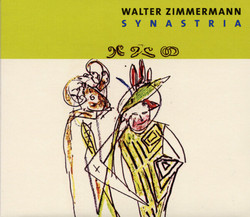
Zimmermann is linked to the so-called Cologne school, and both works share an attention to texts that resist dramatic development. Die Blinden won the Prix Italia in 1988, and Zimmermann received the Schneider-Schott Music Prize the following year. The cover is by the artist Nanne Meyer, his wife, and the disc comes with a 42-page booklet with liner notes in German and English by Henning Weidemann and Manfred H. Wenninger.
CD, Wergo WER 6510 2, released in 1996 in the Edition Zeitgenössische Musik of the German Music Council.