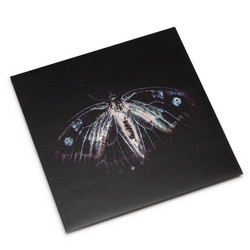
With Sonnailles, Franck Vigroux returns to raster by stepping further onto the fault line between sound art and sheer physical assault. Framed as a sequence‑driven work, the album eschews amorphous drift in favour of sharply delineated passages that click forward with a kind of mechanical inevitability. Each track functions like a chamber of pressure, defined by grids of rhythm and pulse that are constantly stressed, broken and rebuilt. Within these tightly structured architectures, shards of human voice appear not as narrative anchors but as ghostly intrusions, drifting in and out of view like memories half‑remembered or intercepted transmissions. They do not explain; they haunt. Those vocal fragments become crucial to the album’s peculiar tension. Set against Vigroux’s dense electronic fields - saturated bass, corroded mids, high‑frequency whine - they register almost as hallucinations.
A syllable here, a breath there, a phrase warped beyond legibility: these traces puncture the abstraction just enough to remind you that a body is implied, even when absent. As they flash through the mix, they amplify the music’s sense of forward drive, triggering changes in texture or rhythm, tilting the emotional temperature from menace to melancholy in a few seconds. The voices never dominate the compositions, but their spectral presence sharpens every contour around them. At the core of Sonnailles lies a deliberate and productive collision. On one side, there is raw, almost primitive sonic force: rough‑hewn bass tones that feel gouged out rather than synthesised, drum patterns that thud and clatter with a blunt, percussive insistence, textures that scrape at the threshold of distortion. On the other, there is unmistakable compositional sophistication: micro‑adjusted dynamics, carefully staged drops in density, intricate layers of detail that only reveal themselves on repeat listens. Vigroux uses this friction as his main engine, asking how far he can push immediacy and impact without relinquishing the hyper‑controlled sound design that has defined his work for years. The answer is a music that feels both rigorously constructed and permanently on the verge of eruption. The genesis of the album sits outside the usual experimental art‑music bubble.
Two atypical invitations - a rock and punk festival in France and a run of techno‑oriented club performances in China - forced Vigroux to think differently about function. Instead of treating the audience as a seated, contemplative presence, he had to imagine sound as something that needed to grab bodies first, then work on minds. Sonnailles bears the imprint of that shift: tempos lean into dance‑floor vectors, grooves lock in with a more frontal urgency, breakdowns and build‑ups are shaped with an ear for physical response as much as timbral nuance. Yet this is not an attempt to “do techno” or “go rock”; it’s a translation of those environments’ energy into Vigroux’s own grammar, where even the most propulsive moments carry a residue of instability and threat. For an artist who has long worked with dancers and devised interdisciplinary performances marked by radical physicality, this turn toward body‑oriented structure feels less like a diversion than a convergence. Offstage, Vigroux’s collaborations with choreographers and visual artists have continually probed the relationship between sound pressure, gesture and light. On Sonnailles, those parallel practices fold back into the studio work: you can hear choreography in the way rhythms pivot, in how blocks of noise enter like stage elements, in the tension between repetition and rupture. The album effectively closes a circle in his ongoing exploration of sound and movement, rendering that relationship audible without the need for a visible performer.
In the end,
Sonnailles is an album of collisions resolved not into compromise but into a new kind of clarity. It captures a composer known for his severity embracing the demand that music must move, then asking what happens when that demand is pushed to its limit. The result is a record that lives at the intersection of club impact and experimental austerity, where sequences grind forward, voices flicker like ghosts, and every frequency seems tuned to the point at which the body starts to react before the brain can name what it’s hearing.
| A1 | Mordor | 8:46 | |
| A2 | Dancer | 10:43 | |
| B1 | Gabales | 5:01 | |
| B2 | La Porte Du Paradis | 6:36 | |
| C1 | Plein Soleil | 8:30 | |
| D1 | Videopolis | 4:55 | |
| D2 | Elvis | 5:13 |