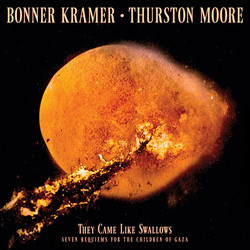
Bonner Kramer, Thurston Moore
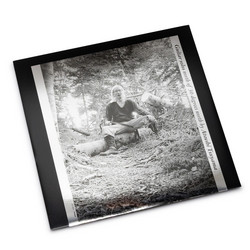
They Came Like Swallows - Seven Requiems for the Children of Gaza (LP)
They Came Like Swallows – Seven Requiems for the Children of Gaza is the first full‑length collaboration between Bonner Kramer and Thurston Moore, and it arrives already bearing the weight of a shared history. Friends for nearly forty‑five years, veterans of parallel undergrounds, they finally found their schedules aligning in South Florida, far from their New York origins. The setting is deceptively idyllic: Florida sunlight slipping through palm leaves, lizards jittering across windowsills, a makeshift studio wired up in Moore’s temporary home. Out of this calm comes a record that refuses to look away from catastrophe, dedicating itself as “sonic activism” and a “prayer to the war‑torn souls of the families of Palestine,” as Moore puts it. The result is seven pieces that move between primitive outsider rock, avant‑garde composition and progressive ambient, unified by a sense that noise, when handled with care, can be a form of witness.
The working method mirrors that dual commitment to structure and spontaneity. Kramer began by composing and recording a handful of pieces in his home studio, building skeletal frameworks of organ, strings, rhythm and texture. With those ghosts on tape, he flew down to join Moore, capturing guitar overdubs and new ideas over a few high‑charged days. Watching Moore “spontaneously compose his parts” was, in Kramer’s words, astonishing: riffs, drones and melodic shards conjured in real time against tracks he was hearing fresh. Once those initial pieces felt complete, the duo turned to pure improvisation, following wherever the music pointed them. The additional works that emerged share the same DNA: an instinctive negotiation between Kramer’s meticulous arranging sense and Moore’s feral, instantly recognisable guitar language. “It’s like jazz, you don’t think about it, you just do it,” Kramer says. “It was miraculous, and you don’t fuck with a miracle.”
Opener “Urn Burial” sets the tone with a blast of ritual gravity. Swirling organ mists and pounding toms frame Moore’s guitar as both siren and scarifier, lines thick with jagged dissonance tearing at the edges of Kramer’s stately underpinning. The piece feels like a distant cousin to the historic union of John Cale and Terry Riley – modern composition and ecstatic pulse fused to meet an emergency. “The Redness in the West” pivots to strings: Kramer’s cello and viola scrape and keen in tense counterpoint while Moore’s high‑tension electric guitar taps out a Morse code of unease above them. The music mounts and mounts without obvious release, building a fog of inevitability that reads like a slow‑motion prelude to war, or a recollection of one already underway.
Across the album, that sense of experimentalism is in “full grandeur,” but never for its own sake. Kramer’s arrangements give each piece an architecture – motifs that return, dynamics that arc, instrumental roles that shift – while Moore’s playing keeps the edges frayed, ready to burst into feedback, slide into lyricism or dissolve into texture. The dividing line between song and improvisation blurs until it’s functionally meaningless. You hear passages that feel composed, then learn they were improvised; you hear spontaneous eruptions that lock into patterns like long‑planned refrains. The record roams through scorched rock minimalism, hovering drones, clanging ritual and near‑ambient zones where time seems to thin out, but everything is tied together by a shared commitment to melody as much as noise – “the song” and “the freedom,” in Moore’s words, treated as co‑conspirators.
That dual allegiance is crystallised in the closing track, a nocturnal cover of Joy Division’s “Insight.” After six wordless requiems, the appearance of a fully fledged song lands with quiet shock. Kramer and Moore sing in unison over a bed of subdued but unmistakably Thurston guitar melody, those glassy, slightly skewed lines that once threaded through Sister and Daydream Nation now turned inward. Their version of “Insight” doesn’t try to outdo the original’s desolation; instead, it tilts the lyric into the album’s own frame, the repeated line “I’m not afraid anymore” taking on the quality of a mantra, or a dare. As the only vocal piece and the lone “classic” song form here, it acts as a hinge back to the lineage of post‑punk and art‑rock that shaped both artists, while underlining how far they’ve travelled from it on this record.
The biographies behind They Came Like Swallows trace the outer reach of independent music over the last four decades. As a producer and label head, Bonner Kramer decoded and amplified the sound of bands like Galaxie 500, Low and Will Oldham, and helped smuggle the underground into the mainstream via Urge Overkill’s “Girl, You’ll Be a Woman Soon” on the Pulp Fiction soundtrack. Through Shimmy‑Disc he gave early homes to Daniel Johnston, Ween, Boredoms, John Zorn’s Naked City and countless others, quietly shaping an aesthetic where lo‑fi intimacy and avant‑garde bravado could coexist. Thurston Moore, as co‑founder of Sonic Youth and through his solo work, has been a central figure in the explored tension between rock songcraft and noise, pushing alternate tunings, feedback systems and downtown experimentalism into the rock bloodstream while remaining a restless collaborator and cultural catalyst.
Here, their histories converge in a way that feels both inevitable and newly urgent. They Came Like Swallows – Seven Requiems for the Children of Gaza is not a protest record in any narrow, slogan‑driven sense; it’s something more oblique and perhaps more enduring: a suite of pieces that refuse to prettify horror, yet insist on the possibility of beauty and solidarity in the face of it. It is, as Moore writes, “our duo exchange for human dignity… our soul music for any semblance of a peaceful planet” – a work that treats distortion, dissonance and drone not as escape, but as a way of staying with the trouble, together.
![Σ [sigma]](https://cdn.soundohm.com/data/products/2026-10/a0550686140_10-jpg.jpg.250.jpg)