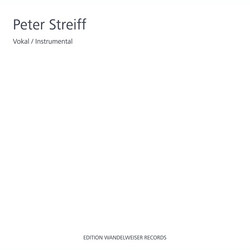
Peter StreiffFeaturing: Urs Peter Schneider
Works For Piano
Tracked express shipping from Italy, no customs or import VAT in the EU. Shipping costs
2014 release **
"Peter Streiff’s music moves in historical webs, encompassing the connected worlds of allusion and individuality in a language that is at once direct and cryptic. This new disc of his piano music, performed by fellow composer Urs Peter Schneider, is a microcosm of Streiff’s creative trajectory. For ease of comprehension, I will use English versions of composition titles in this review. “Of Magic” (1970), the earliest material represented here, has a fair amount in common with the stark and accented pointilisms, not to mention the rapid-fire juxtapositions of dynamic and note length, in Webern’s middle period works; but a simplicity of texture ensures that the structure is readily audible. We hear the fifth and sixth pieces in the cycle, and then they are played simultaneously, signaling a departure from the piece as “work” to a larger sphere of influence governed by Cage and those in sympathy with him. From only three years later, the “Three Piano Studies” inhabit an entirely different world. Some of the longest works on the disc, they could not be more different from each other. The first sounds as if Webern has been slowed to a snail’s pace, each note disappearing into a deeply meditative silence before the next emerges. The second sets the listener adrift in a gradual decrescendo of flurried notes played in what might be one of those ancient Greek scales, a beautiful slab of continuous sound approaching silence. The third rivals the first for sparseness, its spare octaves derived from nothing more threatening than a C-major scale. The three are a study in contrast and varied historical precedent. Along similar lines, but more involved, are the Nine Small Basses, presumably a set begun in 1975 and revised in 2013. The nine miniatures seem to explore the potential of related bass lines, though they’re all heard in the keyboard’s mid-range with the higher and lower notes providing quieter color. Like Berg’s Wozzeck, Streiff uses various historical devices, like the chromatic and repeating “lament” bass (No. 2) and some Bartokian fourths (no. 5) in the service of his own inclusive compositional language. The first, subtitled “Pendulum-Bass,” is one of the most provocative. Tones at either end of the pitch spectrum place the bass line in rapidly changing contexts, forcing the listener to reinterpret it as the miniature progresses. This is refreshing music, systematic but remarkably free from any immediately discernible dogma, and while not directly associated with the vast silences of what might be called Wandelweiser music, there is certainly a common ground. Perhaps early Feldman is a point of reference, but really, this is music for which adequate descriptors are still being coined, and the cycle encapsulates Streiff’s diverse aesthetic. Schneider’s playing is extraordinary. He has clearly lived with this music and understands its oblique but somehow simple nature; he’s alive to its subtleties. There’s plenty of atmosphere around the recording, so that the listener is placed close enough for detail but also given a concert hall experience. The liner notes are even more cryptic than the music, raising more questions than they answer, which is somehow fitting to music of such depth and mystery."
| 1 | Von Magischem Nr. 5 (1970) | 5:56 | |
| 2 | Von Magischem Nr. 6 (1970) | 4:51 | |
| 3 | Von Magischem Nr. 5 Und 6 (simultan) | 5:54 | |
| Drei Klavieretüden (1973) | |||
| 4 | 1 | ||
| 5 | 2 | ||
| 6 | 3 | ||
| 7 | Melodien Band I (1971-77) | 4:34 | |
| 8 | Kleines Symbol IV (1982) | 1:22 | |
| 9 | De?Pression! (1993) | 0:44 | |
| Durchflossener Granit (Elf Kiesel) Klavierfassung (1995/2004) | |||
| 10 | 1 | ||
| 11 | 2 | ||
| 12 | 3 | ||
| 13 | 4 | ||
| 14 | 5 | ||
| 15 | 6 | ||
| 16 | 7 | ||
| 17 | 8 | ||
| 18 | 9 | ||
| 19 | 10 | ||
| 20 | 11 | ||
| 21 | Modell zur Gewichtsverlagerung (2007) | 3:35 | |
| 22 | Neun Kleine Bässe (1975/2013) | 5:25 | |
- Peter Streiff
- Composed By
- Urs Peter Schneider
- Piano