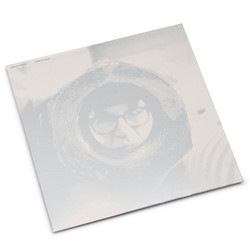
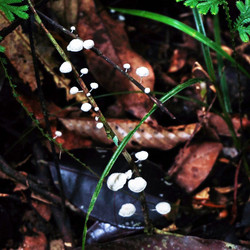
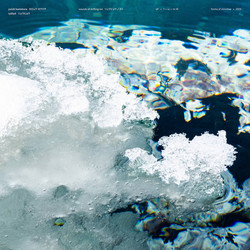
** Edition of 200. Booklet by Seiha Kurosawa and David Toop, a score for the track “Waterforest,” and photographs) ** Waterforest documents a pivotal chapter in Yoichi Kamimura’s ongoing investigation into how landscapes can be heard as much as seen. Conceived first as a 4.1-channel sound installation for his solo exhibition at Hakari Contemporary in Kyoto in the summer of 2025, the project is rooted in environmental field recordings gathered from sites around the world. Water and ice form the work’s central axis - drips, flows, fractures, thaw and freeze - but Kamimura folds in the surrounding environments as well: air currents, distant human traces, shifting wildlife and the barely perceptible resonances of built and natural spaces. The album’s opening piece presents the soundtrack to the installation itself, translated from an enveloping multichannel space into a focused stereo narrative that retains the sense of being surrounded by an unstable, breathing environment.
Where the installation invited visitors to move physically through a field of sound, the recording invites a more introspective journey. In this first track, layers of water and ice are woven into a continuous, evolving tapestry: glacial creaks might give way to rain against foliage, a submerged rumble might soften into the fine grain of trickling meltwater. Rather than imposing overt musical structures, Kamimura lets the intrinsic rhythms of these materials - the periodicity of waves, irregular drip patterns, the slow surge of wind - build a kind of natural polyphony. The result is a listening experience that feels both documentary and dreamlike, as if one were passing through a sequence of superimposed climates where seasons overlap and distant geographies momentarily touch.
Tracks 2–6 shift the focus toward what Kamimura describes as “unadorned” field recordings: selections drawn from the broader Waterforest archive, finely shaped but presented with minimal intervention. Here, the emphasis is on the specificity of each place and moment. One hears the way a particular shoreline holds sound differently from a harbour; how ice on a river speaks in short, percussive ruptures, whereas snowpack absorbs and dulls impact; how a microphone placed close to a trickle or fissure reveals micro-events that usually vanish into the larger ambience. These pieces operate almost like sonic photographs or contact prints, each preserving a fragment of the larger project while allowing its textures to be examined up close.
The album is explicitly framed as an archival record of the exhibition “Yoichi Kamimura | Waterforest,” organized by Hakari Contemporary and held from June 14 to July 21, 2025. Its release in a first edition of 200 copies in March 2026 extends the life of a time-bound installation into a portable, replayable form, while still foregrounding its origin in a specific curatorial and spatial context. Design by Keigo Shiotani and photographic documentation by Hibiki Miyazawa (COG WORKS Co., Ltd.) and Hyogo Mugyuda situate the audio within a carefully considered visual and material frame, echoing Kamimura’s broader practice of combining sound with drawing, text and light. Essays by Seiha Kurosawa and David Toop, translated between Japanese and English by Christopher Stephens and Naomi Matsuura, further expand the project’s theoretical and poetic dimensions, tracing lines between listening, ecology and the ways in which environments inscribe themselves in perception.
Across its duration, Waterforest remains faithful to Kamimura’s core question: how might listening alter the way landscapes are perceived and remembered? By centering water and ice - elements that are both vital and acutely sensitive to climate and time - the album captures environments that are always in the midst of becoming something else. The record does not present nature as pure or distant; instead, it reveals a network of entanglements, where human presence is implied in the act of recording even when no overt human sound is heard. In this sense, Waterforest stands as both an archive and an invitation: a carefully crafted trace of an exhibition, and a prompt to keep listening for the subtle, often overlooked languages of the more-than-human world.