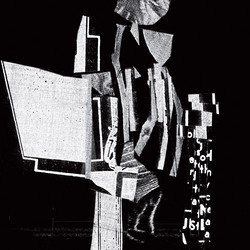
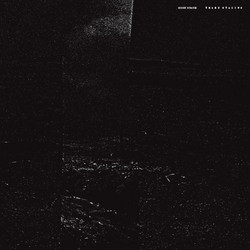
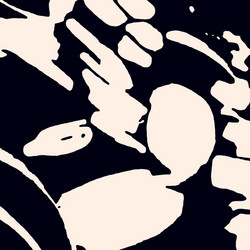
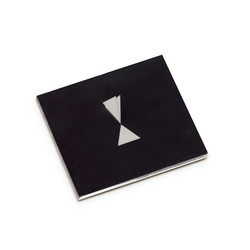
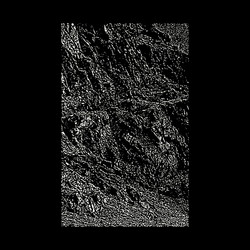
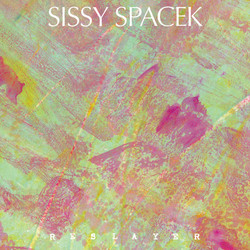
Declension finds Sissy Spacek in its purest, least negotiable form: the core duo of Ch. Mumma and John Wiese alone in rooms in Chicago and Cleveland in mid‑2024, turning voice and electronics into a single, seething mass. The record is split into two long pieces – “Abgrund” and “Spiraled Galaxy” – that function less as tracks and more as hostile environments. From the first second, you’re inside a pressure chamber of chaotic, cascading signal: squalls of high‑end scree, sub‑bass shudder, violently clipped midrange, and a vocal presence that has been shredded past language into raw, ragged texture. It’s “vocal hell” in the most literal sense – not theatrical evil, but the sound of a throat pushed beyond what it was built to do, swallowed and multiplied by circuitry.
The duo’s longstanding chemistry is crucial here. Mumma’s voice, already a central weapon in Sissy Spacek’s arsenal, isn’t simply screamed over the top; it’s fed into Wiese’s electronics, folded, reversed, granulated, smeared until it becomes one more cascading layer in the torrent. Wiese, in turn, treats the entire spectrum like a sculptural material, piling dense blocks of noise and then letting them fracture, punching sudden holes in the wall to let brief flashes of space or pure tone through before slamming it shut again. “Abgrund” – the abyss – lives up to its title, dropping the listener into a free‑fall where orientation is constantly sabotaged: no beat, no riff, just shifting strata of impact and erosion. “Spiraled Galaxy” feels like its warped twin, the same materials whipped into a more centrifugal motion, sounds flung outward in spirals that keep snapping back toward the centre.
Recorded on the road between two Midwestern cities, the album carries the grit of live energy without being a live document. You can hear the immediacy of performance in the way the structures evolve: sections swell to near‑unbearable density, then implode into jittering filigree, only to be buried again under fresh avalanches of signal. There’s no sense of post‑production smoothing; edits, if they exist, serve only to tighten the screws. What emerges is a kind of maximalist minimalism: two sound sources, two people, and an absolute refusal to dilute the confrontation.
Within Sissy Spacek’s vast and mutating discography, Declension reads as a statement of renewed focus. No guest players, no expanded instrumentation, just the project’s founding duo pushing their core elements – voice and electronics – to another threshold. It’s a record that asks for a lot: volume, attention, a willingness to let form reveal itself not through melody or rhythm but through shifts in texture and intensity. In return, it offers a rare thing: a noise record that feels less like a genre exercise and more like a single, sustained, lived‑through event, two sides of a crisis etched into tape.