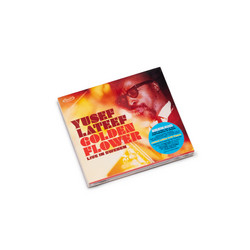
There are musicians who play jazz and there are musicians who expand its very definition. Yusef Lateef was the latter - a visionary who brought the oboe, the argol, the shanai, the bamboo flute and countless other instruments into the jazz vocabulary decades before "world music" became a marketing category. Golden Flower: Live in Sweden presents two never-before-released concert recordings that capture this master at the height of his powers, finally emerging from the Sveriges Radio tape vaults after more than half a century.
The first session dates from September 13, 1967, recorded at Mosebacke in Stockholm. Lateef leads a quartet with Swedish pianist Lars Sjösten, the young Palle Danielsson on bass - already displaying the deep tone and melodic intelligence that would make him indispensable to Keith Jarrett's European Quartet - and the magnificent Albert "Tootie" Heath on drums. The program opens with "The Golden Flute," Lateef's signature piece, then moves through "Blind Willie," "One Little Indian," a swinging "Straighten Up and Fly Right" and the contemplative "The Poor Fisherman." This is Lateef in his Atlantic Records period, balancing accessibility with adventure, never sacrificing depth for charm.
Five years later, on August 1, 1972, at the Åhus Jazz Festival, a different quartet takes the stage. Kenny Barron is now at the piano - one of the great accompanists in jazz history, whose harmonic sophistication pushed Lateef into new territory. Bob Cunningham holds down the bass, and Tootie Heath returns on drums, providing continuity across both sessions. The repertoire shifts dramatically: "Inside Atlantis" stretches past fifteen minutes, "Eboness" past thirteen. This is the exploratory Lateef of the early seventies, less concerned with song form than with texture, color, spiritual atmosphere. "Yusef's Mood" closes the set with over twenty minutes of collective searching.
The contrast between these two concerts - separated by five years and a seismic shift in the jazz landscape - illuminates Lateef's remarkable adaptability. He moved from hard bop to modal jazz to free exploration without ever losing his distinctive voice: that warm, slightly grainy tenor tone, the flute playing that ranged from delicate to incantatory, the compositions that drew equally from Detroit, Cairo and Calcutta.
Produced for release by Zev Feldman with his customary archival rigor. The deluxe 180-gram 2LP gatefold includes a 12-page booklet with rare photographs and new essays by Herb Boyd, plus testimonies from Jeff Coffin, Chico Freeman and Charlie Apicella. LP mastering by Matthew Lutthans at The Mastering Lab from the original Sveriges Radio tapes. Numbered limited edition of 2,500 copies. Also available as a Deluxe 2CD set.