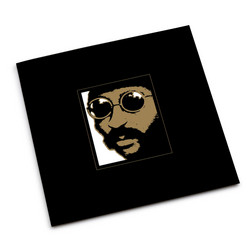
Hidden Fire Volumes 1 & 2 returns as one of the most elusive chapters in Sun Ra’s vast mythology - now finally remastered and properly unveiled after decades as a near‑myth private artefact. Originally issued in minuscule quantities on his El Saturn label in 1988, the album captured Ra over three nights at New York’s Knitting Factory, effectively closing a 33‑year run of fiercely independent, home‑grown releases. Those original LPs, with their hand‑written labels, minimal packaging and cryptic artwork, always felt more like talismans than products. This new edition retains that aura while making the music itself fully audible at last, revealing a late‑period Ra that is darker, more dissonant and more uncompromising than almost anything else he recorded in the 1980s.
What immediately sets Hidden Fire apart is the sound source at its core. Ra performs exclusively on the Yamaha DX7, the then‑ubiquitous digital synthesiser better known for glassy pop presets than for cosmic upheaval. In his hands, its brittle FM tones become alien matter: bell‑like clusters snap into jagged fanfares, warped organ registrations smear into metallic drones, piercing leads cut across the stereo field like coded transmissions. Gone are the warm, rolling acoustic piano and lush electric keyboards that colour much of his later work; here, timbre itself feels cold, electric, slightly toxic, as if the band were playing inside a malfunctioning mainframe. Ra takes that limitation as a challenge, pushing the instrument past familiarity until its sounds feel de‑contextualised, stripped of 1980s gloss and recast as raw signal.
Around this digital core, the Arkestra appears in a uniquely configured guise. Most striking is the presence of a heavy string section, including three violins with Billy Bang among them, bringing a serrated, free‑jazz string‑band energy rarely heard in Ra’s ensembles. Their lines scrape, swarm and slice through the texture, sometimes doubling themes, sometimes plunging into near‑aleatoric scrabble that thickens the sense of unrest. The rhythm section, anchored by electric bass (Rollo Radford) and guitar (Bruce Edwards), gives certain passages a gritty, almost fusion‑like low end, but without the usual sheen; everything is filtered through Ra’s tense DX7 harmonies and the Arkestra’s volatile dynamics. Over and between these layers floats the singular space voice of Art Jenkins, whose eerie textures, muttered incantations and extended techniques recall the Choreographers Workshop era of the early 1960s, now rendered even more uncanny by the digital aura around them.
The repertoire reads like a survey of Ra’s concerns filtered through a final, feverish lens. “Retrospect / This World Is Not My Home” opens with a palindromic riff that briefly nods toward Ellington, a reminder of the bandleader’s longstanding dialogue with big‑band tradition. Almost immediately, the music veers into sermon: Ra intones his warning about death’s dominion over Earth‑bound minds, the DX7 lacing his words with metallic echoes and uneasy harmonies. “Hidden Fire Improvisation” lives up to its title as a torrent of tone science: Marshall Allen, Billy Bang and John Gilmore unleash ferocious solos over relentless drumming and Ra’s cascading synth clusters, the ensemble sounding less like a big band than like a weather system tearing itself apart. “Hidden Fire Blues” takes one of Ra’s familiar blues vehicles and subjects it to an electrified hall of mirrors, guitar and bass claiming centre stage while the keyboard refracts the form into something warped and flickering.
Perhaps the most startling piece is “My Brothers The Wind And Sun #9,” a late, live reimagining that channels the experimental weight of The Heliocentric Worlds. Here, crashing percussion, pulsing synth and voice duets, and string‑driven chaos coalesce into a ritual that feels as much invocation as composition, spiralling repeatedly toward the brink of total dissolution. Even the ostensibly quieter “Hidden Fire II,” a duet between Ra and Art Jenkins, offers little in the way of comfort: its spare exchanges and shadowy beauty feel thick with unease, like half‑heard messages in the dark. Throughout, what’s striking is how little interest Ra shows in revisiting the more joyous, outer‑space swing that endeared the Arkestra to festival audiences in his later years. Instead, he seems intent on using these performances to open new, more forbidding portals, as if insisting that the journey was never meant to end in nostalgia.
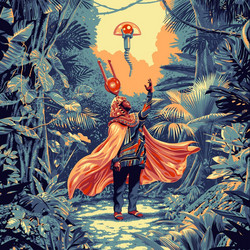
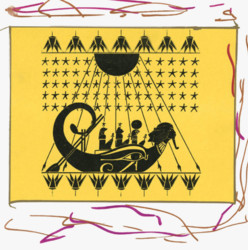
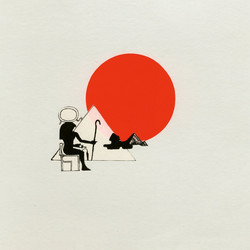
This reissue restores that intent with care. Remastered from original sources, Hidden Fire now reveals detail that the Saturn pressings could only hint at: the grain of Jenkins’ voice, the rosin on the strings, the jagged edges of Ra’s DX7 envelopes, the way drums and crowd noise bleed into the room. Archival photos situate the band in the cramped, charged environment of the late‑’80s Knitting Factory; new liner notes by Paul Griffiths trace the album’s place in Ra’s chronology and unpack the ways it both echoes and departs from his earlier experiments. The artwork, inspired by the original Saturn editions, preserves the handmade, esoteric feel while giving the package the durability those fragile originals never had.