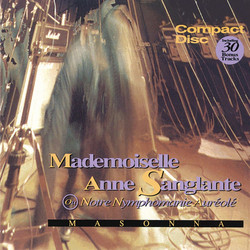
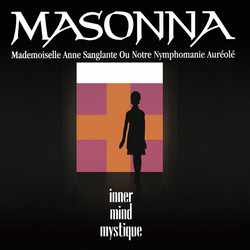
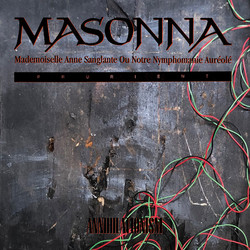
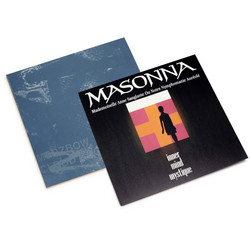
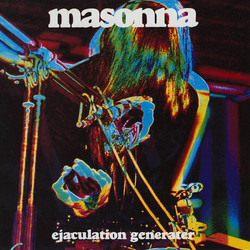
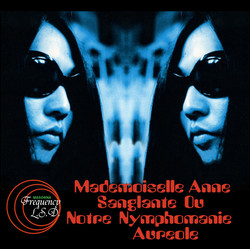
Noisextra captures Masonna at the height of his maximalist powers, turning the core principles of Japanese harsh noise into something so concentrated it borders on hallucination. Operating under the long‑running acronym for “Mademoiselle Anne Sanglante Ou Notre Nymphomanie Auréolé”, Maso Yamazaki has always treated sound as a direct assault on the nervous system rather than a medium for narrative or mood. Here, that approach is pushed to an extreme: short, violent blasts where the entire frequency spectrum seems to detonate at once, only to be sliced apart by sudden cuts, tape spasms and throat‑shredding vocal eruptions. It’s not “songs” in any conventional sense, but a sequence of precisely timed detonations, each one resetting the listener’s sense of what counts as too much.
What distinguishes Noisextra from a generic wall of distortion is Masonna’s almost surgical sense of pacing and texture. Within the overload, there are constant micro‑shifts: high‑end feedback ribbons coiling around blunt low‑end thuds, contact‑mic grit folding into shortwave‑like fizz, human screams mangled into pure waveform. Abrupt drop‑outs act like involuntary blinks, tiny silences where you realise how hard your body’s been bracing, before the next blast arrives even hotter. The stereo field is weaponised, with sounds snapping from channel to channel or collapsing into a mono spike that feels like it’s boring straight into the skull. As with his most iconic work, there is a strange, deranged musicality buried in the chaos - patterns that surface for a second and then immolate, hints of rhythm in the stutter, overtones that almost sing before they’re torn apart.
In the broader context of Masonna’s catalogue, Noisextra reads like both a distillation and a dare. It bottles the delirium of his legendary, self‑destructive live sets - bodies flying, PA systems red‑lined, performances cut short by sheer physical excess - into a studio‑forged artefact that retains their volatility. Yet there’s nothing incidental about it: for all the apparent randomness, these pieces are built with a clear internal logic, a sense of when to surge, when to slam on the brakes, when to let a particular texture chew through the listener’s bandwidth before introducing a new one. For noise devotees, it is a bracing reminder of why Masonna remains a touchstone decades on; for the merely curious, it is as pure an immersion in the outer edge of sound as you’re likely to find, a record that doesn’t invite passive listening so much as demand that you decide how much intensity you can actually take.