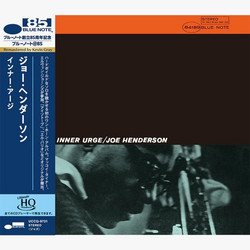
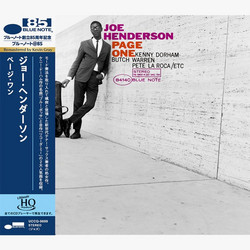
Tetragon captures Joe Henderson at a moment of poised transition. As his second album for the Milestone label, it finds the tenor saxophonist consolidating the fiercely articulate post‑bop voice he’d honed with Blue Note while quietly pushing toward the more searching, spiritual territories that would colour his later work. The title suggests both geometry and enigma: four sides, multiple angles, a structure you can walk around and never quite exhaust. That’s exactly how the record unfolds - as a set of pieces that are impeccably constructed yet open enough to let Henderson’s imagination roam.
He’s flanked here by a genuinely world‑class cast. With Ron Carter on bass anchoring the low end, Jack DeJohnette and Louis Hayes sharing drum duties, and Kenny Barron and Don Friedman at the piano bench, the ensembles shift from track to track but the level never drops. Carter’s supple, singing lines supply both harmonic glue and counter‑melodic bite; DeJohnette and Hayes bring contrasting but complementary energies, from rolling, polyrhythmic turbulence to crisp, straight‑ahead swing; Barron and Friedman trace different angles on the harmonic grid, one with a more percussive sparkle, the other with a probing, pianistic lyricism. Henderson thrives in this environment, his tenor tone firm but flexible, capable of slicing through dense rhythm or melting into a ballad line without losing its core.
Repertoire-wise, Tetragon balances original material with reimagined standards, using each as a different kind of launch pad. Henderson’s own tunes tend to be structurally sly, full of turns that reveal their logic only after a chorus or two, while the standards are reharmonised, re‑accented and stretched rhythmically until they feel like new terrain. Throughout, his improvising is a lesson in narrative soloing: motifs are introduced, developed, worried at, inverted; rhythm is toyed with, riding just ahead of or behind the beat; sudden bursts of double‑time are reeled back into long, plush phrases. You can hear hints of the more overtly “spiritual” vocabulary that will surface later - the incantatory repetitions, the willingness to sit on a single tonal centre and explore its interior - but here they’re folded seamlessly into a post‑bop syntax that remains taut and focused.
Heard in the wider sweep of Henderson’s career, Tetragon stands as a key waypoint: the sound of a major tenor voice deepening its resources while testing the walls of its current room. The combination of a killer band, sharp writing and exploratory yet grounded improvisation gives the album a sense of urgency that hasn’t dimmed with time. It’s a record where craft and forward motion are perfectly aligned, and where you can already feel the gravitational pull of the more expansive, spiritually inflected music that lies just over the horizon.