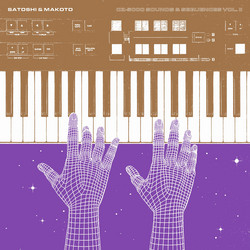
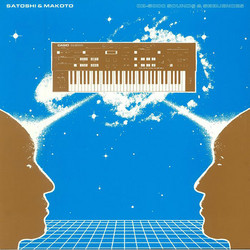
Six years after their last full‑length, Cafe Mirage marks a graceful yet quietly radical return for Satoshi & Makoto. The Japanese twin duo, long cherished for their intimate, hand‑played approach to synthesizers, stretch their language into something more expansive here: a record that behaves less like a collection of tracks and more like a place you can walk into, inhabit, and reluctantly leave. Released on 8mm Records in collaboration with Standart Magazine, the album builds on their history while opening a new chapter, one that thinks about listening the way coffee people think about brewing - as a ritual, a craft, and a shared moment in time.
From the opening bars, Cafe Mirage feels designed as a fully immersive sensory environment. The duo’s familiar palette of glowing synth tones and unhurried patterns is deepened with more detailed sound design, subtle room impressions and a heightened sense of narrative pacing. Refined electronica flows into ambient passages where melodies hover like steam over a cup; understated rhythm programming provides a gentle but insistent pulse, closer to a heartbeat than a club kick. Hints of jazz - a chord voicing, a brushed‑snare feel hiding inside a drum machine, a wandering bassline - slip through the arrangements, adding human warmth without ever tipping into pastiche. Everything is measured, elegant, but never sterile; you can hear the living hands behind the machines.
The title is not just metaphor. Cafe Mirage posits an imaginary café as its central stage - a space of contemplation, informal community and quiet inspiration. Each piece suggests a different corner of that room: early‑morning light with almost beatless textures and breathing pads; mid‑day sequences where the groove comes forward and soft arpeggios trace the rhythm of conversation; late‑night stretches where harmony darkens, delays bloom and time seems to slow to the pace of a solitary drinker lost in thought. The collaboration with Standart Magazine deepens this framework, binding music and coffee culture into a shared vocabulary of slowness, attention to detail and global connection. It’s an album that feels equally at home in a Yokohama apartment, a Berlin café or a small listening bar in Milan.
Across the record, Satoshi & Makoto write with a maturity that makes every choice feel deliberate. The production is rich yet restrained: reverb is used sparingly, leaving plenty of air around each element; drum patterns are economical, allowing tiny syncopations and ghost notes to carry surprising emotional weight; patches are carefully sculpted so that no sound overstays its welcome. There’s a constant play between introspection and forward motion - tracks that invite eyes‑closed drifting still carry a gentle momentum, while the more rhythmically insistent pieces never shout. Lush harmonies unfold slowly, with chord changes that feel inevitable only after they’ve arrived, and small melodic motifs reappear in different guises, lending the album a quiet internal coherence.
What makes Cafe Mirage feel like more than just a long‑awaited comeback is the sense of expanded vision. After six years of silence in album form, the duo don’t simply repeat what worked; they refine it, deepen it, and frame it within a clear conceptual world. The result is a record that rewards close, attentive listening - headphones, late evening, lights low - but also functions as a subtle, elevating presence in the room, the way a perfectly brewed cup can make an ordinary day feel fractionally more luminous. In that balance of precision and ease, intimacy and cinematic scope, Cafe Mirage stands as a defining entry in Satoshi & Makoto’s catalogue and a quietly outstanding statement in contemporary electronic music.