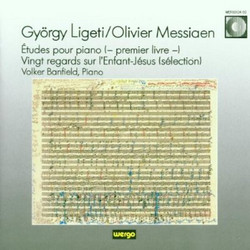
György Ligeti wrote the first book of his Études pour piano in 1985 and added two more over the following sixteen years. This disc presents all eighteen études, played by the German pianist Thomas Hell. At the time many in new music circles saw the étude as a relic, but Ligeti made the genre a laboratory for some of the most demanding piano writing in the repertoire.
Ligeti (1923-2006) was a Hungarian composer. He wanted to revive a great tradition, the one running from Czerny, Chopin and Liszt to Bartók, Debussy and Stravinsky, and to test it in a contemporary form. He also liked to play the piano himself, with what he called "inadequate pianistic technique": "The anatomical situation of my hands and the configuration of the piano keyboard determined the products of my imagination." The recording is by Deutschlandradio Kultur, with Bernd Friebel as engineer and Stefan Lang as producer. Robert Nemecek wrote the liner notes. Hell studied in Hanover with David Wilde and took first prize at the Concours international de piano d'Orléans. He has played the complete études in Darmstadt, Basel and Tokyo, where the Japanese journal Ongaku no tomo chose his performance as best concert of 2010.
The études are exercises in polyphony in a much expanded sense: polyrhythmic, poly-temporal and even, as the label puts it, poly-ethnic, drawing on material from very different musical cultures, from the Balkans to Africa and Asia. They also reflect Ligeti's admiration for the great piano literature from Bach to Debussy. The first book runs from Désordre and Cordes à vide to Arc-en-ciel and Automne à Varsovie. The second, the largest, includes Galamb borong, Vertige, Der Zauberlehrling and L'escalier du diable, at five minutes the longest piece on the disc.
The third book holds four études, White on White, Pour Irina, À bout de souffle and a closing Canon of under two minutes. Taken together the eighteen pieces go far beyond technical studies: each sets a precise pianistic task and turns it into a short poetic form.
CD, Wergo WER 6763 2, released in 2012, 57 minutes.