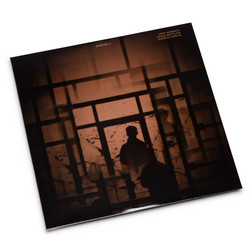
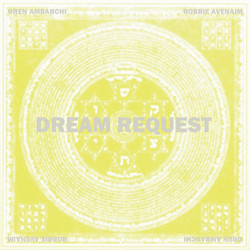
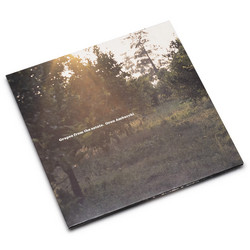
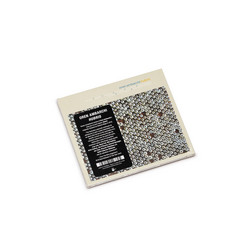
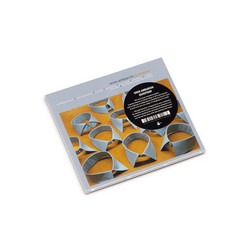
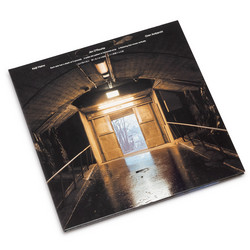
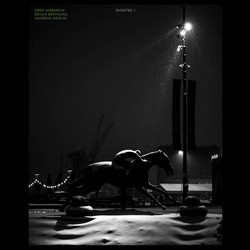
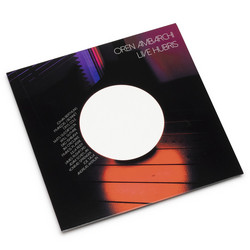
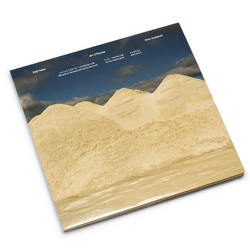
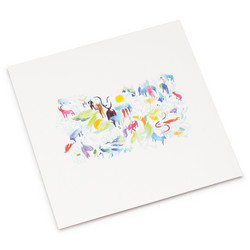
** 2026 Repress ** First released in 2016 and long out of print, Hubris has come to feel like a pivot in Oren Ambarchi’s catalogue - the moment when his fascination with groove, repetition and ensemble friction finally detonated into something both overwhelming and weirdly precise. This new edition gives that record the sonic treatment it always deserved. Working from the original mixes, mastering engineer Joe Talia revisits the album with what can only be called forensic care, teasing out layers and micro‑events that were previously half‑buried: the grain of each palm‑muted guitar, the shifting phase relationships between motorised strings, the tiny hesitations in the drums, the way synths smear into harmonics. The result is not a revision but a sharpening of focus, revealing just how densely worked Ambarchi’s “relentless” music really is.
Hubris continues the exploration of driving, almost monomaniacal rhythm that defined Sagittarian Domain (2012) and Quixotism (2014), but it does so from an unexpected starting point. Where those earlier records leaned on Krautrock and techno as gravitational centres, the sidelong opening piece here takes its cue from disco and new wave, specifically Ambarchi’s long‑standing affection for Wang Chung’s soundtrack to William Friedkin’s To Live and Die in L.A. Rather than quoting those sources, he strips them down to their structural DNA: the sense of forward glide, the shimmer of guitars locked into tight patterns, the emotional ambiguity in bright harmonies riding dark currents. From that seed, he builds a sustained, pulsating web of layered palm‑muted guitars, each line a slightly different length or contour, cycling against the others until the surface starts to ripple. Individual voices rise and recede, melodic figures appear almost accidentally and then are swallowed back into the mesh.
As the first piece evolves, more elements enter its orbit. Jim O’Rourke’s guitar synth sweeps across the texture with a lushness that feels almost indecent in such a rigorously patterned environment, pouring colour into the interstices between Ambarchi’s latticed lines. Konrad Sprenger, known for his work with Arnold Dreyblatt, contributes overtone‑rich motorised guitar, its chiming harmonics threading through the palmed figures and nudging the music toward a point where shimmering minimalism meets bodily propulsion. In its final section, electronic percussion from Mark Fell snaps into place with surgical clarity, adding a hyper‑articulated high‑end grid that both locks the groove and throws its human imperfections into relief. The piece climbs, layers thickening and perspective shifting, until it reaches a kind of hovering plateau rather than a traditional climax - a system humming at full capacity.
The short second section, by contrast, feels like a skewed interlude, a chamber piece in which Ambarchi, Jim O’Rourke and Crys Cole pay oblique tribute to the eccentric harmonic and rhythmic sensibility of Albert Marcoeur. Built from interlocking guitar figures and abstracted speech, it twists pulses around unexpected accents and lets spoken fragments function as both texture and dislocated commentary. Where the first track stretches a single idea to near‑breaking point, this one moves like a crooked smile: brief, gnomic, full of tiny feints.
The long final piece takes the concept of the opener and drags it into darker, denser terrain. Here the layered, percussive guitars are transformed into a raw, tumbling fusion‑funk groove, the kind of hot, rolling feel that recalls early Weather Report or the first Golden Palominos LP, but channelled through Ambarchi’s obsession with repetition and incremental shift. The rhythm section is formidable: twin drums from Will Guthrie and Joe Talia, plus electronics from Ricardo Villalobos, who injects his own sense of slippery, micro‑detailed pulse into the proceedings. Together they ride a single repeated chord change with stubborn determination, finding endless nuance in how it can be stressed, delayed or pushed.
As this engine runs, a sequence of foreground events erupts over it. Keith Fullerton Whitman lets loose aleatoric synthesizer streams - burbles, flares, voltage‑driven arcs that seem to operate on their own logic, skimming across the groove at skew angles. Arto Lindsay then carves into the mix with slashing, skronk guitar, his signature combination of violence and precision cutting through the accumulating density. Finally, Ambarchi himself steps forward, his fuzzed‑out harmonics and distorted figures rising above the churn as the ensemble arcs toward an ecstatic, heedless frenzy. It’s a passage where the album’s title feels earned: a gathering of high‑calibre players, each with strong identities, thrown together in a situation that could easily have dissolved into chaos, yet somehow held to a singular line.