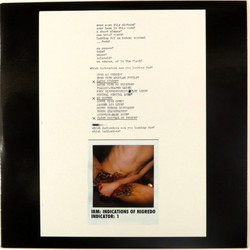
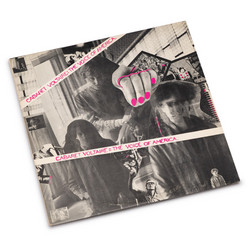
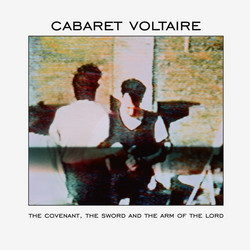
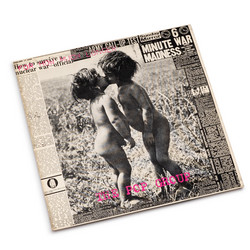
condition (record/cover): EX / VG+ (light ring wear and dirt)
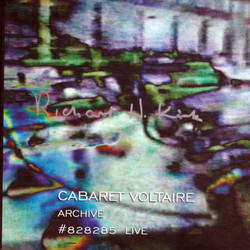
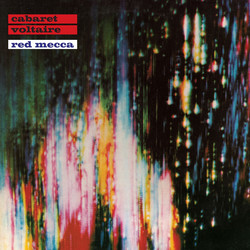
Cabaret Voltaire first performed live during a student disco at Sheffield University in 1975. In keeping with the group's Dadaist ethos, the show was cut short as the audience -- expecting rock music, not challenging noise experiments -- invaded the stage and attacked the trio. Recorded in London four years after that ill-fated debut, this live set proceeds without incident and provides evidence of Cabaret Voltaire's foundational contribution to the electronic and industrial genres that would burgeon in the '80s and '90s. The sound of late-'70s Cabaret Voltaire featured here is sparse and austere: Stephen Mallinder's bass and Richard H. Kirk's guitar, supplemented with basic drum-machine beats, primitive synth, and Chris Watson's cut-and-paste tape loops. The band's harsh minimalism is encapsulated on tracks like "The Set Up" from 1978's Extended Play and "On Every Other Street" from Mix-Up (1979). The incorporation of found sounds on the more abstract "Baader Meinhoff" underscores the notion that Cabaret Voltaire's early work often had more in common with musique concrète than pop music. Whereas the Velvet Underground's "Here She Comes Now" is rendered largely unrecognizable, certain numbers show that the trio was able to fashion their paired-down sonic experiments into more conventional song formats (for instance, the Joy Division-esque "No Escape" and the droning and distorted electronic garage charge of "Nag, Nag, Nag"). That the galloping beat of "Havoc" recalls the Doctor Who theme is not as odd as it might seem; the BBC Radiophonic Workshop was an important influence on British electronic and industrial artists, and moreover, Kirk, Mallinder, and Watson had covered that track with a 1977 side project, the Studs. Although this album isn't easy listening -- and of course it wasn't intended to be -- it documents Cabaret Voltaire's role as electro-industrial pioneers alongside the likes of Throbbing Gristle.
| A1 | Untitled | 5:51 | |
| A2 | On Every Other Street | 4:16 | |
| A3 | Nag, Nag, Nag | 4:55 | |
| A4 | The Set Up | 4:13 | |
| B1 | Expect Nothing | 6:18 | |
| B2 | Havoc | 3:02 | |
| B3 | Here She Comes Now | 4:12 | |
| B4 | No Escape | 3:42 | |
| B5 | Baader Meinhof | 4:10 |
- Scott Piering
- Recorded By