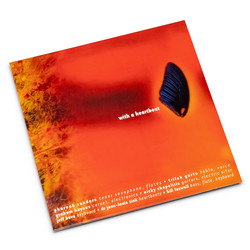
Thirty years on, Pharoah Sanders' Message From Home returns to vinyl. Music On Vinyl reissues the 1996 Verve album on 180g black vinyl, its first LP pressing since the original French Polydor edition, a record that has been out of reach for most of that time.
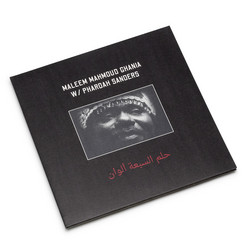
Pharoah Sanders was fifty-five when he signed to Verve. The label's first move was to put him in a room with Bill Laswell, who had already drawn him into two of the mid-nineties' stranger sessions: the Gnawa trance recordings with Maleem Mahmoud Ghania on Axiom, and a pair of tracks on Jah Wobble's Heaven and Earth. Message From Home, recorded at Sony Studio in Manhattan and Greenpoint Studio in Brooklyn, is what came of that meeting when Sanders was given the whole record. It is his first Verve album, produced by Laswell, and the beginning of a run that continued with Save Our Children two years later.
The band tells you most of what you need to know. Foday Musa Suso on kora and dousongonni, with a chorus of Gambian singers around him. Hamid Drake on drums, tablas and frame drums, Aiyb Dieng on congas, bells and gongs. Bernie Worrell on keyboards, William Henderson on piano, Charnett Moffett and Steve Neil on bass, Michael White on violin, Dominic Kanza on guitar, Jeff Bova on programming. Sanders himself plays tenor and soprano, flutes, bells and singing bowls, and sings. Laswell's job was to hold all of this in one frame without flattening it.
The opener sets the terms. Our Roots (Began In Africa) runs over ten minutes on a hip-hop pulse heavy enough to move a room, a chanted refrain, plucked thumb-piano figures and, over the top, Sanders in full cry, the split tones and overblown screams intact. It is the closest he ever came to a club record and it does not sound like a compromise. Nozipho is the other pole: slow, devotional, the tenor stretched to the point of tearing, the kind of playing that made his name on Impulse! in 1969. Between them the album moves through Tomoki, named for his son, with its bright pan-African rhythm; Ocean Song, where the electronics fall away and the acoustic band breathes; Kumba, a Suso composition that carries the sound of a Gambian village; and Country Mile, which puts a country and western backbeat under a juju-style guitar and somehow makes the two fit.
The production is unmistakably Laswell, and that has always divided listeners. The Penguin Guide found the electronic setting mechanical. Robert Christgau gave it an A-minus and called Sanders a natural fit for Laswell's world-jazz methods. AllMusic heard a volcano waking up. Heard now, with the 1990s at a safe distance, the beats read less as a period concession and more as one more rhythmic language among many on a record built on the idea that the diaspora talks back to its source.
The original vinyl was a French pressing that never circulated widely. This edition puts the album back where it belongs, on two sides, in a pressing you can actually find.