Marta Salogni, Stefano Pilia
Phren (LP)
Label: Maple Death Records
Series: Opale
Format: LP
Genre: Experimental
Preorder: Releases Early October, 2026
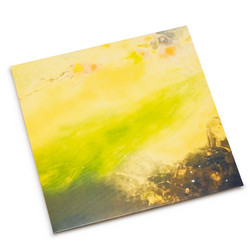
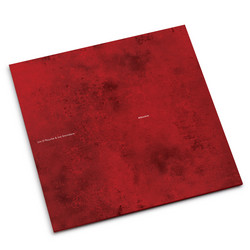
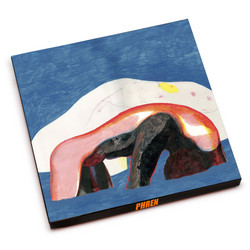
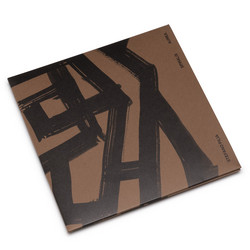
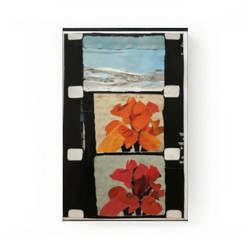
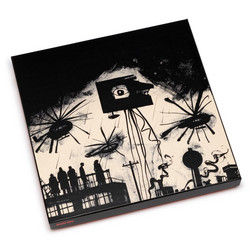
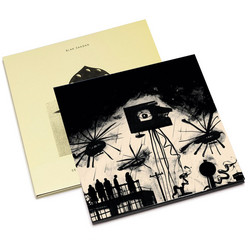
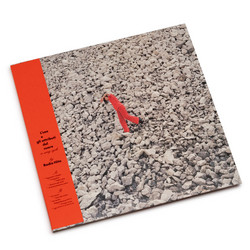
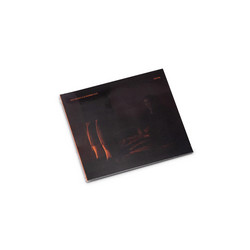
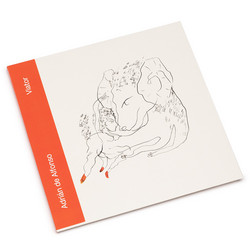
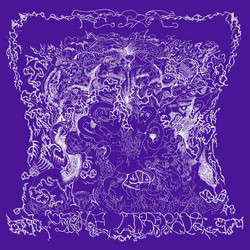
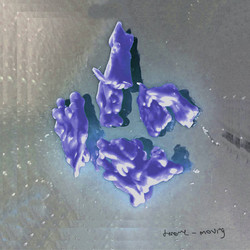
** Artwork by Sarah Mazzetti. Design & Packaging by eee studio ** Phren begins with an image: a structure rising from water, suspended between architecture and landscape, between reflection and depth. Inside that imagined building - created by Sarah Mazzetti for the Opale series - another space opens, dedicated to listening, isolation and encounter. It is in dialogue with this place that Marta Salogni and Stefano Pilia shape their first collaborative work, a layered sound‑hymn‑dialogue between Pilia’s abstract guitar and Salogni’s manipulation of tape machines. Rather than treating sound as a fixed document, they approach it as living material: something that carries traces, absorbs new meanings and generates unfamiliar voices as it moves.
At the core of Phren lies a simple but constantly shifting principle. A sound is set in motion, then passed through a series of interconnected systems in which it is delayed, altered and returned in another form. Pilia’s electric guitar travels through a complex modular chain - stages of preamplification and filtering, then a tape‑echo system that introduces further layers of repetition, resonance and spatial displacement. These signals enter Salogni’s Revox tape machines, where additional lines of delay, modulation and environmental transformation reshape the material again. What emerges is not a dialogue between two separate instruments, but a shared system: a living architecture in which a single signal moves simultaneously through parallel and serial pathways, gathering traces from each passage until gesture and echo begin to dissolve into each other.
In this sense, Phren converses with a lineage of artists who have explored sound, duration and recording technology as forms of memory - from the immersive harmonic environments of Éliane Radigue to the fragmented archives of Philip Jeck and the sustained meditations of Pauline Oliveros. Yet where those practices often turn repetition toward erosion or disappearance, Salogni and Pilia take another path. Their loops do not simply circle back to the past to witness its fading; they become generative spaces in themselves, processes through which unfamiliar harmonies, new temporalities and new voices can emerge. Memory here is not a fragile residue but an active force that keeps transforming what it holds.
One movement carves out its own distinct route inside this architecture. “ma la mia anima è testimone” is built around a custom system of just intonation derived from a constellation of harmonics and undertones, related to Harry Partch’s tonality diamond. Instead of conventional equal temperament, harmony becomes a physical structure shaped by proportion, resonance and vibration. Frequencies lock into unusual relationships; beating patterns and overtone clusters turn tuning into a tangible, almost architectural experience. The final movement, “e il mio fiume scorre verso te, oh mare, accoglimi,” introduces another form of transmission: fragments from Giovanni Pierluigi da Palestrina’s Lamentations of Jeremiah enter as a distant voice, carried through layers of transformation and temporal displacement. The timeless vocal material does not appear as citation so much as trace - another body of sound passing through present‑day mechanisms, re‑voiced by the system.
Water, waiting, memory and testimony return as currents throughout the work, not as symbols to decode but as physical sensations embedded in the music’s movement. Each gesture seems to carry a small residue of what has come before; each echo feels like a new utterance. The title Phren recalls an ancient Greek term connected to the seat of thought and feeling, and the album treats memory accordingly: not as a fixed archive of what has been lost, but as something unstable and alive, capable of metamorphosis.
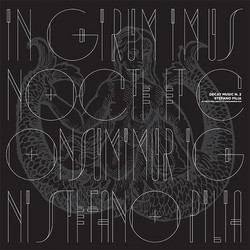
Composed and recorded between Bologna, London, Venice and Isola di Sant’Andrea over 2025/2026, Phren stays close to the landscapes that inform it, both physical and imagined. Salogni’s role encompasses tape machines and field recordings; Pilia’s encompasses electric guitar routed through his modular system and samples. Mixed and mastered in London at Studio Zona, the album retains the tactile grain of its processes - the wobble of tape, the subtle noise-bed under quiet passages, the way reflections seem to carry traces of rooms and weather. A lathe cut by Matt Colton at Metropolis Studios translates this living architecture into vinyl with an attention to nuance and dynamic that mirrors the care taken in the composition.
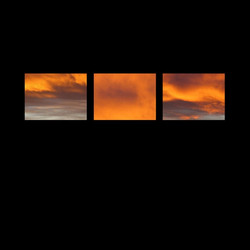
Visually and materially, Phren is the third release in Opale, a series curated by Maple Death Records and publishing house Canicola Edizioni that has, for the last decade, traced the intersection of music and narrative through sound and images. Each Opale title pairs an LP with an illustrated book in a limited box set, linked by a red thread running through atmospheres, emotional temperatures and glimpses of content. For Phren, Mazzetti contributes artwork, images and a 32‑page singer‑stitch illustrated book/carnet d’artiste that extends the album’s imagined architecture into visual storytelling. Her practice, which has appeared in outlets like The New York Times, The New Yorker, Die Zeit and The Guardian, and in books published by Canicola, similarly explores narrative, memory and invented worlds - making her a natural counterpart to Salogni and Pilia’s sonic inquiry.