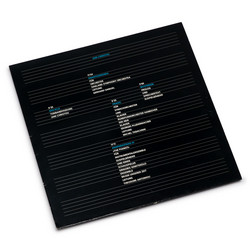
Horatiu Radulescu
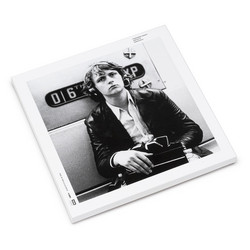
Clepsydra / Astray (LP)
condition (record/cover): M / M No insert.
The title of the first piece tells you something essential. A clepsydra is a water clock - time measured not by mechanical division but by the continuous, patient flow of liquid from one vessel to another. Horațiu Rădulescu chose it for Clepsydra (op. 47, 1982), a work for 16 Sound Icons: grand pianos laid horizontally on their sides, their strings played not with hammers but with bows. What emerges when sixteen of these objects are set in motion simultaneously belongs to its own temporal order. A sound that does not tick, but pours.
Rădulescu (1942-2008) left Romania for Paris in the late 1960s, attending seminars with John Cage, György Ligeti, Karlheinz Stockhausen, and Iannis Xenakis at Darmstadt, and presenting his work in Olivier Messiaen's classes at the Paris Conservatoire. Messiaen called him "one of the most original young musicians of our time." His spectral language, developed independently from the French school, is grounded in subharmonics, sum and difference tones, and what Rădulescu termed "self-generating functions" - harmonic ratios that propagate from within their own material, like cells dividing. He codified this approach in his book Sound Plasma (1975).
Clepsydra, performed here by the European Lucero Ensemble under the composer's direction, unfolds across more than twenty-two minutes of orchestral scraping, bowing, and resonance. Dense, dark, glistening. The Sound Icons do not behave like pianos. They do not carry melody or harmony in any received sense. They are resonating bodies, and what Rădulescu extracts from them is closer to geology than music - strata upon strata of harmonic material rising, shifting, and disappearing into the lower frequencies.
The flip side brings Astray (op. 50, 1983): scored for two identical duos, each comprising a saxophonist playing six saxophones (bass to sopranino) and a performer on Sound Icon. Daniel Kientzy plays the saxophones; Rădulescu himself operates the Sound Icon. Premiered at the Villa Medici in Rome in 1984, the work deploys the saxophone not as a melodic voice but as a further generator of partials, the breath column interacting with the bowed piano strings in unpredictable and astonishing ways.
Originally issued in 1990 by the Berlin-based Edition RZ with DAAD support, Clepsydra / Astray is Rădulescu's definitive early statement - a record of inexhaustible depth. Original pressing.