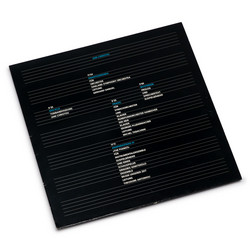
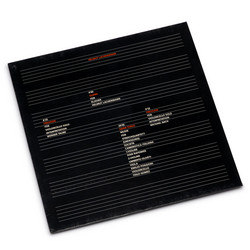
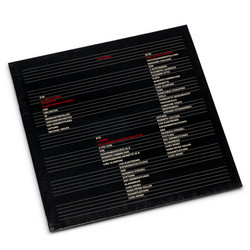
The Orchestra Of The National Center For Korean Traditional Performing Arts
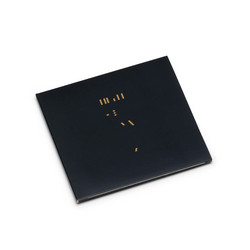
Yŏmillak: The Selection Of Korean Classical Music (2CD)
LabelEdition RZGenreContemporary Composition
Out of stock
Tracked express shipping from Italy, no customs or import VAT in the EU. Shipping costs
Selection of Korean classical music, performed by the Orchestra National Center for Korean Traditional Performing Arts. Cast your mind back to the 15th century. That is, of course, difficult if not impossible to do, but the major piece recorded on these CDs, Yomillak, 'Giving the People Joy', provides something of a sonic reference point: it was first performed in 1447. Y'millak is the most extended piece of orchestral court music surviving in Korea, and it has for many centuries been used for royal processions and at banquets. A performance today in many ways looks like one of old, with the musicians dressed in red cloaks (red is the royal colour) with elaborate embroidered squares of cloth denoting rank stitched to their backs. The musicians are virtually motionless, and respond to signals given by a senior official who strikes the pak wooden clappers at the beginnings and ends of sections.
Barely discernable slow and regularly repeating rhythmic cycles form a structural baseline, marked out by formulaic strikes on two drums (the hourglass-shaped changgo and the barrel-shaped chwago), but the effect is of timelessness, the movements flowing seamlessly into each other. The music is totally controlled, the epitome of Confucian order and decorum
Format
"Yŏmillak is the most extended piece of orchestral court music surviving in Korea and it has for many centuries been used for royal processions and at banquets. Yŏmillak is the piece notated in the oldest surviving Korean score - a score contained in the Annals of Sejong, written in 1454.
The piece originally consisted of ten movements, but three were discarded over time, leaving just the seven movements heard here, and different variants evolved, distinguished in terms of orchestration and size; two of the later (19th century) versions, Kyŏngnokmugang Chigok and T'aep Yŏngch'un Chigok are contained here. The final piece, Sŏilhwa Chigok, is an additional orchestral suite."
This release was made possible by courtesy of The National Center for Korean Traditional Performing Arts ℗ 1979, 1988.
Made in Austria.
Release notes
"Yŏmillak is the most extended piece of orchestral court music surviving in Korea and it has for many centuries been used for royal processions and at banquets. Yŏmillak is the piece notated in the oldest surviving Korean score - a score contained in the Annals of Sejong, written in 1454. The piece originally consisted of ten movements, but three were discarded over time, leaving just the seven movements heard here, and different variants evolved, distinguished in terms of orchestration and…
| 1-1 | 1st Movement | 21:52 | |
| 1-2 | 2nd Movement | 20:04 | |
| 1-3 | 3rd Movement | 19:20 | |
| 2-1 | 4th-7th Movement | 22:24 | |
| 2-2 | Kyŏngnokmugang Chigok | 14:30 | |
| 2-3 | T'aep Yŏngch'un Chigok | 8:14 | |
| 2-4 | Sŏilhwa Chigok 1st-6th Movement | 7:42 | |
| 2-5 | Sŏilhwa Chigok 7th-16th Movement | 15:02 |
- Klauß
- A&R
- Durand
- A&R
- Berkenhoff
- Design
- Ott + Stein
- Design
- Keith Howard
- Liner Notes