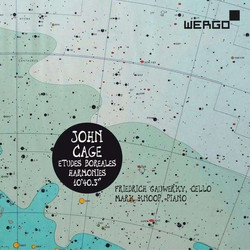
Solo for Cello ... gathers works for cello by John Cage, recorded and compiled by the cellist Friedrich Gauwerky. The pieces range from graphic and indeterminate scores of the 1950s and 60s to the Etudes Boréales of 1978, and together they form a reference set for Cage's unusual way of composing.
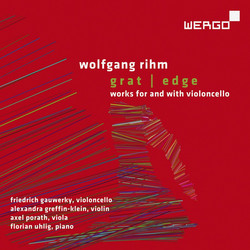
Cage was born in Los Angeles on 5 September 1912 and died in New York on 12 August 1992. Gauwerky plays everything himself. In Atlas Eclipticalis, heard in a version for two cellos, he plays against a playback of his own cello, and the version of Variations I for solo cello is his own. The recording is a coproduction with Bayerischer Rundfunk, produced and engineered by Wolfgang Schreiner, with liner notes by Heinz-Klaus Metzger. A critic in the Neue Zeitschrift für Musik, Lutz Lesle, called Gauwerky "a virtuoso with far-sightedness, good taste, amazing technique, and a captivating instrument."
Solo for Cello (1957-58) is a part of the Concert for Piano and Orchestra, a work made of individual parts whose execution is free of every constraint, each conceived as an autonomous piece. The Concert itself was first given at New York's Town Hall in May 1958, with David Tudor at the piano. 59 1/2 Seconds for a String Player (1953) is one of Cage's time-length pieces and among his most radical graphic compositions. In Atlas Eclipticalis (1961-62), originally for one to eighty-six instruments and the longest work here at almost 27 minutes, stars become notes or noises, again without a score. Variations I (1958), dedicated to David Tudor and written for any number of people using any kind and number of sound sources, pushes indeterminacy to its outer limit.
Against these open forms the four Etudes Boréales, written in memory of Jeanne Kirstein, stand as a demanding written-out work that the Schott text compares in status to Bach's music for cello. Cage also helped put the varied forms of silence on the musical map, and the disc lets those silences be heard on a single instrument.
CD, Wergo WER 6693 2, released in 2007 in the Edition John Cage. Total running time 52'20".