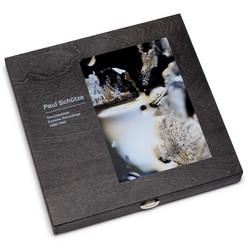
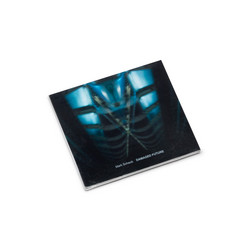
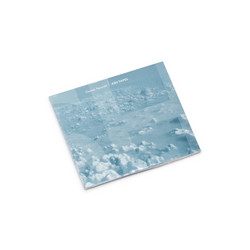
The Crystal Suite finds Paul Schütze returning to one of the most enduring obsessions in his artistic life: J. G. Ballard’s 1966 novel The Crystal World. First encountered in the early 1970s, the book has, in his words, “haunted” him ever since. Its vision of a world succumbing to an implacable, unexplained disease of matter and of time - a slow crystallisation that fixes forests, cities and human bodies into glittering stasis - has only grown more resonant. For Schütze, Ballard is not only “our greatest writer” but, increasingly, “our most incisive philosopher”: a guide to reading the accelerating collapse of the present as something both terrifying and strangely lucid. The Crystal Suite is his attempt to translate that bejewelled menace into sound.
Rather than illustrate the novel’s scenes literally, Schütze approaches Ballard’s premise as a set of conditions: time thickens, matter hardens, motion becomes ambiguous. Working with electronics alongside guitarist Daniel Pennie, he builds pieces that move at a glacial, inexorable pace, more like weather systems than tracks. Harmonic fields drift into view and then seem to ossify, held in place by barely perceptible internal shifts. High, glassy tones flicker at the edges of the stereo field like light catching on faceted surfaces; low, granular textures suggest something grinding to a halt beneath the surface. The music often feels suspended between decay and radiance, echoing Ballard’s paradoxical landscapes, where catastrophe appears in the guise of exquisite beauty.
Pennie’s guitar work threads through these environments as a source of both warmth and corrosion. Sometimes it arrives as long, bowed‑sounding lines that blur into Schütze’s electronic drones, adding organic instability to otherwise static harmonies. Elsewhere, the guitar fractures into chiming harmonics, clipped figures and distant, reverberant chords that hang in the air like remnants of a more recognisable musical language. This interplay of recognisable and alien is central to the suite’s mood. You can sense echoes of ambient, of post‑rock, of Schütze’s own past work in sound design and film scoring, but everything is processed through the crystalline logic of the project: edges sharpened, decay prolonged, time subtly stretched until ordinary musical markers start to feel unreliable.
Across the suite, Schütze leans into the idea that Ballard’s “disease” is as much temporal as physical. Structures often refuse traditional build‑and‑release arcs. Instead, they advance by accumulation and refraction: a motif repeats until it seems fixed, then is reframed by the addition of a single, dissonant overtone or by a sudden shift in spectral focus. Rhythmic information is largely subliminal, arising from the slow pulsing of filtered noise or the breathing of reverb tails rather than from overt beats. Listening becomes closer to observing a process than following a story. Time doesn’t simply pass; it congeals, doubling back on itself in subtle, prismatic loops.