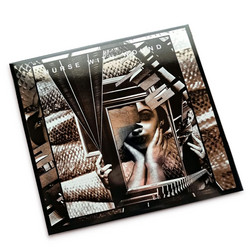
With Canvas on Which It Is Impossible to Paint, Tungu and Hui-Chun Lin push their ongoing collaboration into its most paradoxical territory yet: an album that treats the very idea of a “canvas” as something unstable, porous, and constantly eroded by sound. This is the duo’s third release together and the second outing on ADN for Tungu, crystallizing a partnership that has grown from a single duet session into a sustained, restless dialogue between cello, electronics, bass and voice. The title reads like a provocation, but it’s also an accurate description of the record’s method - every time a clear image threatens to form, it’s promptly smudged, cut, or bent out of recognition.
Born in Kaohsiung and now a key presence in Berlin’s improvised music scene, Hui-Chun Lin approaches the cello as both resonant body and fault line. Her playing ranges from raw, grainy bow pressure and fractured harmonics to sudden surges of lyrical intensity, all held together by a distinctive improvisational grammar that refuses easy idioms. On this album, that grammar is set against, and entangled with, the multi-layered sonic world of Sergiy Senchuk, a.k.a. Tungu - sound artist, bassist and experimental musician based in Chernihiv, Ukraine. His work carries the imprint of a city now widely recognized for its resilience, and his music seems to absorb that determination, translating it into structures that hold fast even as they flirt with collapse.
Tungu’s path to this duo was anything but linear. Emerging from the Kollectiv, a circle of like-minded improvisers dedicated to spontaneous creation, he moved through hardcore, metal and noise bands before pivoting, around 2014, to cut tape, field recordings and samples. Those early Tungu projects established a practice in which fragments of reality - environmental sounds, stray voices, mechanical residue - are recomposed into shifting, narrative-averse terrains. At the same time, he has been steadily expanding a network of global collaborations, recording with figures such as Amy Denio, Mark Feldman, George Cartwright, Mia Zabelka, Ron Anderson, Noel Akchoté, Luciano Margorani, Phil Minton, Henry Kaiser, Sainkho Namtchylak, Jean-Marc Montera, Jaap Blonk, Fred Lonberg-Holm, René Lussier, Al Margolis, Giulio Aldinucci, Martin Tétreault, Bob Drake and Dirk Serries, among many others. Each partnership adds a new contour to his sound-world, but the core remains: a fascination with how instinctive poetics can emerge from the collision of planned structure and circumstantial noise.
The story of this album begins, as Sergiy recalls, with an invitation. “My acquaintance with Hui-Chun Lin began when I invited her to record a duet for my album ‘Successful Utilization of Elements’,” he notes. The chemistry of that encounter led to two full collaborative albums: Brain Particles, Which Resist and I See, I Hear, But I Can't Describe It. Both records established a tradition of featuring a guest vocalist on one track - Amy Denio on the first, Klara Ahleraten on the second - as a way of introducing a new, destabilizing voice into the duo’s evolving language. Canvas on Which It Is Impossible to Paint extends that tradition and complicates it further, inviting Makigami Koichi, of the legendary Japanese group Tokyo Kid Brothers, to step into the frame.
Makigami’s presence is more than a cameo. His vocal interventions act like a hand suddenly smearing pigment across an already unstable surface: fragments of song, extended techniques, theatrical whispers and non-verbal exclamations tear holes in the fabric the duo is weaving, then stitch them back up with different threads. Around him, Lin’s cello and Tungu’s layered sound-objects respond not by accompanying in a conventional sense but by tilting their own trajectories, bending phrasing, dynamics and texture to accommodate this new gravitational center. The track with Makigami becomes a focal point for the album’s larger concerns - the impossibility of a fixed image, the pleasure of continual re-inscription, the tension between description and the failure of description hinted at in the title of their previous album.
Across the record, the duo’s established chemistry is unmistakable. Lin’s dramatic intensity and wide sonic palette carve arcs through Tungu’s cut-up structures and bass pulses, while his assemblages of samples, field recordings and electronic residues create frameworks that are precise yet open enough to invite sabotage. Moments of near-silence give way to dense knots of sound; a single sustained cello tone may suddenly find itself shadowed by distant footsteps, radio ghosts or metallic shudders. The music often seems to hover on the brink of becoming “composition” in the traditional sense, only to veer back into a space where spontaneous decisions and unresolved tension dominate.
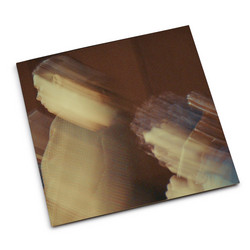
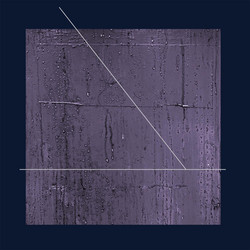
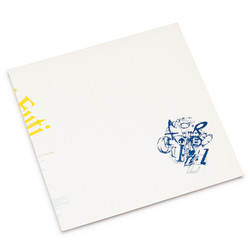
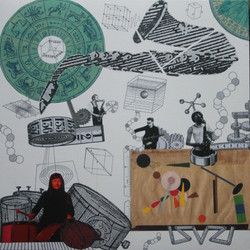
Visually, the album is anchored by cover artwork featuring a painting by Illia Chulochnikov, a friend of Sergiy’s. The image functions like an external echo of the record’s internal logic: a canvas that refuses to resolve into simple depiction, inviting the viewer to project, misread and revisit. It reinforces the sense that Canvas on Which It Is Impossible to Paint is not simply a collection of tracks but a single, multifaceted proposition about what it means to create under conditions of instability - geographic, emotional, artistic.



![Σ [sigma]](https://cdn.soundohm.com/data/products/2026-10/a0550686140_10-jpg.jpg.250.jpg)