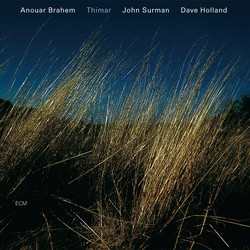
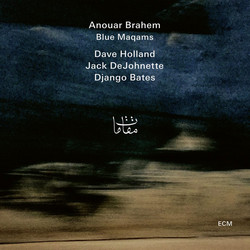
Astrakan Café is the record on which Anouar Brahem returned to a more purely Middle Eastern music after the trans-cultural Thimar, recorded with John Surman and Dave Holland. Released by ECM in September 2000, his sixth album for the label, it documents the trio of oud, clarinet and hand percussion that had been his first priority for several years.
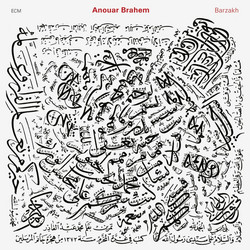
Brahem was born in 1957 in Halfaouine, in the Medina of Tunis, and studied the oud with Ali Sriti. His partners here are his two most long-standing ones. The Tunisian percussionist Lassad Hosni, on bendir and darbouka, had played on his first cassette and on Barzakh (1990). The Turkish clarinettist Barbaros Erköse, of Romany origin, had joined for Conte de l'incroyable amour. The trio recorded in June 1999 at the Propstei St. Gerold in Austria, with Manfred Eicher producing.
There is no bass, no voice and no other harmony instrument, so everything rests on three lines and the space between them. The titles draw a map well east of Tunis, from Erköse's opening Aube rouge à Grozny through The Mozdok's Train, Ashkabad and Karakoum, with Halfaouine pulling the route back home. Ashkabad is credited to all three players, a sign of how much of the record grows from improvised exchange. The ten-minute Astara gives the longest stretch to this dialogue, the melody passing between oud and clarinet over Hosni's hand drumming. Two pieces come from the Ottoman repertoire: Nihawend Lunga by Jamil Bey, and Hijaz pechref.
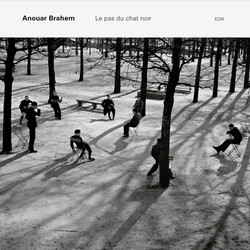
In Songlines, Andy Morgan heard "the mournful beauty of a desert landscape from a myriad different angles", and wrote that Brahem "takes the torch from the late, great oud master Munir Bachir". Reviewing it for the Austin Chronicle in 2001, David Lynch wrote that the album "may be the finest document of his formidable composing, performing, and bandleading gifts to date". Brahem's next record, Le pas du chat noir (2002), left the percussion behind for a trio with piano and accordion.
This edition is the CD, ECM 1718, first released in 2000 and recorded in June 1999 at the Propstei St. Gerold.