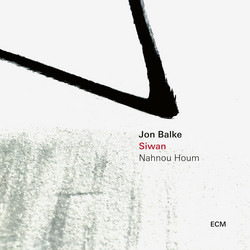
Hafla is the third album by Siwan, the collective led by Norwegian keyboardist and composer Jon Balke, after Siwan (2009) and Nahnou Houm (2017). Its starting point is the poetry of Al-Andalus, the Muslim-ruled Iberian peninsula. Above all it sets the verses of Wallada bint al-Mustakfi, the 11th-century Umayyad princess of Córdoba, and of her lover Ibn Zaydun. Baroque strings, Turkish and Persian instruments and North African song meet in a single, carefully balanced ensemble.
The voice is Algerian singer Mona Boutchebak, who had replaced Amina Alaoui on the second album and also plays the kwitra, an Algerian lute. Around her are Derya Türkan on kemençe, Pedram Khavar Zamini on tombak, drummer Helge Norbakken and the Norwegian group Barokksolistene led by violinist Bjarte Eike, about fifteen musicians in all. The album was recorded in May and June 2021 at The Village Recording in Copenhagen, with Thomas Vang as engineer. Balke was the recording producer and Manfred Eicher the executive producer. Pandemic rules kept the ensemble from playing together in the studio at once, so the album was assembled from separate takes.
Balke wrote all the music except Mirada Furtiva, Boutchebak's own setting of Ibn Zaydun, in which she accompanies herself on kwitra. The songs are short, and sung in Arabic, Spanish and once in English. Other poets include Ibn Sara As-Santarini and Ibn Hazm, whose Is There No Way closes the record. The strings often turn staccato and percussive, while two instrumentals, Línea oscura and the driving Saeta, give the players room on their own.
In Jazzwise, Nick Hasted heard Boutchebak sing "with confiding intimacy" and called the album "very ECM in its sense of space and restraint". Tom Newell in Songlines pointed to strings close to the orchestras of Oum Kalthoum, set against jazz harmonies and rhythmic bass. Writing in Notes & Observations, Geoff Andrew praised the "rich, sensuous, sumptuously detailed and constantly shifting orchestral colours." The title means a party or celebration, and the cover photograph by Sarah Murtaja shows a boy running through a ruined town.
CD edition, ECM 2726, released on 22 April 2022, with the poems translated into English in the booklet.