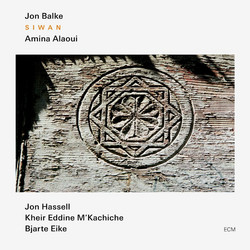
Nahnou Houm is the second album by Siwan, the international collective led by the Norwegian keyboardist, composer and arranger Jon Balke. Its self-titled ECM debut of 2009 won the Jahrespreis der deutschen Schallplattenkritik, the German record critics' album of the year prize. Balke began the project from perceived correspondences between Arabic music, Andalusian classical music and European baroque, setting poetry of Al Andalus that reflects a time of coexistence between Islam, Judaism and Christianity. The title means "We are them". The result is a contemporary creation, not a historical reconstruction.
The group now has a new lead singer, Mona Boutchebak from Algeria. Beside her and Balke's keyboards are Derya Türkan on kemençe, Helge Norbakken on percussion and Pedram Khavar Zamini on tombak, with strings from the Norwegian baroque ensemble Barokksolistene. The album was recorded in January 2017 at Madstun and The Village Recording in Copenhagen with engineer Thomas Vang, and mixed there in May by Vang and Balke. Discogs credits Manfred Eicher as producer. The texts span the 11th to the 17th century, from Ibn al-Zaqqaq and the Persian Sufi poet Attar to Lope de Vega and St John of the Cross.
Balke wrote all the music except a traditional song and one instrumental by Zamini. On the opening Duda, a poem by Ibn al-Zaqqaq, a baroque-like surge of strings and harpsichord gives way to lighter percussion, and Türkan's kemençe answers with a mournful line. Ma Kontou, a traditional Andalusian love song, is sung by Boutchebak in Arabic without accompaniment. In Zem Zemeh, Zamini's tombak solo unfolds over a dark keyboard sound, while elsewhere ostinato basses taken from the chaconne and passacaglia drive the songs.
In Jazzwise, Robert Shore wrote that Balke and his collaborators "make a compelling case that such investigations can produce remarkable music", with ambient electronics blending with harpsichord and baroque strings. Richard Marcus, reviewing the album for Qantara in December 2017, noted that Spanish became the lingua franca of the record and called the results "nothing short of spectacular". In Nordische Musik, Ingo J. Biermann found the music harder to categorise than the debut, closer to Near Eastern folk music in chamber form than to jazz.
This is the CD edition, ECM 2572, first released on 3 November 2017.