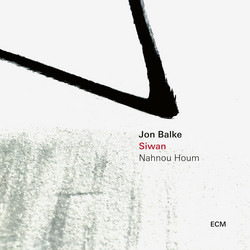
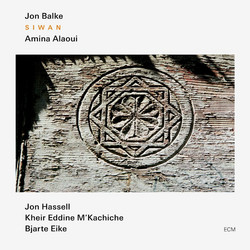
Arco Iris is the first ECM album under the name of the Moroccan singer Amina Alaoui, after her lead vocals on Jon Balke's Siwan, recorded in 2007 and 2008. It looks for the common ground of fado, flamenco and the Arab-Andalusian tradition. In her liner notes she writes that there is "no need to discuss the origins of fado, flamenco or Al Andalusi". The songs set poems written across about a thousand years, from the 11th-century poet-king Al-Mu'tamid Ibn Abbad and Saint Teresa of Ávila to 20th-century fado.
Alaoui was born in Fez and trained in the Moroccan Gharnati tradition, then studied European classical music, medieval chant and Persian song. Here she sings and plays daf with a small acoustic ensemble. Saïfallah Ben Abderrazak (violin) and Sofiane Negra (oud) come from Tunisia, and José Luis Montón from Barcelona plays flamenco guitar. The mandolinist, born in Brazil and based in Portugal, links choro and fado, and Alaoui's son Idriss Agnel plays percussion and some electric guitar. The album was recorded in April 2010 at the Auditorio RSI in Lugano and produced by Manfred Eicher.
The violin often doubles or echoes the voice, while oud, guitar and mandolin wrap around it. In Fado Al-Mu'tamid an Arabic poem by Al-Mu'tamid is sung as a fado, with the mandolin taking the place of the Portuguese guitar. Las Morillas de Jaén, an anonymous Spanish text, is darker and more forceful, with fierce instrumental passages. Near the end, Que faré adds Agnel's electric guitar, and the title song closes the album in praise of the rainbow (arco iris in Spanish).
In Songlines in 2011, Simon Broughton gave the album four stars and wrote that "it's the crystalline purity of her voice that is striking", though he found more poetic meditation than fire. Jon Pareles wrote in The New York Times that Alaoui "imagines her own Iberian Peninsula: a latter-day Andalusia where the Middle East and Europe meet". Bill Shoemaker in Point of Departure noted that she avoids the voice-shredding intensity common in both fado and flamenco.
This is the CD edition, ECM 2180, first released on 10 June 2011, with lyrics translated into English in the booklet.