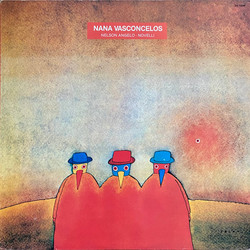
Eventyr, a Norwegian word for fairy tale or adventure, brings together Jan Garbarek, the American guitarist John Abercrombie and the Brazilian percussionist Naná Vasconcelos. It is a trio without bass or drum kit, recorded in Oslo in December 1980 and released by ECM in September 1981. Most of the music is collective improvisation, framed by a handful of traditional melodies and by titles drawn from the world of Norwegian folk tales. The closing East of the Sun and West of the Moon borrows the name of one of the best known of those tales. It ends on a traditional saxophone and vocal theme.
The session took place at Talent Studio, with Jan Erik Kongshaug engineering and Manfred Eicher producing. Garbarek plays tenor and soprano saxophones and flutes. Abercrombie uses electric six- and twelve-string guitars and a mandolin guitar, while Vasconcelos plays berimbau, talking drum and other percussion, and sings. Five of the eight pieces are credited to the three players and two to Garbarek and Vasconcelos alone. Weaving a Garland is a traditional tune arranged by Garbarek, and several of the improvisations open or close on a traditional saxophone or flute theme.
The opening Soria Maria runs for more than eleven minutes. A low drone sits under Garbarek's long legato lines, and Abercrombie scatters quick, glinting figures around them. On the title track Vasconcelos carries the rhythm with his percussion and his gravelly, chant-like voice. Snipp, Snapp, Snute takes its name from the nonsense words that close Norwegian fairy tales, much like "happily ever after". It is the lightest piece on the record, built on wooden flute and small percussion.
Reviewers have been divided. In Jazz Journal in 1982 Matthew Bateson felt that both sidemen bent their own voices to Garbarek's concepts and called the album "just another typical ECM release". He still praised Abercrombie on Once Upon a Time for "a darting, pensive solo of considerable intelligence". Writing on the ECM blog Between Sound and Space, Tyran Grillo heard the same blend as a strength, a single texture from which separate voices emerge only on Lillekort.
This CD edition contains the eight pieces of ECM 1200, first released on LP in 1981.