Floh De Cologne
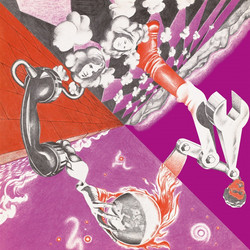
Geyer-Symphonie
Tracked express shipping from Italy, no customs or import VAT in the EU. Shipping costs
"This album celebrates the death of Freidrich Flick, who became incredibly wealthy from Nazi ties. He was a part of the Nuremberg trials & sentenced to 7 years, but was allowed to keep his money. He died in 1972 as the richest man in all of Germany, one year before the album was released. The band takes old recordings of Flick and implements them next to their own dialogue. This feels like a radio drama in an album form. The music itself isn’t too interesting, but it provides a break in between dialogue. At times, their dialogue is sung, which also makes it feel like a musical? It’s a strange experience."
This edition
condition: NM/NM
Format
Hauptinformationsquelle [Main source of information]: Günther Ogger, 'Friedrich Flick der Große', Bern - München - Wien 1971.
Die Originalreden wurden aufgenommen bei der Trauerfeier für Friedrich Flick am 28. Juli 1972 um 10.30 Uhr am Robert-Schumann-Saal in Düsseldorf, Ehrenhof 4a. [The original speeches were recorded at the funeral service for Friedrich Flick, 28th of July, 1972 at 10:30 a.m. at the Robert-Schumann-Saal, Düsseldorf, Ehrenhof 4a]
P. 1974 [on Side B record label]
Runouts are stamped
Release notes
Hauptinformationsquelle [Main source of information]: Günther Ogger, 'Friedrich Flick der Große', Bern - München - Wien 1971. Die Originalreden wurden aufgenommen bei der Trauerfeier für Friedrich Flick am 28. Juli 1972 um 10.30 Uhr am Robert-Schumann-Saal in Düsseldorf, Ehrenhof 4a. [The original speeches were recorded at the funeral service for Friedrich Flick, 28th of July, 1972 at 10:30 a.m. at the Robert-Schumann-Saal, Düsseldorf, Ehrenhof 4a] P. 1974 [on Side B record label] Runouts…
| A1 | 1. Satz: La Grande Tristesse (Requiem) | 7:10 | |
| A2 | 2. Satz: Danse Macabre (Totentanz) | 13:02 | |
| B | 3. Satz: Sérénade Des Vautours (Leichenschmaus) | 23:30 |
- Peter Geitner
- Design [Cover Design], Illustration
- Dick Städtler
- Drums, Bongos, Tambourine, Claves, Performer [Hui-Hui, Bobbies], Shaker, Triangle, Percussion [Schlüsselbund], Tenor Saxophone, Alto Saxophone, Clarinet, Flute [Div. Flöten], Vibraphone, Harmonica [Chromonika], Mandolin, Acoustic Guitar [Konzertgitarren], Piano, Clavinet, Organ, Kazoo, Accordion, Reeds [Harmonietta], Electric Guitar [E-Gitarre], Bass, Banjo, Trombone, Synthesizer, Mellotron, Electric Piano [E-Piano]
- Dieter Klemm
- Drums, Bongos, Tambourine, Claves, Performer [Hui-Hui, Bobbies], Shaker, Triangle, Percussion [Schlüsselbund], Tenor Saxophone, Alto Saxophone, Clarinet, Flute [Div. Flöten], Vibraphone, Harmonica [Chromonika], Mandolin, Acoustic Guitar [Konzertgitarren], Piano, Clavinet, Organ, Kazoo, Accordion, Reeds [Harmonietta], Electric Guitar [E-Gitarre], Bass, Banjo, Trombone, Synthesizer, Mellotron, Electric Piano [E-Piano]
- Gerd Wollschon
- Drums, Bongos, Tambourine, Claves, Performer [Hui-Hui, Bobbies], Shaker, Triangle, Percussion [Schlüsselbund], Tenor Saxophone, Alto Saxophone, Clarinet, Flute [Div. Flöten], Vibraphone, Harmonica [Chromonika], Mandolin, Acoustic Guitar [Konzertgitarren], Piano, Clavinet, Organ, Kazoo, Accordion, Reeds [Harmonietta], Electric Guitar [E-Gitarre], Bass, Banjo, Trombone, Synthesizer, Mellotron, Electric Piano [E-Piano]
- Hansi Frank
- Drums, Bongos, Tambourine, Claves, Performer [Hui-Hui, Bobbies], Shaker, Triangle, Percussion [Schlüsselbund], Tenor Saxophone, Alto Saxophone, Clarinet, Flute [Div. Flöten], Vibraphone, Harmonica [Chromonika], Mandolin, Acoustic Guitar [Konzertgitarren], Piano, Clavinet, Organ, Kazoo, Accordion, Reeds [Harmonietta], Electric Guitar [E-Gitarre], Bass, Banjo, Trombone, Synthesizer, Mellotron, Electric Piano [E-Piano]
- Markus Schmid
- Drums, Bongos, Tambourine, Claves, Performer [Hui-Hui, Bobbies], Shaker, Triangle, Percussion [Schlüsselbund], Tenor Saxophone, Alto Saxophone, Clarinet, Flute [Div. Flöten], Vibraphone, Harmonica [Chromonika], Mandolin, Acoustic Guitar [Konzertgitarren], Piano, Clavinet, Organ, Kazoo, Accordion, Reeds [Harmonietta], Electric Guitar [E-Gitarre], Bass, Banjo, Trombone, Synthesizer, Mellotron, Electric Piano [E-Piano]
- Theo König
- Drums, Bongos, Tambourine, Claves, Performer [Hui-Hui, Bobbies], Shaker, Triangle, Percussion [Schlüsselbund], Tenor Saxophone, Alto Saxophone, Clarinet, Flute [Div. Flöten], Vibraphone, Harmonica [Chromonika], Mandolin, Acoustic Guitar [Konzertgitarren], Piano, Clavinet, Organ, Kazoo, Accordion, Reeds [Harmonietta], Electric Guitar [E-Gitarre], Bass, Banjo, Trombone, Synthesizer, Mellotron, Electric Piano [E-Piano]
- Dieter Dierks
- Producer [Produziert], Mixed By [Gemischt Von]
- Heiner Friesz
- Technician [Assistent]
- Floh De Cologne
- Words By [Text], Music By [Musik]