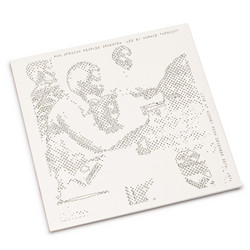
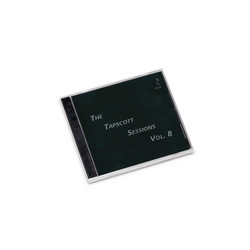
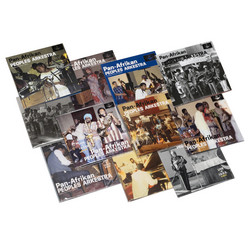
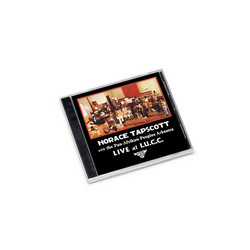
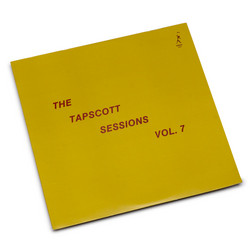
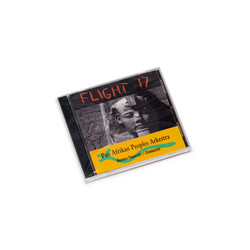
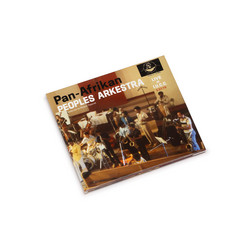
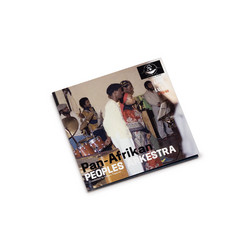
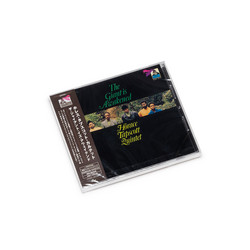
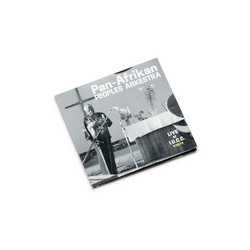
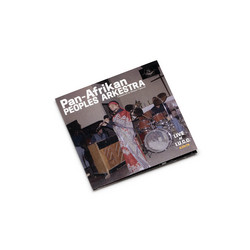
For nearly two decades, Horace Tapscott and his Pan-Afrikan Peoples Arkestra made music without making records. They played in parks, on street corners, at fundraisers, churches, community centers - anywhere the people needed them. While the rest of the jazz world chased contracts and critics, Tapscott was building something else entirely: an ark for the Black arts in the heart of Los Angeles.
The story of The Call is inseparable from this larger project. When long-time jazz devotee Tom Albach founded Nimbus West Records in the late 1970s, he did so specifically to document Tapscott and his circle. This was among the first fruits of that collaboration - a sixteen-piece orchestra session recorded at Hollywood Sage and Sound and United Western studios, capturing the Arkestra's singular blend of spiritual searching and collective discipline.
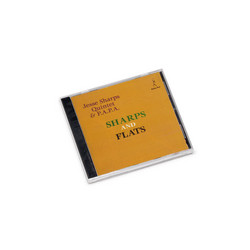
The personnel reads like a roll call of Los Angeles creative music: Jesse Sharps on soprano, tenor and bamboo flute (also serving as bandleader); Linda Hill on piano; Adele Sebastian on vocals and flute; Lester Robertson on trombone; David Bryant on bass; Everett Brown Jr. on drums. Add a string section for two of the four pieces, and you have the full sweep of Tapscott's orchestral vision - dense, polyrhythmic, searching, but never losing its connection to the blues and the Black church.
The programme draws from Arkestra members: the title track and "Quagmire Manor at Five A.M." are communal compositions, while Jesse Sharps' "Peyote Song No. III" is a swirling modal journey with his soprano saxophone weaving through the ensemble. The standout may be Cal Massey's "Nakatini Suite" - a composition previously recorded by Lee Morgan (on Lee-Way) and John Coltrane (as "Nakatini Serenade" on The Believer). Tapscott's reading expands it into full orchestral territory, the strings adding a moody, cinematic dimension while the rhythm section maintains that characteristic West Coast looseness.
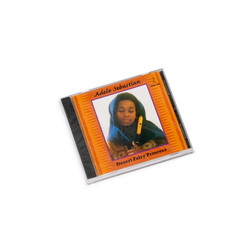
Tapscott's piano work throughout is extraordinary - percussive, harmonic, simultaneously anchoring and destabilizing. There's a quality to his touch that feels almost otherworldly, as if he's finding notes from some dimension adjacent to this one. "Quagmire Manor" opens with Sebastian's voice in a style reminiscent of her approach on Desert Fairy Princess - intimate, incantatory - before the band lifts off into collective exploration.
Originally pressed in just 1,000 copies in 1978, The Call circulated among collectors and devotees for years before gaining wider recognition. It stands as essential documentation of a movement that prioritized community over commerce, that understood music as spiritual practice and social action. Tapscott (1934-1999) never achieved the fame of his East Coast contemporaries, but figures like Arthur Blythe, David Murray, Butch Morris, and Azar Lawrence all came through his Arkestra. The legacy runs deep.
For anyone drawn to the orchestral dimensions of spiritual jazz - Sun Ra's cosmic big bands, the Strata-East collective recordings, the AACM's large ensemble work - this belongs in your collection. A foundational document.